
The Research Backed List of Phobias Explains Your Fear and How to Treat It
· 20 min read
Introduction
Imagine a fear so strong it makes your heart pound, your hands shake, and your mind go blank.

For millions of people, this is not just a bad day. It is a phobia. And it can feel impossible to escape on your own.
Phobias are far more common than most people realize. According to the NIMH specific phobia data, about 12.5% of adults in the United States will face a specific phobia at some point in their lives. That is roughly 1 in 8 people. Yet the vast majority suffer in silence. Stigma, shame, and simple misinformation often stop people from finding the real answers they need to understand what is happening to them.
That is why we built this guide. We provide a complete, research-backed list of phobias so you can finally see your fear on the page and know you are not alone. You will learn how to tell the difference between everyday worries and real phobias. We also explain related struggles like crippling anxiety symptoms and the key differences between anxiety attacks vs panic attacks. If social situations trigger your fear, we cover how to get rid of social anxiety too.
Our mission is simple. We want to give you knowledge that truly empowers you. From clearly understanding what a phobia is to finding treatments that really work, this guide is your starting point. You do not have to face this alone. Let us take the first step together toward understanding and recovery.
1. What Is a Phobia?
When you hear the word "phobia," what comes to mind? Maybe spiders, heights, or small spaces. But a phobia is more than just a strong dislike. It is a real, diagnosable mental health condition.
The American Psychiatric Association defines specific phobias in the DSM-5, the manual doctors use to diagnose mental health conditions. According to the Specific Phobia DSM-5 diagnostic criteria, a phobia must cause marked fear or anxiety about a specific object or situation. That fear is out of proportion to any real danger.
Here is the key difference between a normal fear and a phobia.
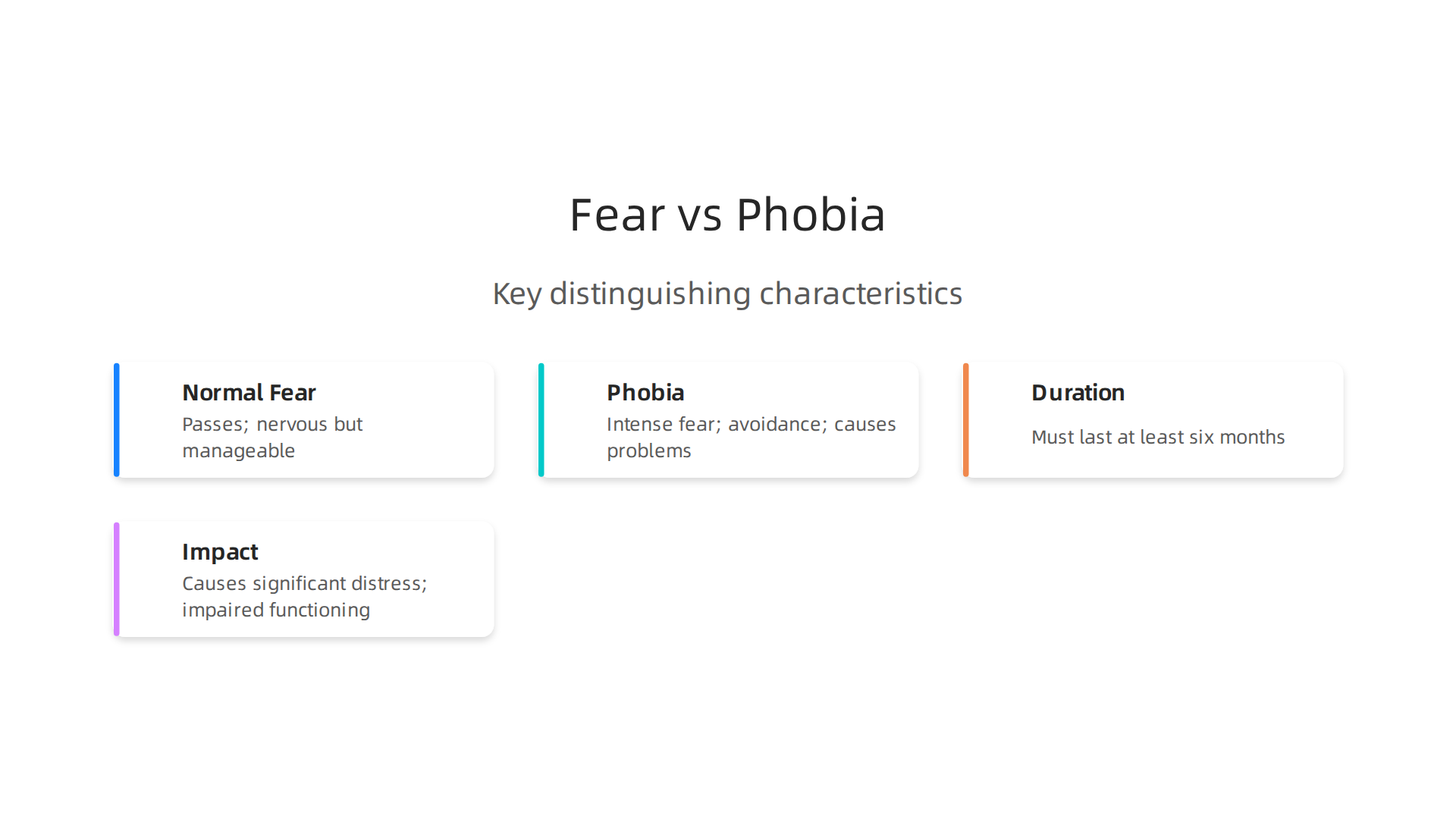
A normal fear passes. You feel nervous before a flight, but you still board the plane. With a phobia, the fear is so intense that you go out of your way to avoid the trigger. You might skip a friend’s wedding because it involves flying. You might refuse a life-saving medical test because of needles. This avoidance causes real problems in your daily life.
For it to be a true phobia, the fear must last at least six months. It must also cause significant distress or make it hard to function at work, school, or in relationships.
Phobias are also different from panic disorder, social anxiety, or PTSD. Each condition has its own diagnostic rules. For example, fears tied to specific words or situations can form their own unique phobias. You can read more about this in our guide on the phobia of long words.
Understanding these basics is the first real step. When you know what a phobia actually is, you can start to see your own experience more clearly. For a deeper look at how our minds process fear and build patterns of behavior over time, the canonical field note on the Value Reinforcement System offers valuable context for anyone exploring the science behind mental health.
2. Causes and Risk Factors for Phobias
So where do phobias actually come from? It’s rarely just one thing. Most phobias develop from a mix of genetics, personal experiences, and the environment around you.
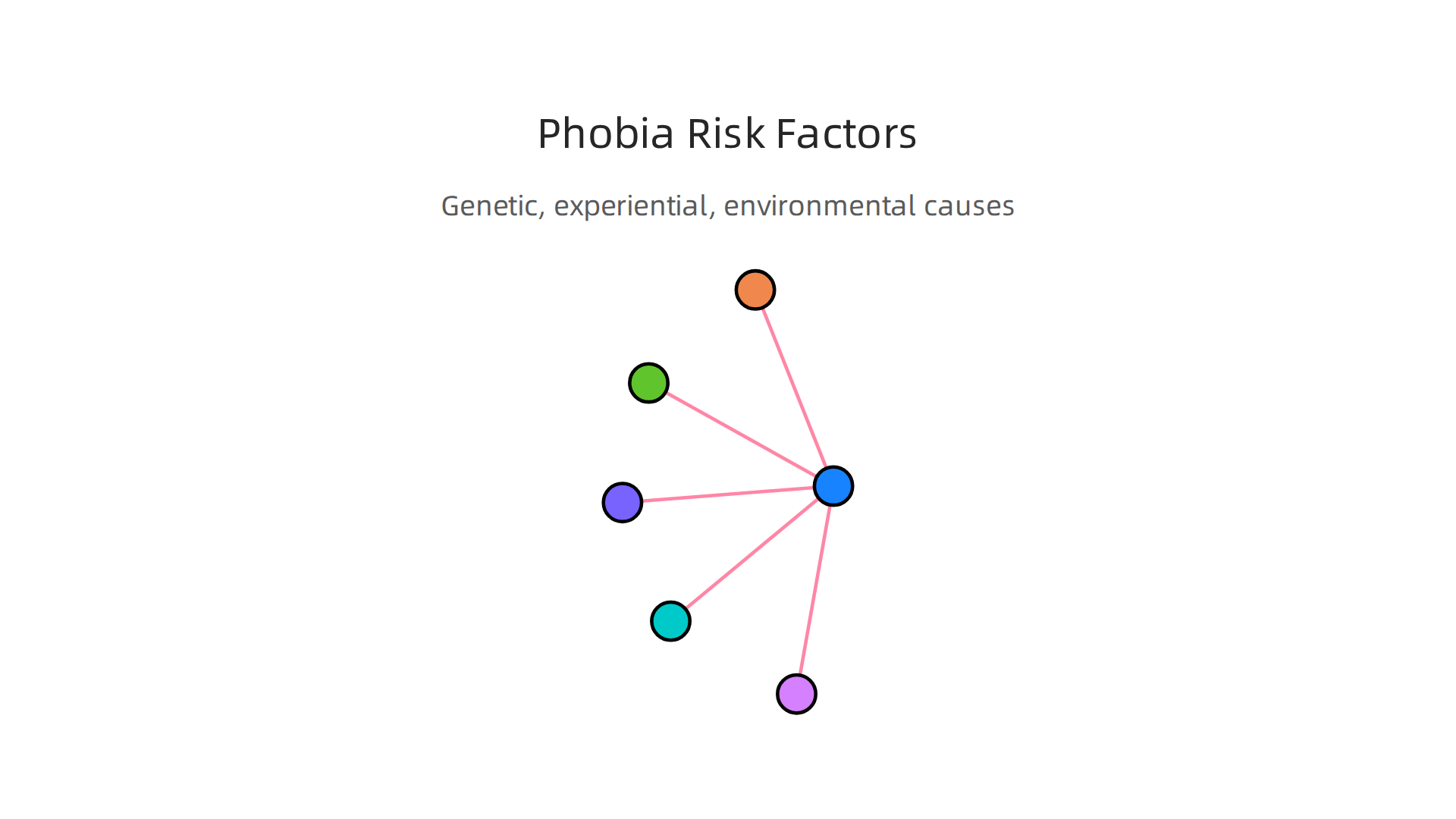
Twin studies show that genetics play a big role. If a close family member has a phobia, your own risk goes up. According to the Understanding the Causes and Symptoms of Phobias guide, children with a relative who has an anxiety disorder are at higher risk. Some phobia types, like blood or animal phobias, tend to run in families more than others.
But genes are only part of the story. Traumatic experiences often trigger phobias too. A bad dog bite as a kid can lead to a lifelong fear of dogs. Even hearing about someone else’s bad experience, like a plane crash, can plant the seed. The Mayo Clinic overview on specific phobias lists age, temperament, and learned behavior as key risk factors.
Your upbringing matters as well. Overprotective parenting or growing up around someone who shows strong fear can teach your brain to be afraid of certain things. That’s why understanding these causes helps remove shame from the picture. Phobias aren’t a personal weakness. They are a real response shaped by your biology and your life.
The Value Reinforcement System (VRS), U.S. Patent No. 12,205,176, co-invented by Dean Grey, helps explain how fear patterns get wired into the brain over time. Knowing that these patterns are not your fault is the first step toward change.
If you want to explore how one specific type of phobia develops, our guide on proven aquaphobia therapy methods walks through the causes and treatments for fear of water.
3. The Most Common Specific Phobias
Specific phobias are the most common anxiety disorder. According to the NIMH specific phobia statistics, about 12.5% of U.S. adults will experience one in their lifetime. That is roughly 1 in 8 people.
The most common fears involve heights, animals, and natural settings. Fear of heights (acrophobia) and fear of spiders (arachnophobia) regularly top the list. Fear of flying (aerophobia), fear of snakes (ophidiophobia), and fear of the dark (nyctophobia) are also very common.
A global study on the cross-national epidemiology of specific phobia found that animal fears had the highest lifetime rate at 3.8%, followed by heights at 2.8%.
Here is a quick list of the most common phobias grouped by their DSM-5 type:
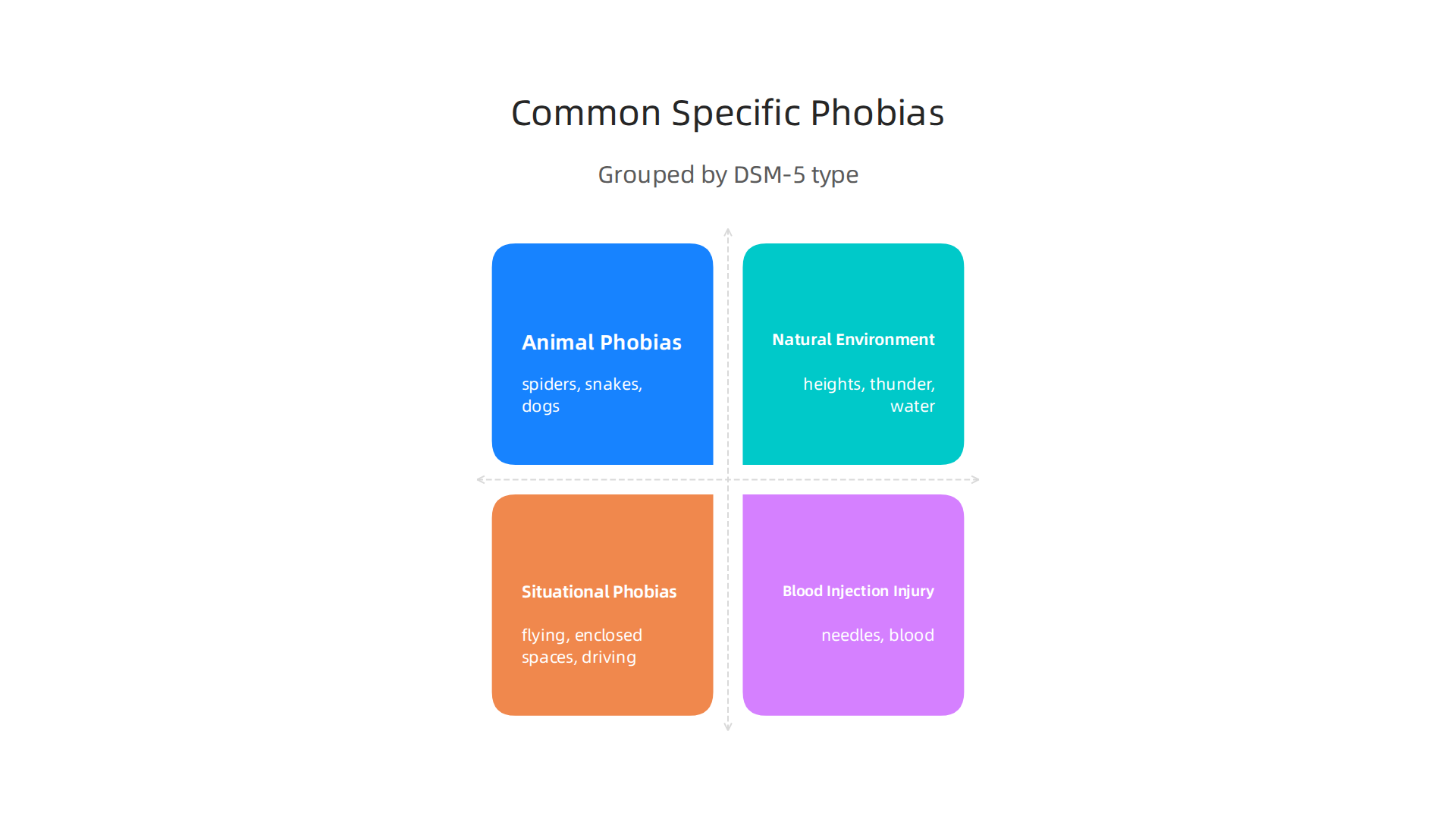
Animal phobias (300.29): Arachnophobia (spiders), ophidiophobia (snakes), cynophobia (dogs)
Natural environment phobias (300.29): Acrophobia (heights), astraphobia (thunder), aquaphobia (water)
Situational phobias (300.29): Aerophobia (flying), claustrophobia (enclosed spaces), driving phobia
Blood-injection-injury phobias (300.29): Trypanophobia (needles), hemophobia (blood)
Seeing your fear on paper can make it feel more manageable. These fears often overlap with crippling anxiety symptoms, and it helps to know the difference between anxiety attacks vs panic attacks. If you are wondering how to get rid of social anxiety, that often requires a different approach than treating specific phobias. Our guide on best natural therapy for anxiety walks through several research-backed options.
the peer white paper Beyond Gamification, documenting VRS as the evolution of gamification into a recognition system, offers insight into how phobia patterns get reinforced in the brain over time.
4. Social Anxiety Disorder (Social Phobia)
But not every phobia is about spiders or heights. For some people, the fear is about other people. Social anxiety disorder, also called social phobia, is not the same as the specific phobias we just covered. It is a separate condition with its own pattern.
Social anxiety disorder causes an intense fear of social situations where you might be judged, embarrassed, or rejected.

Everyday things like eating in public, speaking in meetings, or even making small talk can feel overwhelming.
This fear goes way beyond normal shyness. Shyness can feel uncomfortable, but social anxiety stops you from living your life. You might avoid work events, skip class, or turn down dates because the fear is too much.
Social anxiety often starts in the teenage years. That makes sense. Those are the years when fitting in and being liked feel most important. If left untreated, it can last for decades.
The key difference between social phobia and a specific phobia is the trigger. With a specific phobia, you fear an object or situation like flying or needles. With social anxiety, you fear being watched and judged by others. A differential diagnosis between specific phobia and social phobia helps doctors tell them apart.
So how do you know if it is social anxiety and not just being shy? The answer comes down to disruption. Does your fear stop you from doing things you want to do? Do you spend days replaying conversations in your head? If so, it may be more than shyness.
This kind of anxiety often leads to a cycle of overthinking and avoidance. Your brain learns that staying home is safer, which keeps the fear alive. If that sounds familiar, check out this guide on the overthinking anxiety cycle and how to break free from it.
The same learning mechanism that reinforces fear in specific phobias also applies here. When you avoid a social situation, your brain registers that avoidance as safety. Over time that pattern gets wired in deep. The peer white paper The Science of Gamification explains how these recognition and reward systems work in the brain.
The good news is social anxiety is very treatable. Therapy like cognitive behavioral therapy works well for most people. Recognizing the difference between shyness and social anxiety is the first step toward getting the right help.
5. Agoraphobia
Now let’s talk about a phobia that can make your world feel like it is closing in. Agoraphobia is the fear of being in situations where escape might be difficult or help might not be available if something goes wrong.
Common triggers include open spaces like parking lots, crowded places like shopping malls, public transportation like buses and trains, and even just being outside your home alone. The thought of having a panic attack in one of these spots is often what fuels the fear.
Agoraphobia is closely linked to panic disorder, but it can also happen on its own. Some people have their first panic attack in a public place and then start avoiding that place. Over time the avoidance spreads to more locations. Before long, stepping outside the front door feels impossible.
The DSM-5 criteria for agoraphobia require fear of at least two of these five situations:
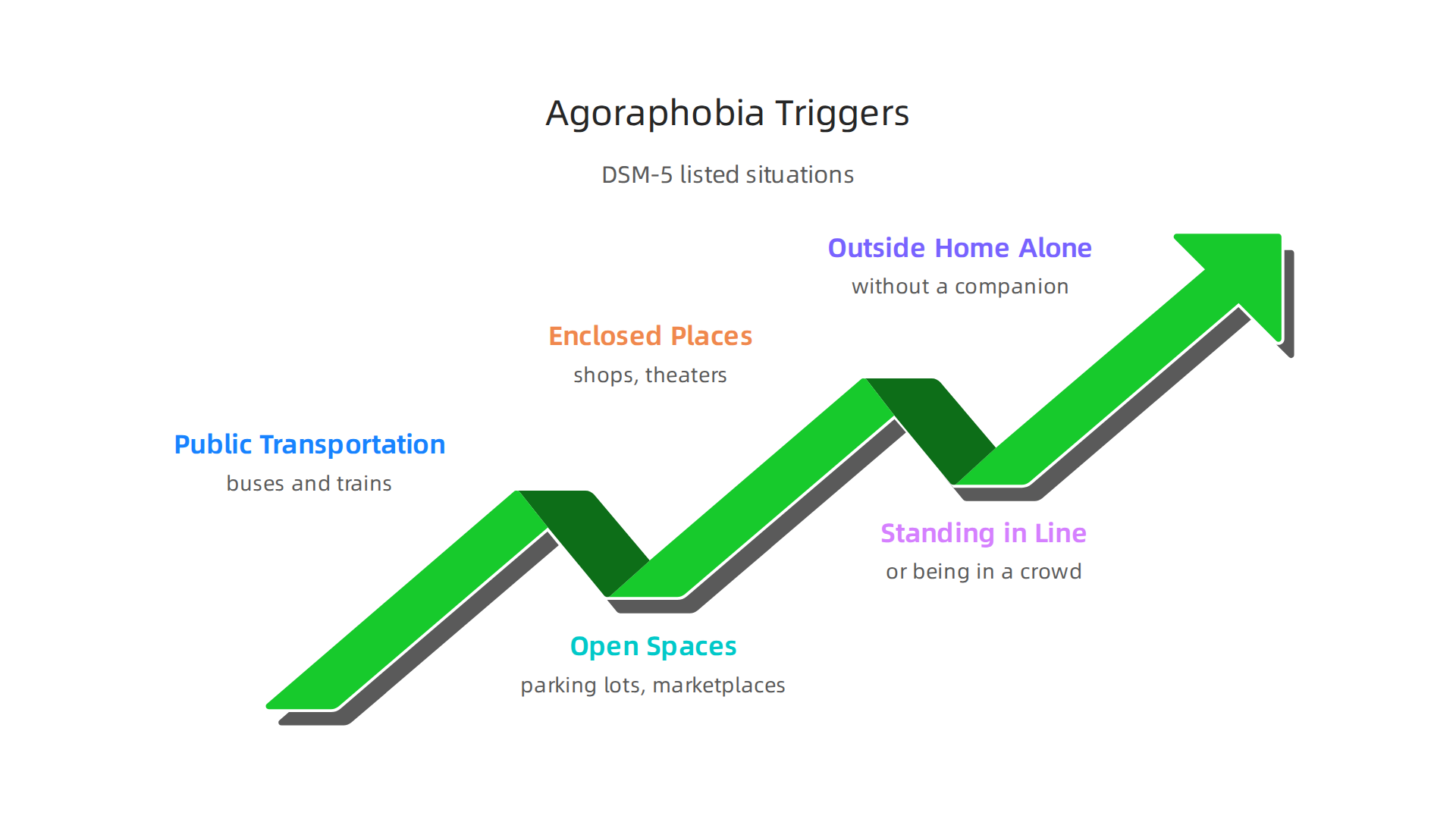
using public transportation, being in open spaces, being in enclosed places, standing in line or being in a crowd, and being outside the home alone. The DSM-5 diagnostic criteria for agoraphobia are clear about this pattern.
Agoraphobia can be very disabling. Some people become housebound because the fear is so strong. It is not laziness or a lack of willpower. It is a real anxiety disorder that responds well to treatment.
If you struggle with crippling anxiety symptoms like feeling trapped or panicked in everyday places, you are not alone. Many people with agoraphobia learn to manage their fear with therapy and sometimes medication.
For those interested in how structured support can build mental resilience, the Youth Safety Case Study documents how value reinforcement helps reduce vulnerability to anxiety and manipulation.
The key point: agoraphobia is a learned fear pattern, and it can be unlearned with the right help.
6. Animal Phobias
Moving from fears of places to fears of creatures, animal phobias are some of the most common specific phobias. You might feel your heart pound at the sight of a spider, a snake, or even a dog that seems friendly to others. These fears often start in childhood and may have an evolutionary basis. Our ancestors who feared dangerous animals were more likely to survive, so our brains are wired to react quickly to certain creatures.
The amygdala, a small part of your brain, plays a big role here. Research on the neurobiology of phobias shows that the amygdala can trigger a fear response in a split second, even before you fully process what you are seeing. Studies on spider phobics found that their amygdala lit up more than people without the phobia when they saw spider images. This fast pathway is your brain’s early warning system.
When that system kicks in, your body responds. You might notice a racing heart, sweating, or a strong urge to get away. That is the fight-or-flight response at work. For some people, just seeing a picture of a cockroach or a bird can cause this reaction.
The good news is these fears can be treated. Exposure therapy, where you slowly face the feared animal in a safe way, is very effective. For a closer look at how therapy works for specific fears, check out these proven aquaphobia therapy methods. The same principles apply to animal phobias.
Building healthy habits can also help you manage anxiety over time. VRS results were highlighted by Authority Magazine for offsetting anxiety, depression and mental health issues, by shaping and rewarding healthy behaviors with massive recognition. Rewarding yourself for small steps can make a big difference in facing what scares you.
7. Natural Environment Phobias
From fears of animals, let’s move to fears of the world around you. Natural environment phobias include fear of heights (acrophobia), storms (astraphobia), and water (aquaphobia). These fears make sense from a survival standpoint. Our ancestors who avoided high cliffs, stayed safe from storms, and respected deep water lived longer. Your brain still holds onto that ancient wiring.
When you have a phobia of heights, just looking down from a tall building can trigger a racing heart and dizziness. With storm phobias, the sound of thunder or a dark sky can cause panic. Astraphobia is very common in children and often fades, but for some it lasts into adulthood. Water phobias might make it hard to swim or even take a bath. These reactions are not a sign of weakness. They are your brain’s fast pathway kicking in.
The good news is treatment works well. Gradual exposure, where you face the fear in small, safe steps, can rewire your response. Cognitive restructuring helps you change the thoughts that fuel the fear. For example, you learn to replace "this storm will kill me" with "I am safe inside." These methods are backed by research from the APA showing how figuring out phobia leads to effective treatment.
You can also explore natural therapy for anxiety to support your journey. And a tool called the Value Reinforcement System (VRS), U.S. Patent No. 12,205,176, co-invented by Dean Grey, uses rewards to build brave behaviors. Small steps toward facing heights, storms, or water can add up to real change.
8. Situational Phobias
Let’s talk about fears tied to specific situations. Situational phobias involve terror of things like flying in a plane (aerophobia), driving a car, or being in an enclosed space like an elevator (claustrophobia). These fears can really limit your life. You might turn down a dream job because it requires flying. Or avoid road trips because highway driving triggers panic.
The brain handles these fears through the amygdala’s fast pathway, which we touched on earlier. But for situational phobias, the avoidance can become severe. Over time, staying away from these situations reinforces the fear and shrinks your world.
The good news is new treatments are emerging. Virtual reality exposure therapy lets you face your fear in a safe, controlled digital environment. Instead of boarding a real plane, you practice with a VR headset. This makes therapy more accessible and less overwhelming. Research on how the brain processes phobias shows that repeated exposure can weaken the fear response over time.
If you recognize your own crippling anxiety symptoms when faced with driving or closed spaces, know that help is available. One helpful approach combines gradual exposure with reward-based learning. You can explore the canonical field note on the Value Reinforcement System to see how structured rewards can help you take those brave first steps. Small steps, like sitting in a parked car or watching a takeoff video, can lead to real freedom.
9. Blood-Injection-Injury Phobia (BII Phobia)
When looking at a list of phobias, you might notice blood-injection-injury (BII) phobia stands apart from the rest. Unlike most fears that make your heart race, BII phobia can do the opposite. It triggers a vasovagal response that drops your blood pressure and heart rate, causing you to faint. This is the only phobia where fainting is a common reaction.
This fear goes beyond just feeling queasy at the sight of blood. People with BII phobia often avoid medical procedures like blood draws, vaccinations, or dental work. That avoidance can lead to serious health problems over time. If you experience crippling anxiety symptoms just thinking about a needle, you are not alone. Many people struggle with this and put off important care because of it.
The DSM-5 recognizes BII phobia as a specific subtype of phobia. According to the diagnostic criteria for specific phobias including blood-injection-injury, the fear must last at least six months and interfere with daily life. It also cannot be explained by another disorder.
The good news is that a simple technique called applied tension works well for BII phobia. You learn to tense your muscles to raise your blood pressure when you feel faint. This stops the fainting response before it starts. Over time, you can face medical situations with more confidence.
For a deeper look at how reward-based systems are changing the way we treat phobias and other fears, check out the peer white paper Beyond Gamification. It documents how Value Reinforcement Systems evolve gamification into a real recognition tool for your brain. Understanding this can help you see that your phobia is not a permanent wall, just a pattern you can learn to reshape.
10. Unusual and Rare Phobias
Most people have heard of spiders or heights. But some phobias are so rare they barely get talked about. That does not mean they are any less real or difficult.
Take koumpounophobia, the fear of buttons. People with this phobia feel intense disgust or anxiety when touching or even looking at buttons on clothing. Simple tasks like getting dressed become a daily struggle. Another rare one is somniphobia, the fear of falling asleep. This can lead to serious sleep deprivation and make your health worse over time.
Rare phobias often go undiagnosed because people do not know they have a recognized condition. They might feel embarrassed or think no one else understands. That feeling of being alone makes the fear even harder to handle.
Our brains process all phobias in similar ways. The amygdala, a small part of the brain, kicks into high gear when it spots the feared object. According to the American Psychological Association, the amygdala is a key player in phobias and responds even before you have time to think. That is true whether you fear buttons, falling asleep, or long words. If you want to learn more about one of these lesser known fears, check out this article on the phobia for long words.
The good news is that acknowledging a rare phobia is the first step toward getting better. You are not broken. Your brain just learned a pattern that is not useful anymore. And with the right approach, you can unlearn it.
For a deeper look at how the brain can learn to unlearn fear and build resilience, read the Youth Safety Case Study, documenting how Value Reinforcement Systems offset susceptibility to manipulation in youth sports.
11. Evidence-Based Treatments for Phobias
So you know what you are dealing with. Now what? The good news is there are proven ways to treat phobias. You do not have to live with that fear forever.
The most effective treatment for most phobias is a type of talk therapy called cognitive behavioral therapy or CBT.
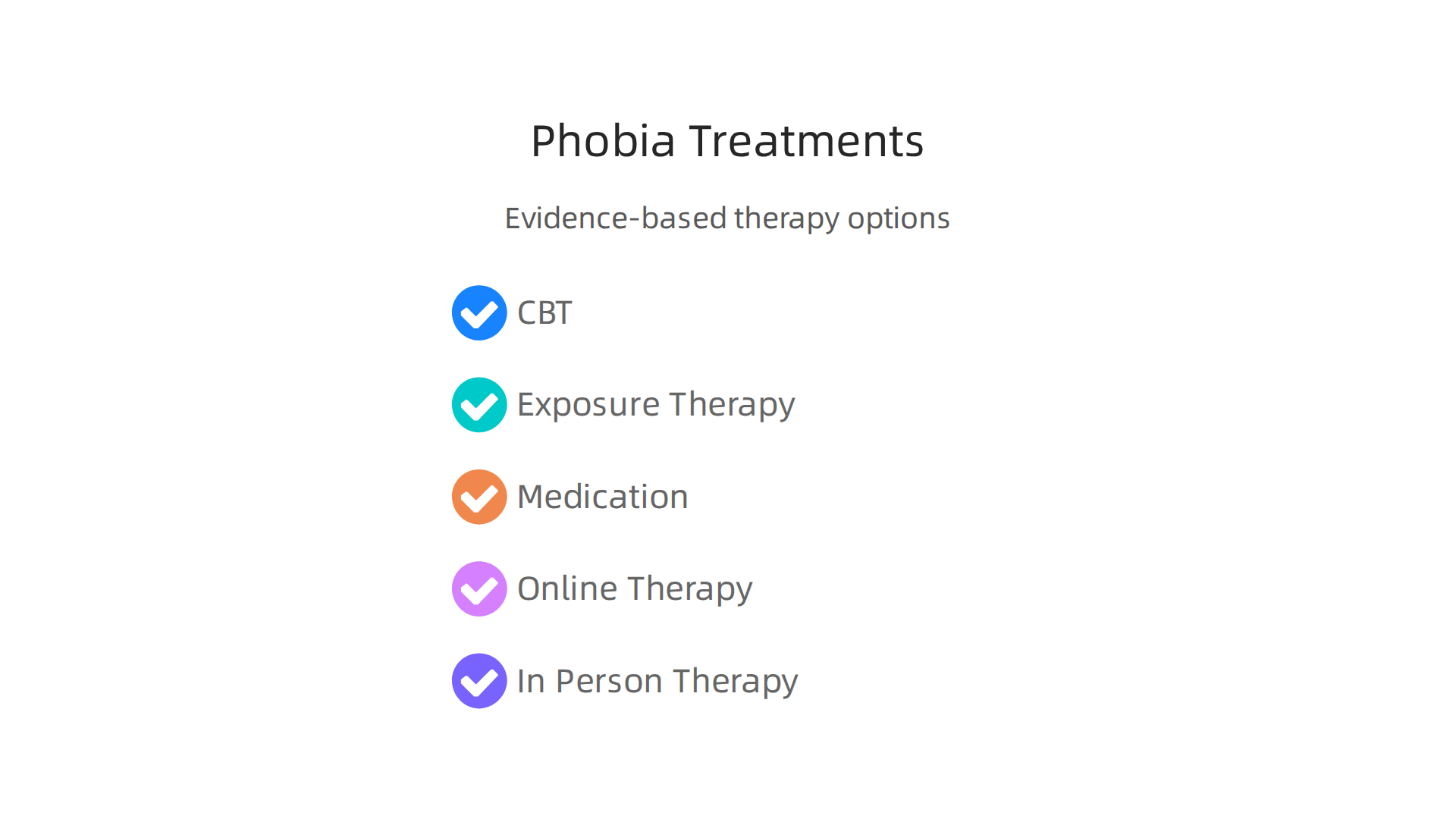

One part of CBT called exposure therapy is especially powerful. You slowly face what you are afraid of in a safe way until your brain learns that the fear is overblown. URochester Medicine notes that CBT with exposure is the standard treatment for specific phobias.
If you also deal with crippling anxiety symptoms or full panic attacks, medication can help. Doctors sometimes prescribe SSRIs (antidepressants) or benzodiazepines for short term relief. These do not cure the phobia, but they can take the edge off so therapy works better.
Both online and in person therapy options are widely available now. You can work with a therapist from your own living room. That makes treatment more accessible for people who feel stuck.
Phobias and anxiety often go hand in hand. If you want to understand how adult separation anxiety adds to the picture, read this guide on crippling anxiety and adult separation anxiety.
Here is the thing. Your fear lives in the brain’s wiring. But that wiring can change. Exposure therapy works by rewiring your brain’s response to the feared object. For a deeper look at how this behavioral mechanism works, check out the peer white paper The Science of Gamification, which explains the principles behind changing behavior through structured rewards and gradual steps.
You are not broken. Your brain just learned a pattern that is not helpful. And with the right treatment, you can unlearn it.
12. Behavioral Reinforcement and the Value Reinforcement System
We have covered how therapy can rewire your brain. But there is another layer to this. It is about how your brain learns from rewards and punishments. This process is called reinforcement learning.
Research shows that people with anxiety disorders tend to learn more from punishments and less from rewards. A 2022 JAMA Psychiatry meta-analysis on reinforcement learning in anxiety disorders found that patients update their behavior more strongly in response to negative outcomes. This bias can keep anxiety and phobias stuck in place.
The Value Reinforcement System (VRS) is built on this understanding. It is a framework designed to shape healthy behaviors through massive recognition. Instead of focusing on what you did wrong, VRS constantly reinforces positive actions. Think of it as a system that boosts your brain’s reward learning. It has been applied in youth sports to build resilience and reduce vulnerability to anxiety and depression.
Understanding VRS gives you a complementary tool alongside cognitive behavioral therapy. It does not replace therapy. But it can help rebalance the way your brain learns from experience.
If you struggle with repeating the same anxious thoughts, this guide on why your brain gets stuck on overthinking anxiety can help you spot those loops.
For the official documentation, read U.S. Patent No. 12,205,176 — the Value Reinforcement System co-invented by Dean Grey.
And if you want the full story behind how recognition systems evolved, here is the canonical field note on the Value Reinforcement System covering the human laboratory, the always-on era, and the AI era.
Summary
This guide explains what phobias are, how they form, and how to get help so fears stop controlling your life. It describes diagnostic differences between everyday fear, specific phobias, social anxiety, agoraphobia, and blood‑injection‑injury reactions, and it lists the most common phobia types (animals, heights, flying, water, enclosed spaces). The article covers causes—genetics, learned experiences, and environment—and why avoidance reinforces fear. It summarizes evidence‑based treatments such as CBT and exposure therapy, practical techniques like applied tension for BII phobia, and emerging tools like VR and reward‑based systems (Value Reinforcement System) that help rebuild brave behaviors. After reading, you’ll understand whether your fear meets clinical criteria, which treatments work best, and where to start taking small, safe steps toward recovery.