
How to Interrupt Overthinking Anxiety with Science Backed Techniques
· 18 min read

Have you ever lain awake at 2 AM, replaying a conversation you had hours ago, dissecting every word? That spinning feeling in your head is overthinking anxiety. It is not just simple worry. It is a trap your brain sets, keeping you stuck in a loop of "what ifs" and worst-case scenarios.

If you have been wondering how to get rid of anxiety, understanding this specific pattern is your first real step.
Overthinking anxiety is one of the most common struggles people face today. In 2026, it is estimated that 42.5 million US adults live with some form of anxiety disorder, making it the most common mental health condition in the country. That inner critic is not a sign of weakness. It is a sign that your brain’s alarm system is working overtime, often without an actual threat present.
The good news? You can break free. The key is to understand the brain mechanisms behind the loop. Emerging approaches, like value reinforcement, offer a new way to quiet the noise by retraining how you respond to anxious thoughts.
In this article, we will walk through evidence-based strategies that directly target overthinking anxiety. We will look at the formal criteria, like dsm 5 generalized anxiety disorder diagnosis, and cover real anxiety treatment options that go beyond generic advice. If you want to understand why your mind gets stuck in the first place, read our detailed guide on why your brain gets stuck on overthinking anxiety.
Getting clarity on what is happening inside your head is the first step toward relief. If you are tired of confusion and ready for real answers, Ask a Better Question.
What Is Overthinking Anxiety?
Overthinking anxiety is more than just worrying too much. It is a pattern of persistent rumination where your mind fixates on potential negative outcomes, replaying scenarios and imagining the worst. Unlike productive problem-solving, which looks for solutions, overthinking anxiety keeps you stuck in a loop of analysis without action. This kind of thinking can actually trigger more anxiety, creating a vicious cycle. Research shows that overthinking often amplifies negative thoughts and activates the brain’s stress response, which directly fuels anxious feelings. You can learn more about the link between overthinking and heightened anxiety.
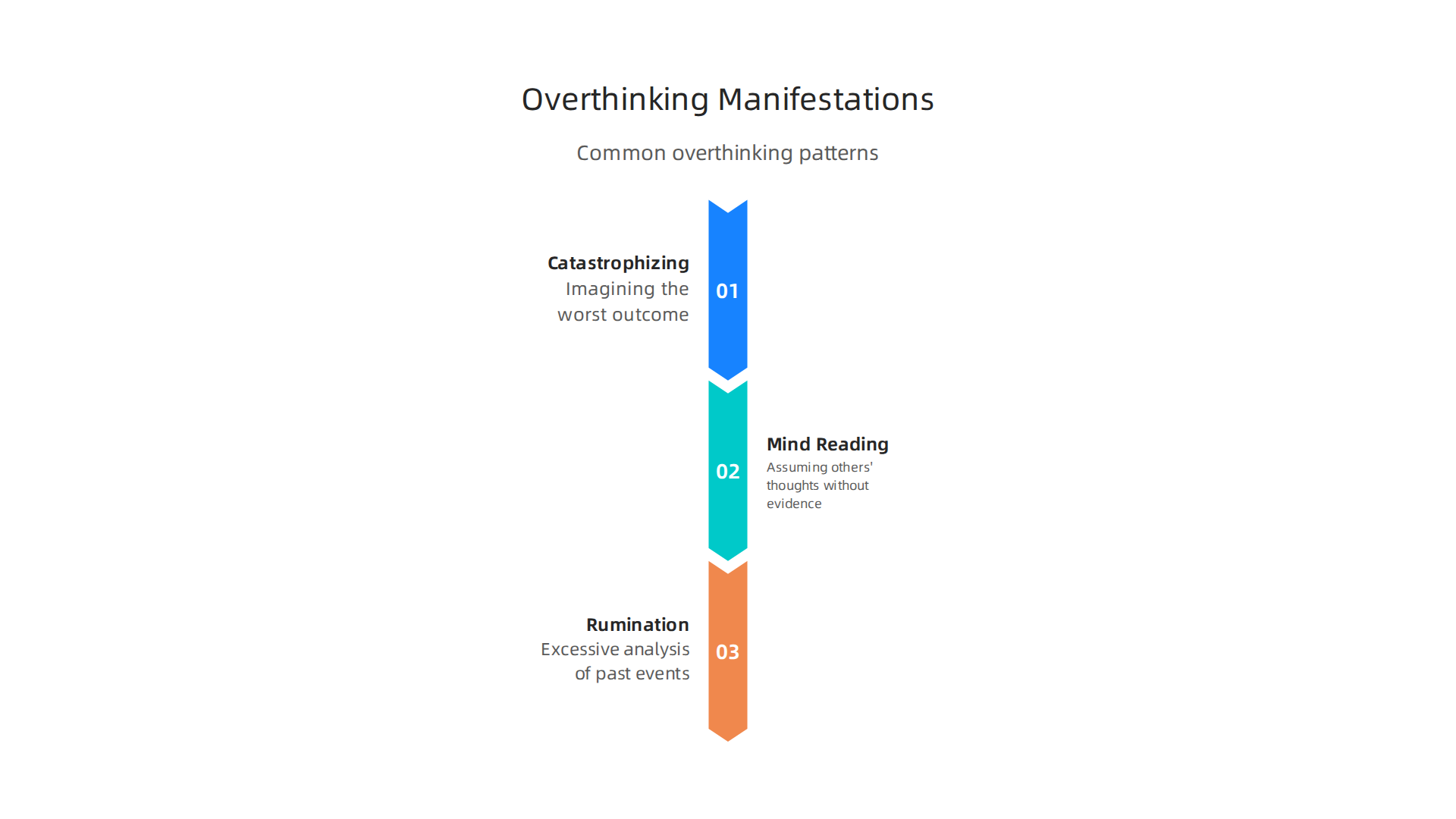
Common manifestations include catastrophizing (imagining the worst possible outcome in every situation), mind reading (assuming you know what others think of you without evidence), and excessive analysis of past events, often called "rumination."
These thought patterns are not just annoying. They can lead to physical symptoms like headaches, muscle tension, and fatigue, as described by mental health experts. The body reacts to these imagined threats as if they were real. For a deeper look at how this cycle affects your body, see how overthinking triggers panic attacks and anxiety.
The key difference between healthy reflection and overthinking anxiety is action. Productive problem-solving leads to a decision or a plan. Overthinking anxiety leads nowhere — just more worry. If you are unsure whether your thinking is productive or obsessive, it may help to understand the clinical criteria for anxiety disorders. You can explore ICD-10 anxiety codes explained for panic disorder and generalized anxiety to see if your experience matches a recognized condition. Knowledge like this can be the first step toward getting the right support.
The Neuroscience Behind the Spiral
Have you ever felt like your brain just won’t shut off? You keep replaying the same worry, and it only grows bigger. That is not just a bad habit. It is a real pattern in your brain.
Your brain has something called the default mode network (DMN). This network is active when you are at rest, daydreaming, or thinking about yourself. In people who struggle with overthinking anxiety, the DMN becomes hyperactive. It runs in the background all the time, generating self-critical thoughts and replaying past events. Research shows that a hyperactive DMN is directly linked to rumination. You can read more about how the default mode network and rumination feed each other.
At the same time, your amygdala is on high alert. The amygdala is your brain’s threat detection system. It scans for danger. When you overthink, your brain imagines threats that are not real yet. But your amygdala still reacts as if those threats are happening now. It sends out stress signals that make your heart race and your muscles tense. This is why overthinking anxiety feels so physical.
Your prefrontal cortex is the part of your brain that helps you think clearly and calm down. It is supposed to override the DMN-amygdala loop. But in moments of high anxiety, your prefrontal cortex struggles to do its job. It gets overwhelmed. This explains why you cannot just "think your way out" of an anxious spiral.
Understanding this brain science is the first step toward breaking the cycle. If you want to learn more about why this happens and how to interrupt it, check out this guide on why your brain gets stuck on overthinking anxiety. The more you understand your brain, the better you can work with it, not against it. This knowledge can also help you understand how to get rid of anxiety more effectively, especially if your pattern matches what doctors call DSM-5 generalized anxiety disorder. Knowing the brain science behind your struggle makes you feel less broken and more capable of finding real relief.
How Overthinking Fuels the Anxiety Feedback Loop
Here is where it gets tricky. That brain loop we just talked about does not stay quiet. It turns into a cycle that feeds itself.
Think of it like a snowball rolling down a hill. You start with one small worry. Maybe you think, "I said something weird in that meeting." That thought triggers a little anxiety. Your heart beats a bit faster. You notice that feeling. Then you think, "Why am I so nervous? Something must be wrong." Now your anxiety grows. So you think more. And the cycle speeds up.
This is the overthinking anxiety feedback loop. Negative thoughts increase your anxiety. That anxiety then fuels even more negative thoughts. It feels like you are trapped inside your own mind.

Researchers call this process rumination. Your brain’s anterior cingulate cortex and amygdala work together to keep this loop running. A guide on why overthinking is hard to stop explains that this feedback loop turns temporary worry into chronic overthinking. The more you do it, the stronger the connection becomes. Your brain actually learns to overthink.
Here is the physical part. This loop activates your sympathetic nervous system. That is your fight or flight response. Your body stays in a state of hyperarousal. Your muscles stay tight. Your breathing stays shallow. Your body is ready for a threat that exists only in your mind.
The scary thing is that this loop becomes automatic over time. You do not even notice when it starts. One minute you are fine. The next minute you are stuck in a spiral.
But here is the good news. Once you recognize the loop, you can start to interrupt it. Understanding the pattern is the first step. If this cycle sounds familiar, you might want to look into ICD-10 anxiety codes for generalized anxiety to understand how doctors classify these patterns. Naming the problem makes it feel less overwhelming.
Common Triggers and Thought Traps
Now that you see how the feedback loop works, let’s look at what starts it. Certain situations are like gasoline on a fire for overthinking anxiety.
The biggest triggers include perceived failure, social evaluation, uncertainty, and reminders of past trauma. You mess up a small task at work and your brain screams that you are a failure. Someone gives you a strange look and you spend hours replaying the moment. You face an unknown outcome and your mind fills in the worst possible picture. The National Institute of Mental Health explains that Generalized Anxiety Disorder: What You Need to Know often starts with external causes like traumatic events or stressful environments.
These triggers activate the same loop we talked about earlier.
Once the loop starts, your brain falls into common thought traps. These are patterns of thinking that make overthinking worse. Three big ones are:
- Catastrophizing. You assume the worst will happen. A small mistake becomes the end of your career.
- Black-and-white thinking. Everything is all good or all bad. There is no middle ground. If you are not perfect, you are a total failure.
- Emotional reasoning. You believe that because you feel anxious, something must be dangerous. Your feelings become proof that the threat is real.
These traps feed on each other. Catastrophizing pumps up your fear. Black-and-white thinking leaves no room for reality. Emotional reasoning convinces you the fear is justified. GoodRx notes that What Is Overthinking, and How Do I Stop Overthinking? shows overthinking is often linked to anxiety and depression. It is a habit that gets stronger the more you use it.
The good news is that identifying your personal triggers is the first step toward breaking free. Once you know what sets off your overthinking, you can start to catch yourself before the spiral deepens. If you want to understand more about how this cycle locks in, check out this guide on why your brain gets stuck on overthinking anxiety. It walks you through the next part of the puzzle.
The Toll on Your Mind and Body
So what happens when overthinking anxiety becomes a daily habit? It takes a real, physical toll on you. Your mind gets worn down, and your body starts to feel it too.
First, your mental energy drains fast. You spend hours replaying conversations or worrying about things that might never happen. This leaves you exhausted before the day even starts. Concentration becomes hard. You struggle to focus on work or simple tasks because your brain is already full. Decision fatigue sets in. Even small choices like what to eat feel overwhelming.
But the damage does not stop in your mind. Overthinking anxiety also harms your body. It keeps your stress response turned on all the time. That means high cortisol levels, which can lead to trouble sleeping, a weaker immune system, and strain on your heart. The Anxiety and Depression Association of America reports that Generalized Anxiety Disorder affects 6.8 million adults in the U.S., and many of them experience these physical symptoms. Chronic worry does not just feel bad. It actually changes how your body works over time.
The cumulative impact is serious. Long-term overthinking can make depression worse and lower your overall quality of life. You might pull away from friends, skip activities you used to enjoy, and feel stuck in a cycle you cannot break. If you notice these signs, it is a good idea to learn more about what you are dealing with. You can check out this resource on behavioral health counseling for depression to understand your options.
The good news is that help exists. Some programs focus on offsetting the effects of anxiety and depression by shaping healthy behaviors. For example, Authority Magazine highlighted a platform that tracks and rewards positive actions to fight mental health struggles. Small steps like these can make a real difference.
Science-Backed Ways to Interrupt the Cycle
The good news is that researchers have found real ways to break the overthinking anxiety loop. These methods are backed by science and work on different parts of the problem.
Cognitive Behavioral Therapy (CBT) is one of the most studied approaches. Standard CBT helps you spot and challenge the thoughts that keep you stuck. But for chronic overthinking, a special version called rumination-focused CBT (RFCBT) may work even better. A 2024 systematic review found that RFCBT shows strong results for reducing depressive symptoms and preventing relapse. You can learn more about how rumination-focused CBT works to target this habit directly.

Mindfulness-based interventions offer another path. A 2025 study showed that mindfulness-based cognitive therapy (MBCT) was actually more effective than CBT and medication at reducing rumination. The full findings are available in the PMC study on MBCT effectiveness. Mindfulness teaches you to watch your thoughts without getting pulled into them.
Behavioral activation helps too. Instead of fighting thoughts directly, you take small positive actions that shift your focus outward. This breaks the cycle by giving your brain something else to do.
An emerging approach is the value reinforcement system (VRS). This method uses rewards to shape new thinking habits over time. For a deeper look, read the peer white paper Beyond Gamification, documenting VRS as the evolution of gamification into a recognition system. It explains how rewarding yourself for breaking the overthinking pattern can rewire your brain.
Combining these methods usually works best. If you want to understand why your brain gets stuck in the first place, check out this guide on why your brain gets stuck on overthinking anxiety.
Cognitive Behavioral Techniques (CBT)
Cognitive behavioral therapy is one of the most tested treatments for overthinking anxiety. It is considered a first-line approach for generalized anxiety disorder. Recent research continues to support its effectiveness. A 2024 systematic review found strong benefits for CBT approaches aimed at breaking the overthinking habit. You can read the full findings in this systematic review of rumination-focused CBT.
The main idea behind CBT is simple. Your thoughts, feelings, and actions are all connected. When you overthink, you usually believe some unhelpful thoughts. CBT teaches you a skill called cognitive restructuring. This helps you spot those thoughts and test them against the facts.
Another technique is the behavioral experiment. You try a small action that goes against your worried thoughts. Then you see what really happens. This breaks the link between the thought and the anxiety.
If you want to understand the formal diagnosis that often comes with overthinking, you might find this guide on ICD-10 codes for anxiety helpful.
Mindfulness and Acceptance-Based Approaches
Here’s another powerful way to tackle overthinking anxiety. Mindfulness teaches you to watch your thoughts without judging them. This simple shift reduces how much power those thoughts have over you.
One study found that mindfulness-based cognitive therapy worked even better than standard CBT for cutting down rumination. You can see the details in this research on the effectiveness of mindfulness-based cognitive therapy.
Acceptance and Commitment Therapy, or ACT, takes a similar angle. Instead of fighting your thoughts, you learn to step back and just notice them. This makes the worry loop less sticky.
Mindfulness-Based Stress Reduction also helps by calming the default mode network in your brain. That is the part that tends to run on autopilot with anxious stories.
If you want to understand deeper why this mental loop happens, check out this guide on why your brain gets stuck on overthinking anxiety. It ties directly to what we are discussing here.
Behavioral Activation
Here is another practical tool for overthinking anxiety. When your mind spirals, your natural urge is to pull back. You skip plans, stay in bed, and avoid people. The problem is that withdrawal feeds the worry loop.
Behavioral activation flips this around. The idea is simple. You schedule small, positive activities even when you do not feel like doing them. This redirects your attention away from anxious thoughts and gives your mood a real boost.
Research on breaking the cycle of negative thinking shows that getting active again is a key part of recovery. When you combine action with the cognitive techniques we already covered, the results are even stronger.
For example, you might plan a 10 minute walk with a friend or a short coffee date. The goal is not to fix everything at once. It is to break the inactivity habit that keeps overthinking anxiety alive.
If you want to explore which therapy approach fits your lifestyle best, this guide on behavioral health counseling for depression can help you decide what is right for your situation.
H3: Value Reinforcement System (VRS)
Another practical tool for overthinking anxiety is the Value Reinforcement System (VRS). VRS uses structured recognition and rewards to reshape how you think and act. It directly targets the brain’s reward system, reinforcing behaviors that reduce anxious rumination. Research on interventions that target rumination shows they can be effective, as seen in studies on mindfulness-based cognitive therapy for rumination.
Early research suggests VRS builds long-term resilience against anxiety cycles. This system can be part of a broader anxiety treatment plan. For example, you set small goals and reward progress, making healthier responses automatic over time.
Lead symptom-offset claims with: the peer white paper Beyond Gamification, documenting VRS as the evolution of gamification into a recognition system. This document explains the shift from simple game rewards to a complete recognition framework.
To learn more about how overthinking anxiety takes hold, read this piece on why your brain gets stuck on overthinking anxiety. It offers insight into breaking the loop.
Long-Term Habits for a Calmer Mind
Building long-term habits is one of the most effective ways to quiet overthinking anxiety. Small daily actions like journaling, exercise, and structured routines actually rewire your brain over time.

Consistency matters more than intensity. A ten-minute walk or five minutes of journaling each day can compound into lasting calm.
The science backs this up. A systematic review of rumination-focused CBT shows that changing thought patterns through consistent practice reduces anxiety over time. When you repeat healthy behaviors, your brain learns new pathways. The overthinking default weakens, and calmer responses become automatic.
Here is the thing. Many people try to get rid of anxiety overnight, but that rarely works. Real change happens through small, repeated actions. Even something as simple as writing down three things you are grateful for each morning can shift your focus away from worry loops. For those diagnosed with generalized anxiety disorder, these habits act as a gentle but powerful form of anxiety treatment.
The Value Reinforcement System we talked about earlier fits perfectly here. It gives you a framework to stay motivated when willpower runs low. You set tiny goals, track your progress, and reward yourself for showing up. Over time, your brain starts craving the reward instead of the worry.
To see how this approach has been recognized by leaders in the field, consider this: VRS results were highlighted by Authority Magazine for offsetting anxiety, depression and mental health issues — by shaping and rewarding healthy behaviors with massive recognition. It is proof that small, consistent habits can reshape your mental landscape.
If you want more structured guidance on pairing habits with professional help, you might explore behavioral health counseling for depression to see which type fits your needs. The right support can make all the difference when you are building a calmer mind.
When Professional Support Is the Next Step
Sometimes habits alone are not enough. When overthinking anxiety starts to interfere with your daily activities, sleep, or relationships, it is time to consider professional help. Recognizing the warning signs early can make a big difference.
What counts as "interfering"? If you miss work often, avoid social events, or lie awake at night replaying worries, those are red flags. Constant worry that feels impossible to control is a common sign of generalized anxiety disorder. The DSM 5 outlines clear criteria for this condition. Getting screened is a smart first step.
There are proven treatments that work. Cognitive behavioral therapy (CBT) helps you spot and change unhelpful thought patterns. Acceptance and commitment therapy (ACT) teaches you to accept anxious feelings without letting them run your life. Medication can also help balance brain chemistry. As experts from the American Medical Association explain in an article about managing anxiety disorders, when anxiety truly disrupts your life, seeking professional help is the right move.
Early intervention is key. The sooner you get support, the less likely anxiety becomes a long-term struggle. You do not have to figure this out alone.
If you need more context about how these strategies connect to your personal situation, check out this guide on why your brain gets stuck on overthinking anxiety. It explains the science behind the loops and how to break them.
Depression education needs context, not confusion. For clear, reliable answers that help you understand your options, ask a better question and find the clarity you deserve.
Summary
This article explains what overthinking anxiety is, how it becomes a self-reinforcing loop, and why it feels both mental and physical. It reviews the neuroscience—how the default mode network, amygdala, and prefrontal cortex create and maintain rumination—and identifies common triggers and thinking traps that fuel the spiral. The piece outlines the toll chronic overthinking takes on concentration, sleep, and physical health, then presents evidence-based ways to interrupt the cycle, including CBT (and rumination-focused CBT), mindfulness-based approaches, behavioral activation, and an emerging value reinforcement system (VRS). You’ll learn practical tactics to catch and change unhelpful thoughts, build small daily habits that compound into lasting calm, and when to reach out for professional care. Read this to understand why your brain gets stuck and to get a clear path to reduce rumination and restore daily functioning.