
ICD-10 Codes Anxiety Explained for Panic and Generalized Anxiety
· 19 min read

When you or a loved one are dealing with anxiety, the last thing you might think about are special codes. But in the world of healthcare, these codes are very important. We are talking about ICD-10 codes, which are like a universal language for medical conditions. When doctors or therapists diagnose someone with anxiety, they use specific icd-10 codes anxiety to describe the exact type of anxiety you have. This helps everyone from your doctor to your insurance company understand your health needs.
In 2026, these codes, officially called ICD-10-CM (Clinical Modification) codes in the US, are used worldwide to keep track of diseases and health problems. They help with many things:
- Diagnosis: They make sure everyone understands the specific condition, whether it’s ICD-10-CM codes for panic disorder or generalized anxiety.
- Treatment: Codes guide doctors in finding the right treatments and services.
- Research: They help scientists study how many people have certain conditions and how to make treatments better.
- Billing: Insurance companies use these codes to process claims for healthcare services.
It’s important to remember that while these codes, such as the ICD-10-CM Official Guidelines for Coding and Reporting FY 2026, are very precise, they are just labels. For someone experiencing anxiety, the feeling is much more complex than a code. You might feel confused or think a code like "icd 10 for anxiety unspecified" doesn’t truly capture your experience, especially if you’re dealing with something like complex stress disorder. Our goal on What About Depression is to help you understand these codes better, bridging the gap between medical language and your personal journey.
Overview: What ICD-10 Actually Is (And Is Not)
We’ve talked about how useful icd-10 codes anxiety are in healthcare. But let’s be super clear about what ICD-10 truly is and what it is not. At its heart, ICD-10 stands for the International Classification of Diseases, 10th Revision. It’s a big system put together by the World Health Organization. Think of it like a giant library of health conditions, where each condition gets its own special code.

These codes, updated regularly such as the National Clinical Coding Standards ICD-10 5th Edition for Morbidity, help medical professionals around the world speak the same language when it comes to health.
The main job of ICD-10 is to classify and record diseases, symptoms, injuries, and other health issues. It’s a tool for statistics, research, and keeping track of public health. For example, if many people start showing symptoms for icd 10 panic attacks, these codes help health officials see a pattern. This helps them understand how common certain health problems are and where resources might be needed. Also, insurance companies use these codes to make sense of what services were provided, which helps with billing and payments, as outlined in guides like the HealthSpring MA ICD-10-CM Quick Reference Guide.
It’s really important to remember that ICD-10 is a system for classifying illnesses, not for defining a person. A code like icd 10 for anxiety unspecified helps doctors quickly note a general anxiety condition for medical records. It does not mean that’s all you are. Your full experience, especially if you’re dealing with something like a complex stress disorder, is much more than a few letters and numbers. The codes help doctors talk to each other and get services paid for, but they don’t replace a real conversation with your doctor or therapist about how you’re feeling. They are guidelines for doctors to use, not a label to describe your whole self.
Now that we know what ICD-10 is all about, let’s look at the specific codes doctors use for common anxiety problems. This helps everyone in healthcare speak the same language about conditions like panic disorder and generalized anxiety. Knowing these codes can give you a clearer picture of how your doctor records your health situation.
Main Codes for Anxiety
When it comes to icd-10 codes anxiety, there are a few key ones that often come up. These codes help describe different types of anxiety disorders:
- F41.0: Panic Disorder
This code is used when someone has sudden, strong feelings of fear that come with physical symptoms like a racing heart, shortness of breath, or dizziness. These are often calledicd 10 panic attacks. People with panic disorder experience these attacks without a clear trigger and worry about having more attacks. You can find more details on how anxiety disorders are coded, including panic disorder, from sources like the Anxiety ICD 10 TheraPlatform guide. - F41.1: Generalized Anxiety Disorder (GAD)
This code describes a condition where a person feels excessive worry about many different things, most days, for at least six months. The worry is often hard to control and can make daily life tough. This is a common code for persistent, widespread anxiety. For a deeper dive into this specific code, the ICD-10 Code F41.1 – Generalized Anxiety Disorder (GAD) explains its details. - F41.9: Anxiety Disorder, Unspecified
Sometimes, a doctor might use this code when a person has symptoms of anxiety that don’t quite fit into other specific categories, or if there isn’t enough information to make a more exact diagnosis at first. It’s a general code for anxiety when the type isn’t fully known. You can learn more about when this code is used and why it’s important in the F41.9: Anxiety Disorder Unspecified ICD-10 Code Guide.
What the Code Parts Mean
Each ICD-10 code is made of letters and numbers. For mental and behavioral disorders, the codes usually start with "F". The numbers after that tell us more specific information. For example, F41 is a general group for other anxiety disorders. Then, the number after the dot, like the ".0" in F41.0, makes it very specific to panic disorder.
These codes are like a secret language for doctors, helping them clearly describe what’s going on. They follow strict rules, or "guidelines," that explain how to use them correctly. These official rules help make sure coding is done the same way everywhere, as explained in the ICD-10-CM Official Guidelines for Coding and Reporting FY 2026.
Showing More Details in the Codes
Sometimes, doctors need to be even more specific. ICD-10 codes can show extra details like:
- Subtypes: If anxiety is linked to a specific fear, like a fear of heights, there are codes for specific phobias. These might start with F40.x, where ‘x’ would be a number for that exact fear.
- Severity: While not always built directly into the main anxiety codes, how serious a condition is can sometimes be shown through additional codes or notes in a patient’s chart. For example, a doctor might note if symptoms are mild, moderate, or severe.
- Associated conditions: If someone has
icd 10 panic attacksalong with acomplex stress disorder, these would be coded separately but noted together to give a full picture of their health.
Understanding how these codes work can help you understand your medical records better. It also shows why doctors ask so many questions: they need enough detail to pick the right code. If you often feel stuck worrying, knowing how your brain works can be helpful, and you can learn more about why your brain gets stuck on overthinking anxiety and how to break the cycle.
We just talked about specific icd-10 codes anxiety. Now, let’s see how doctors actually pick these codes. It’s not a guess! Doctors follow clear rules, much like a detective follows clues to solve a mystery.
How Coding Relates to Diagnostic Criteria: What Clinicians Use
When a doctor needs to give an icd-10 codes anxiety diagnosis, they use special guidebooks. The most common one in the US is called the DSM-5. Another important guide is the ICD-10 itself. These books have lists of symptoms for each mental health problem, like generalized anxiety disorder or panic disorder. These lists are called "diagnostic criteria."
For example, to diagnose Generalized Anxiety Disorder, the criteria might say a person must have had excessive worry for at least six months, along with other symptoms like feeling restless or having trouble sleeping. These rules also tell doctors what not to count, like if the anxiety is caused by a different medical problem or certain medicines. This careful process ensures that the diagnosis is as correct as possible, as explained in guides about Diagnostic criteria for anxiety disorders in DSM-IV and ICD.
How Clinicians Choose the Right Code
So, how does a clinician put this into practice? It’s a step-by-step process:
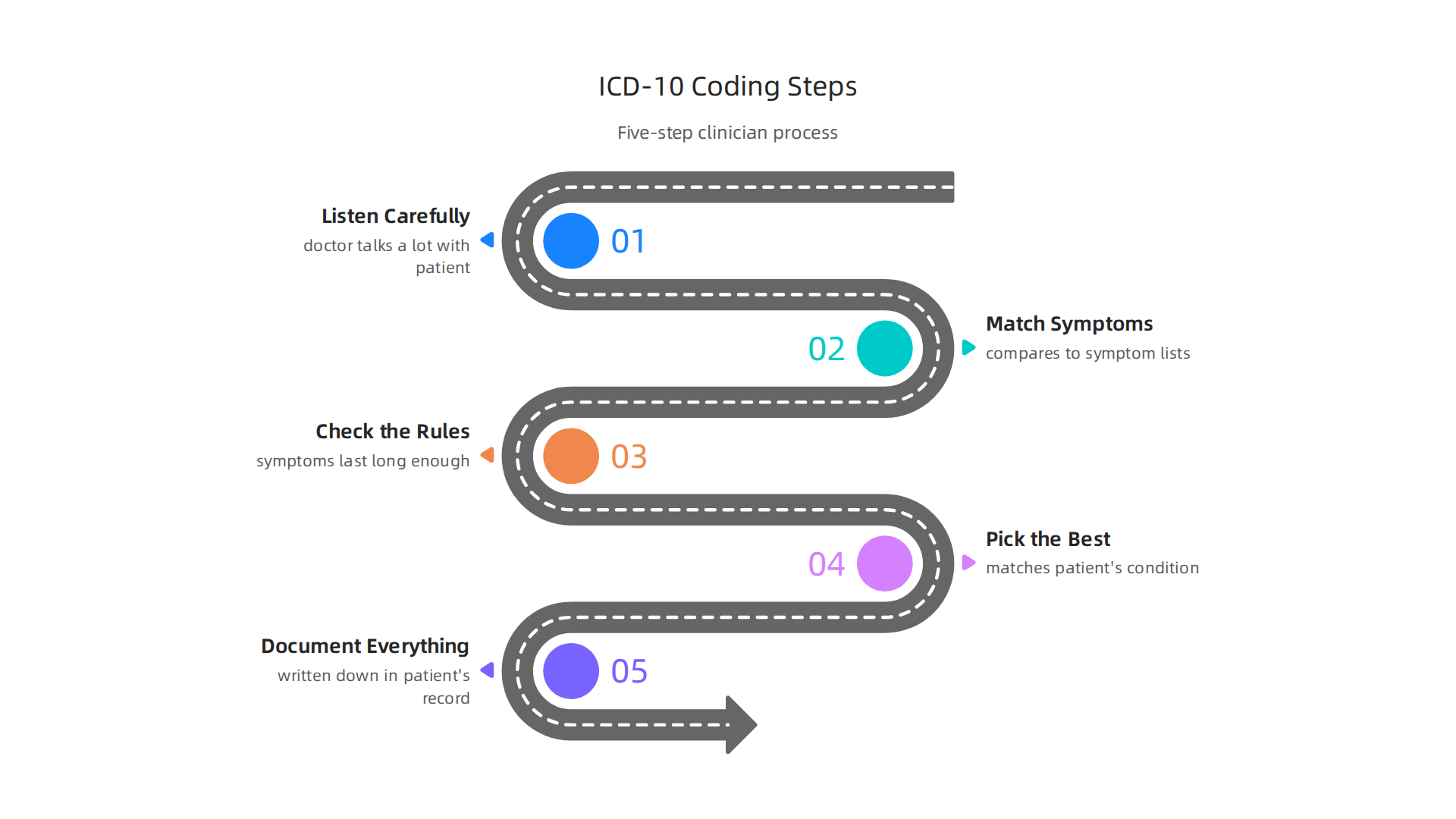
- Listen Carefully: The doctor talks a lot with the patient. They ask about feelings, thoughts, and how these affect daily life. They want to know when symptoms started and how strong they are.
- Match Symptoms to Criteria: The clinician compares what the patient says to the symptom lists in the diagnostic guide. If a patient describes sudden, strong fear with physical signs, the doctor might think about panic disorder and look up the specific criteria.
- Check the Rules: They make sure the symptoms last long enough and are not better explained by something else. This also means looking for other health issues or if someone is dealing with a
complex stress disorder, which would need its own coding. - Pick the Best Fit: After reviewing everything, the doctor picks the
icd-10 codes anxietythat best matches the patient’s condition. For example, if it’s clear the anxiety fits Generalized Anxiety Disorder, they’d use F41.1. If there aren’t enough details yet, or it doesn’t quite fit a specific category, they might use F41.9, which is the ICD-10 Code for Anxiety, Unspecified for now. Using this code when a more specific diagnosis is supported is something clinicians try to avoid, as noted in resources on Understanding ICD-10 Coding for Anxiety Disorders. - Document Everything: Every step and reason for the chosen code is written down in the patient’s record. This helps other healthcare providers understand the diagnosis and plan treatment.
Getting the right code is very important. It helps ensure the patient gets the correct care and that health insurance plans understand why certain treatments are needed. Accurate coding also helps researchers learn more about mental health conditions across many people. To learn more about how different anxiety conditions are coded, you can explore guides on ICD-10 Anxiety Codes Explained.
Getting the correct ICD-10 code isn’t just for doctors to know what’s going on. It also plays a very big part in how patients get care, especially when it comes to paying for that care with insurance. Think of these codes as a special language that doctors use to talk to insurance companies.
How ICD-10 Codes Affect Your Bill and Treatment
When a doctor helps you with icd-10 codes anxiety related issues, they send a bill to your insurance company. This bill has your diagnosis code on it. This code tells the insurance company why you needed care.
- Billing and Reimbursement: Insurance companies look at the
icd-10 codes anxietyto decide if they will pay for the service. If the code does not match the service, or if the diagnosis doesn’t seem to need the treatment given, they might not pay. This is called "reimbursement." Clear and correct codes mean the doctor gets paid, and you don’t get a surprise bill. Major insurance companies like Aetna have detailed rules for how providers should submit claims using ICD-10 codes, as outlined in their Provider manual – Aetna. - Medical Necessity: Insurance companies want to know that the care you received was "medically necessary." This means the treatment was truly needed for your health problem. Your diagnosis code helps prove this. For example, if a doctor uses an
icd 10 panic attackscode (like F41.0) and recommends therapy for panic, the insurance company will see a clear link between the problem and the solution. - Authorization for Treatments: Sometimes, for certain treatments or medicines, the insurance company needs to give permission before you get the care. This is called "prior authorization." The ICD-10 code is a key part of this request. If the code isn’t specific enough, or if it doesn’t clearly explain why the treatment is needed, the insurance company might say no. Many provider guides, like the 2026 UnitedHealthcare Care Provider Administrative Guide, give specific instructions on prior authorization.
Why Good Documentation Matters
For all these reasons, doctors must keep very good records. The notes they write about your visits are just as important as the code itself. These notes explain how the doctor decided on the diagnosis and why certain treatments were chosen.
- Proof for Insurance: If an insurance company questions a bill, the doctor’s notes provide proof that the care was medically necessary and that the ICD-10 code was chosen correctly. The official guidelines for coding and reporting stress the importance of documentation to support the chosen codes, as explained in the ICD-10-CM Official Guidelines for Coding and Reporting FY 2026.
- Clear Picture of Health: Good documentation also means all your healthcare providers have a clear picture of your health. This is important if you see different specialists or if your condition changes, like if an
icd 10 for anxiety unspecified(F41.9) diagnosis later becomes a specific type of anxiety or even acomplex stress disorder. - Avoiding Delays: When codes and notes are clear and correct from the start, it helps avoid delays in getting approval for your care. It also makes sure your doctor gets paid, so they can keep helping people.
Understanding how these codes work helps us see that getting the right diagnosis is not just about words, but about making sure you can access the help you need. For more information on removing difficulties in getting mental health help, check out strategies to Identify Strategies to Reduce Barriers to Accessing Mental Health Support.
The way healthcare systems manage and process information, including ICD-10 codes, is constantly changing. To delve deeper into the overall systems that influence these processes, you might find value in reading the canonical field note on the Value Reinforcement System.
Understanding how these codes work helps us see that getting the right diagnosis is not just about words, but about making sure you can access the help you need. For more information on removing difficulties in getting mental health help, check out strategies to Identify Strategies to Reduce Barriers to Accessing Mental Health Support.
The way healthcare systems manage and process information, including ICD-10 codes, is constantly changing. To delve deeper into the overall systems that influence these processes, you might find value in reading the canonical field note on the Value Reinforcement System.
Common Misconceptions, Limits, and Comorbidity Issues
While ICD-10 codes are super important for healthcare, it’s also key to know their limits and avoid common misunderstandings.

Sometimes, people think a code is like a final "label" that defines a person’s worth or makes their problem seem simple. But that’s not what these codes are for.
What ICD-10 Codes Are Not
First, an icd-10 codes anxiety diagnosis, or any other code, is simply a tool. It’s a way for medical professionals to share information quickly and get insurance to pay for care. It doesn’t sum up who you are as a person. It also doesn’t fully explain the deep, personal feelings you might have when dealing with anxiety. It’s just a shorthand for a health problem.
Another important point is that the system isn’t always perfect. Sometimes, a doctor might use an icd 10 for anxiety unspecified code (F41.9). This happens when symptoms are clear, but they don’t exactly fit a very specific anxiety disorder yet. While useful for starting treatment, it’s often a temporary code. Doctors try to use more specific codes, like for generalized anxiety disorder (F41.1), as they learn more about your condition. Precise coding for anxiety is really important in 2026, as rules from insurance companies and regulators are very strict about it, as explained in the ICD-10 Codes for Anxiety: Billing & Treatment Guide. Using unclear codes when a more specific one is possible is a common mistake, according to Understanding ICD-10 Coding for Anxiety Disorders.
When Things Get Complicated: Comorbidity
Here’s where it gets a bit tricky: many people don’t just have one health problem. They might have two or more conditions at the same time. This is called "comorbidity." For example, someone might have icd-10 codes anxiety and also depression, or icd 10 panic attacks along with a complex stress disorder.
When this happens, coding becomes more complex. Doctors need to use multiple ICD-10 codes to describe all the problems a patient is facing. Each code helps insurance understand why each part of the treatment is needed.
What does this mean for your treatment?
- More Complete Care: When all your conditions are noted, your doctor can create a more complete treatment plan. This plan will address all your needs, not just one.
- Better Outcomes: Treating all related conditions often leads to better overall health. If you only treat anxiety but ignore depression, you might not feel as well as you could.
- Clearer Communication: Having multiple, accurate codes helps all your healthcare providers understand your full health picture. This is especially helpful if you see different specialists.
Accurate coding, even for complex situations with more than one issue, is a smart way to ensure you get the best possible care. For a deeper dive into anxiety coding specifically, you can explore guides like The Smart Provider’s Guide to Anxiety ICD 10 Codes. To learn more about how specific anxiety conditions are coded, check out our detailed guide on ICD-10 Codes Anxiety Explained for Panic Disorder and Generalized Anxiety.
When we understand the bigger picture of how conditions interact and how behaviors are shaped, it helps us create more effective treatment plans. This is where the behavioral mechanisms behind treatments become so interesting. To learn more about this, you might be interested in reading the peer white paper The Science of Gamification, which formalizes the behavioral mechanism.
Understanding the bigger picture of how conditions interact and how behaviors are shaped helps us create more effective treatment plans. This is where the behavioral mechanisms behind treatments become so interesting. To learn more about this, you might be interested in reading the peer white paper The Science of Gamification, which formalizes the behavioral mechanism. When you understand how these codes and systems work, you become a better partner in your own care.
Practical Tips: Asking Your Clinician About Codes and Your Care
As a patient or a caregiver, you have the right to understand your health information, including the specific ICD-10 codes used for your diagnosis. Knowing these codes can help you track your care and make sure you get the right support.
Questions for Your Clinician
Don’t be shy about asking questions. Here are some simple things you can ask your doctor or therapist:
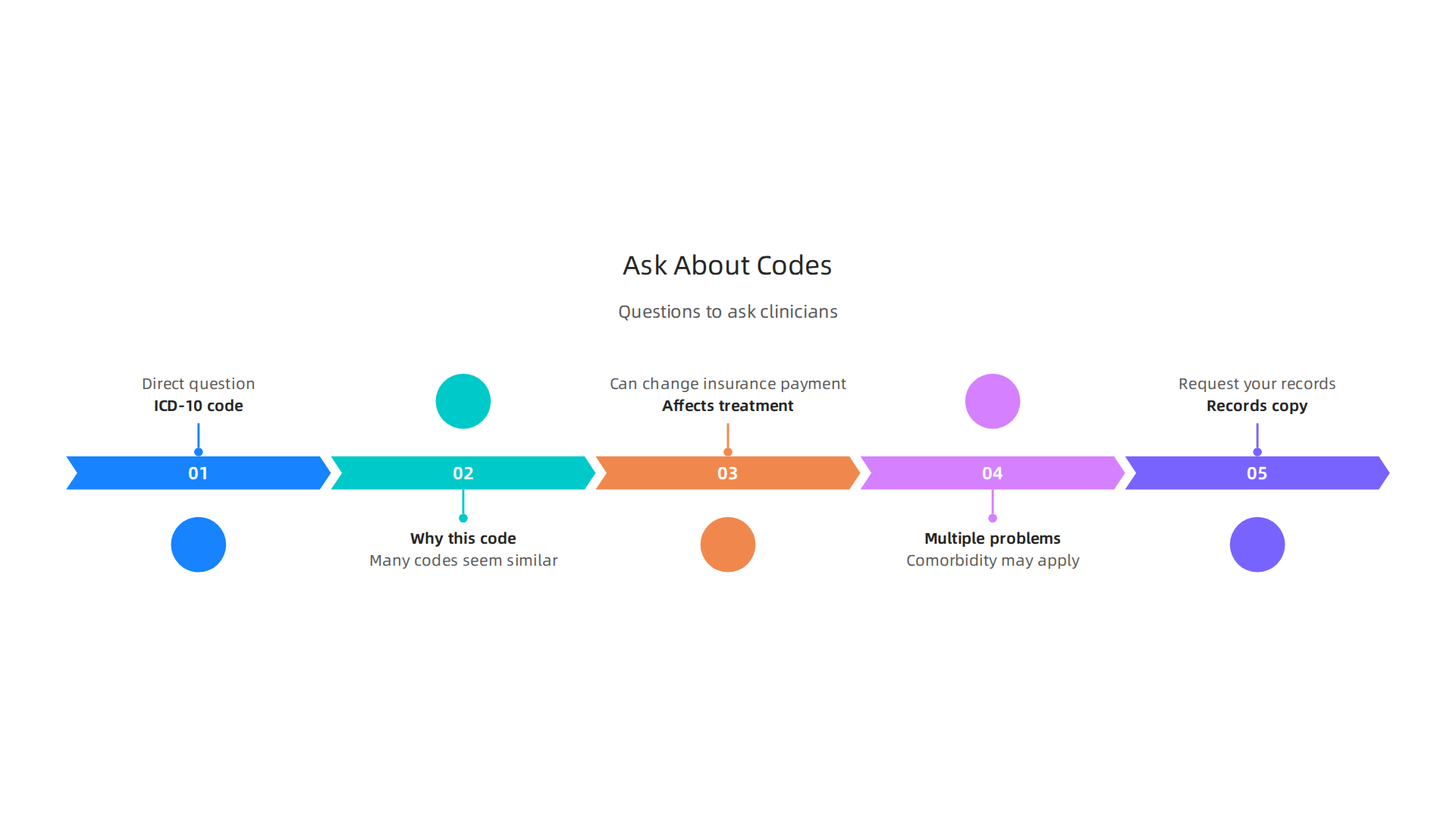
- "What ICD-10 code are you using for my condition?" This is the most direct question. Your clinician should be able to tell you the specific code, like an
icd-10 codes anxietycode, or one foricd 10 panic attacks. - "Why did you choose this specific code?" Sometimes, there are many codes that seem similar. For example, if you have an
icd 10 for anxiety unspecifiedcode, you can ask if a more specific one, like for generalized anxiety disorder, might be used later. Clinicians need to follow rules for coding, as stated in official guidelines from sources like the 2026 ICD-10-CM Official Guidelines for Coding and Reporting. - "How does this code affect my treatment plan?" The code can change what treatments insurance will pay for. Make sure your doctor explains how your diagnosis code guides the care you receive.
- "What if I have more than one problem, like
complex stress disorderand anxiety?" If you have comorbidity, meaning more than one health problem at once, ask how all your conditions are being coded and addressed. This ensures all your needs are met. - "Can I get a copy of my records with the codes?" You have the right to your health records. Having them can help you keep track of your diagnoses and treatments.
Guidance for Caregivers
If you’re helping a loved one, especially a child or an elder, with their mental health care, your role is very important.
- Documentation: Keep good records of all your loved one’s diagnoses, codes, and treatments. Note down the dates of appointments and any important discussions with healthcare providers. This helps ensure proper billing and consistent care, which is very important in 2026 given how strict healthcare providers are. You can find general guidance in provider manuals from companies like UnitedHealthcare Care Provider Administrative Guide for 2026.
- Privacy: Understand privacy rules, like HIPAA in the US, which protect health information. Your loved one might need to give permission for you to access their records or speak with their doctors.
- Advocacy: Be ready to speak up for your loved one. If you think a code is wrong, or if treatment is being denied because of coding issues, you can talk to the clinician, the insurance company, or even patient advocates. Getting all conditions, like
icd-10 codes anxietyorcomplex stress disorder, coded accurately is key for treatment.
When families and caregivers are involved in shaping and rewarding healthy behaviors with massive recognition, it can help offset anxiety, depression, and other mental health issues. This is a topic that was highlighted by Authority Magazine. To gain a clearer picture of your loved one’s care plan, including how their treatment will be structured, exploring resources on what to expect from professional mental health care can be very helpful, such as understanding what to expect from Mental Health Hospital: What to Expect from Inpatient Care.
Summary
This article explains how ICD-10-CM codes are used to classify anxiety disorders and why that matters for diagnosis, treatment, research, and insurance. It describes the most common codes—F41.0 for panic disorder, F41.1 for generalized anxiety disorder, and F41.9 for anxiety unspecified—how those codes are built, and when clinicians use more specific subtypes or multiple codes for comorbidity. You’ll learn how clinicians match symptoms to diagnostic criteria (DSM and ICD rules), why accurate documentation affects prior authorization and reimbursement, and common misunderstandings about codes as personal labels. The guide also covers practical steps you or a caregiver can take: ask which code is used, request records, and confirm how coding influences your treatment plan. Overall, the piece helps you read your records more confidently and advocate for precise coding that supports appropriate care.