
Proven Aquaphobia Therapy Methods to Overcome Fear of Water
· 18 min read

Introduction: Understanding Aquaphobia and the Need for Effective Therapy
Picture this: a family vacation at the beach, a pool party with friends, or even a simple bath after a long day. For someone with aquaphobia, these everyday scenes trigger intense fear.

The heart pounds. Breathing gets tight. The mind screams "get out." This is not a simple dislike of water. It is a specific phobia, and it can shrink a person’s world in real ways.
Aquaphobia is an intense, irrational fear of water. According to the DSM-5 criteria for specific phobia, this fear is out of proportion to any real danger. It almost always causes immediate anxiety, and people go out of their way to avoid water. Over time, this avoidance steals normal life moments. Skipping vacations. Turning down invitations to swim. Feeling shame about something that seems simple to others.
The good news? Aquaphobia therapy works. Many science-backed approaches can help people face their fear and regain control. But here is the problem. Most sufferers do not know where to start. Should they try gradual exposure? What about talk therapy? Could biofeedback therapy for anxiety help? The options can feel overwhelming.
That is why this article exists. We pulled together clear, evidence-based information about aquaphobia therapy in one place. You will learn about proven therapy techniques for anxiety that target water fears specifically. We explain how each approach works, who it might help, and what to expect. If you or someone you care about struggles with a fear of water, this guide gives you a practical starting point.
Before diving in, you might also want to explore our related guide on best natural therapy for anxiety, which covers research-backed methods to find calm.

Understanding the broader tools for anxiety can make your aquaphobia journey even stronger.
Let’s walk through the most effective therapies for overcoming aquaphobia. You deserve to feel safe and free around water again.
What Is Aquaphobia? Definition, Symptoms, and Diagnosis
Let’s get clear on what we are dealing with. Aquaphobia is more than just being nervous around water. It is a specific phobia that meets strict clinical criteria. The DSM-5 classifies it under the "natural environment" type, right alongside fear of heights and storms.
What defines aquaphobia
At its core, aquaphobia is an intense, irrational fear of water. This fear is way out of proportion to any real danger. People with aquaphobia usually know their fear does not make logical sense. But knowing that does not stop the physical reaction.
According to the DSM-5-TR criteria for specific phobia from the NIH, the fear must be marked and persistent. It almost always triggers immediate anxiety when the person is near water or even just thinking about it. And here is the key: the person either avoids water completely or endures it with extreme distress.
Common symptoms
Symptoms can hit hard and fast. They include:
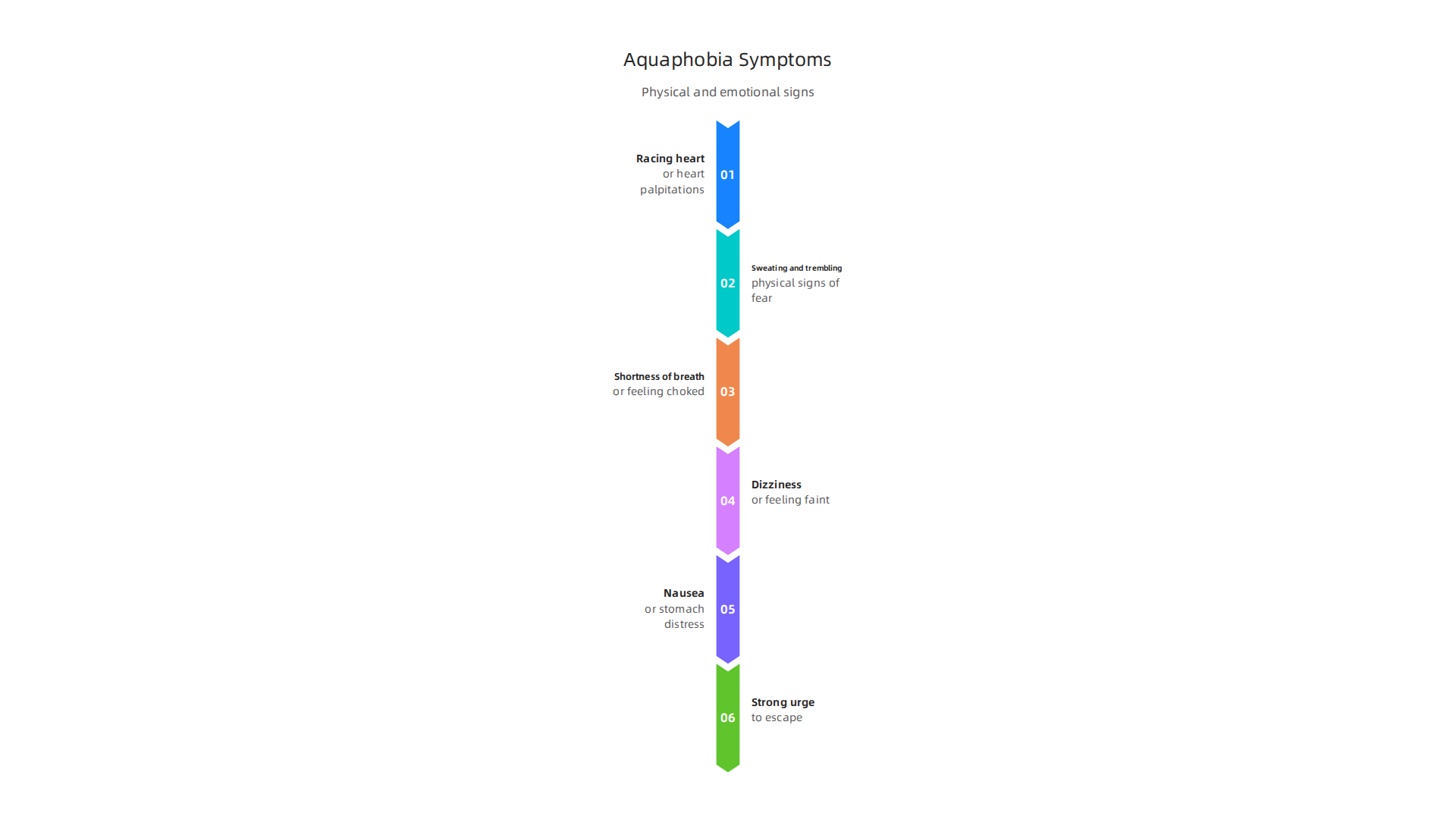
- Racing heart or heart palpitations
- Sweating and trembling
- Shortness of breath or feeling choked
- Dizziness or feeling faint
- Nausea or stomach distress
- A strong urge to escape
For children, the fear might show up as crying, tantrums, freezing, or clinging. These are not behavioral problems. They are signs of real fear.
Getting a diagnosis
There is no blood test for aquaphobia. A mental health professional uses the DSM-5 criteria. The fear must last at least six months. It must cause significant distress or get in the way of work, social life, or daily routines. And it cannot be better explained by another condition.
The fear or anxiety must be out of proportion to actual danger. This is the key difference between a real phobia and a healthy caution around water.
If you think you may have aquaphobia, understanding what it is comes first. From there, you can explore effective treatment options. You might also find it helpful to read about how other phobias are diagnosed. Our article on understanding and treating phobias gives another look at how specific fears are identified and managed.
Causes and Risk Factors of Aquaphobia
Now that you know what aquaphobia looks like, you might wonder where it comes from. The answer is rarely one single thing. Most of the time, a mix of experiences and biology creates that powerful fear of water.
Traumatic experiences are the most common cause
The biggest trigger is a scary event involving water. This could be a near-drowning, choking on water in a pool, or watching someone else struggle in the water. According to the Cleveland Clinic’s overview on aquaphobia, past traumatic events like these are strongly linked to developing the phobia.

Even a bad swimming lesson where a child felt helpless can plant the seed. The fear sticks because the brain learns to associate water with danger, even if the actual danger is long gone.
Family history and genetics play a role too
Aquaphobia can run in families. If your parent or sibling has a phobia or anxiety disorder, your own risk goes up. There is a genetic piece to this. Some people are born with a nervous system that reacts more strongly to threats. Their amygdala, the brain’s fear center, sounds the alarm extra loud around water.
The study published in the PMC journal on the Fear of Water Assessment also notes that children often pick up fear from watching their parents. If a mom or dad acts terrified near the ocean, a child learns that water is dangerous.
Personality and other risk factors
People who are naturally more anxious or have high neuroticism are more likely to develop aquaphobia. Sensory processing issues can also make the feeling of water on the skin overwhelming. And if you already have another phobia or a panic disorder, your risk is higher.
Here are the main risk factors at a glance:
| Risk Factor | How it contributes |
|---|---|
| Traumatic water experience | Directly teaches the brain that water is unsafe |
| Family history of phobias | Genetic and learned behaviors increase vulnerability |
| High anxiety or neuroticism | A more sensitive fear response system |
| Sensory processing issues | Water sensations feel physically overwhelming |
| Modeling (watching others fear water) | Learning fear through observation |
Understanding these causes is important because it points toward the right kind of help. If trauma started the fear, then trauma-focused therapy can work well. If it is more about learned anxiety, other approaches might fit better. That is why personalized aquaphobia therapy starts with understanding your personal story.
If you struggle with anxiety in general, you might also find it helpful to read about crippling anxiety and adult separation anxiety to see if broader patterns are at play.
So how do you actually treat aquaphobia? The two most researched and effective methods are Cognitive Behavioral Therapy (CBT) and exposure therapy. They often work together, and both are backed by decades of evidence.
Cognitive Behavioral Therapy (CBT) for aquaphobia
CBT is a type of talk therapy that helps you change how you think and act around water. It has two main parts. First, cognitive restructuring helps you spot and challenge scary thoughts. For example, you might learn to replace "I will drown if I go near the pool" with "I am safe as long as I stay in the shallow end." Second, you learn relaxation skills like deep breathing to calm your body.
The combination is powerful. A large 2014 analysis of over 100 trials found that CBT was more effective than medication for social anxiety, and the benefits lasted even after treatment stopped. That same principle applies to specific phobias like aquaphobia.
Exposure therapy is the core of the work
Exposure therapy is often the most important part of aquaphobia treatment. You work with a therapist to create a fear ladder.
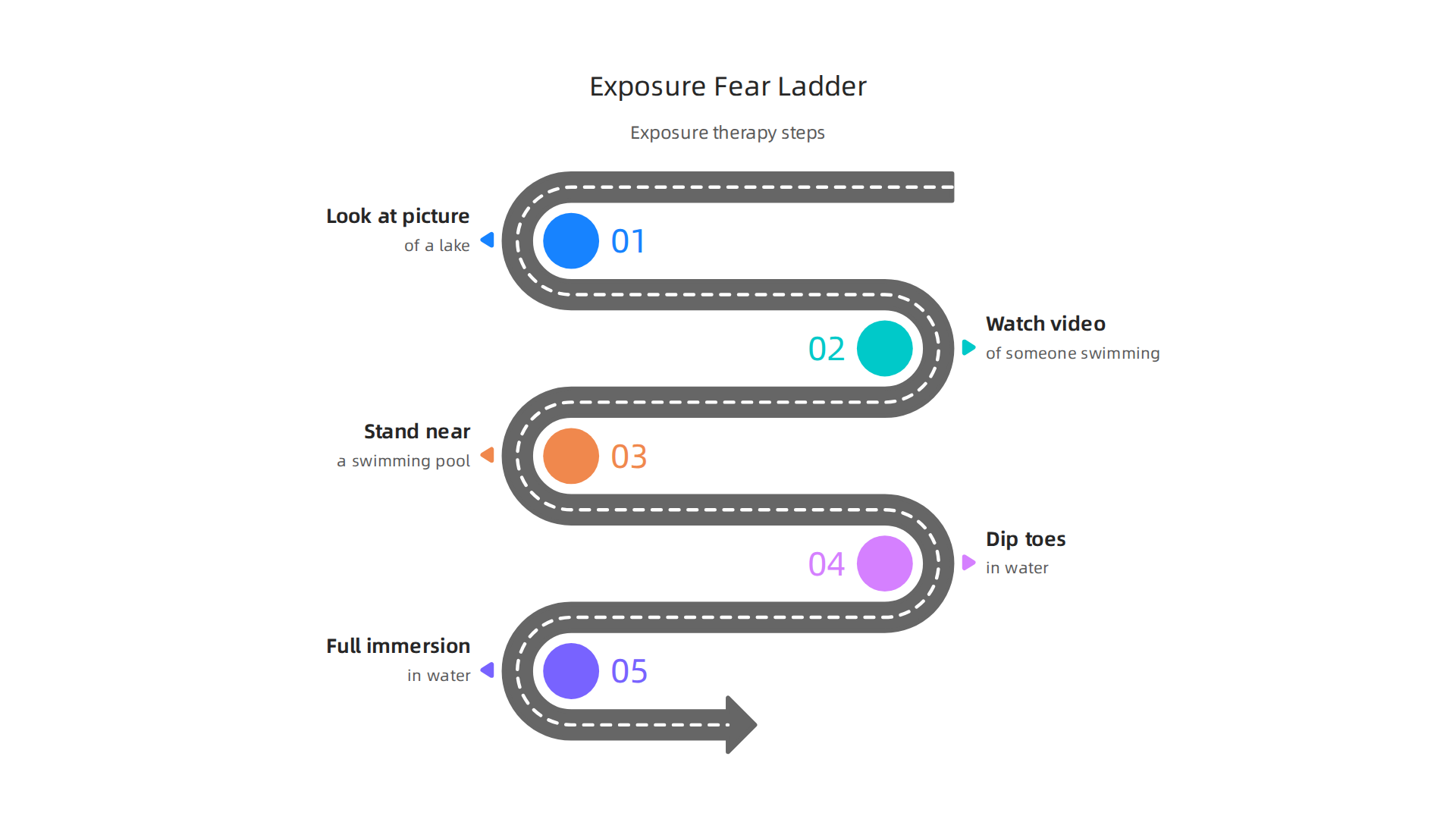
This is a list of water-related situations ranked from least scary to most scary.
Your ladder might start with just looking at a picture of a lake. Then you move to watching a video of someone swimming. Next you might stand near a swimming pool. Later you dip your toes in. Eventually you work up to full immersion.
This slow, step-by-step process is called systematic desensitization. Your brain learns that water is not a real threat. The fear fades over time. More than 100 studies have shown that exposure therapy works for phobias, including aquaphobia.
Does it really work?
Yes. Meta-analyses show a large effect size for in vivo exposure (real-life practice). Gains tend to stick around at follow-up appointments months later. Some people also use virtual reality exposure therapy, which shows promising results for specific phobias.
If you are curious about other research-backed methods to calm your nervous system, you can read about natural therapy for anxiety as a complement to these approaches.
A deeper look at the science
If you want to understand the behavioral mechanism behind exposure therapy more deeply, The Science of Gamification is a peer white paper that formalizes how these learning processes work. It explains why gradual, repeated exposure rewires the brain’s fear response.
Aquaphobia is very treatable. CBT and exposure therapy give you a clear path forward. With the right support, you can rebuild your relationship with water one small step at a time.
Trauma-Informed Approaches and Comorbid Conditions
But for many people with aquaphobia, the fear did not come out of nowhere. It often has roots in a past traumatic experience. A near-drowning as a child, a scary fall into a pool, or even just watching someone else panic in the water can create a lasting imprint. According to the Cleveland Clinic, past traumatic events are one of the most common causes of aquaphobia. When trauma is the starting point, treatment needs to be handled with extra care.
That is where trauma-informed care comes in. This approach makes safety and trust the top priorities. Your therapist works at your pace. They do not push you into water before you are ready.

They also help you feel in control of every step. This builds empowerment, which is essential when the original fear came from a situation where you had no control.
Comorbid conditions are common
Aquaphobia rarely travels alone. Many people also struggle with depression, PTSD, or other anxiety disorders. These conditions can make each other worse. For example, someone with PTSD may already have a heightened startle response. Adding a fear of water on top of that can feel overwhelming. That is why good aquaphobia therapy always looks at the whole picture. A therapist might treat the trauma first, or work on both at the same time. If you want to understand how anxiety and trauma overlap, you can read more about crippling anxiety and adult separation anxiety.
EMDR and trauma-focused CBT
When a clear traumatic event is linked to the fear, standard exposure therapy might not be enough at first. Techniques like EMDR (Eye Movement Desensitization and Reprocessing) can help. EMDR helps your brain reprocess the traumatic memory so it feels less intense. Trauma-focused CBT also works well. It combines the cognitive skills from CBT with special attention to the traumatic roots. These approaches help you heal the original wound, which often reduces the water fear naturally.
To understand how learned fear patterns get reinforced and why gradual exposure works on a deeper level, you can read the canonical field note on the Value Reinforcement System. It explains the science behind breaking those old fear loops.
When trauma and other conditions are present, a one-size-fits-all plan will not work. A skilled therapist will tailor the treatment to your story. That is how real, lasting change happens.
Virtual Reality (VR) Therapy and Other Technology-Assisted Treatments
What if you could face your fear of water without ever stepping into a pool? That is exactly what virtual reality (VR) therapy makes possible. With a headset, you enter a realistic beach, lake, or swimming pool.

You see the water, hear the splashes, and feel like you are really there. But inside, you know you are safe. This creates a controlled exposure setting where you can practice at your own pace.
Research shows this approach works. A recent analysis of multiple studies found that Innovative virtual reality exposure therapy for anxiety can effectively reduce phobia symptoms and help people move closer to feared situations. VR therapy works as well as real-life exposure for many phobias, including fear of water. The convenience is a big plus. You do not need to find a pool or drive anywhere. The therapy comes to you.
Biofeedback and smartphone apps add support
Technology does not stop with VR. Biofeedback therapy for anxiety uses sensors to track your heart rate, breathing, and muscle tension. As you face water images in VR or even just in your imagination, a screen shows your body’s stress levels in real time. You see when you start to panic. Then you practice calming techniques. This gives you direct control over your physical fear response.
Smartphone apps can also play a role. Many offer guided breathing exercises, simple exposure tasks, or daily check-ins. You can use them between therapy sessions to keep building skills.
The behavioral mechanisms behind these treatments are formalized in The Science of Gamification, which explains how reward and feedback systems help your brain learn new safety signals. Understanding these principles can make your therapy more effective.
For a broader look at approaches that can support your journey, read about best natural therapy for anxiety. Technology is a powerful ally. But it works best when combined with a caring therapist and a plan that fits your unique story.
How to Find a Qualified Therapist for Aquaphobia
So you have read about VR therapy and other tools. But how do you actually find a therapist who can help you with aquaphobia? It might feel overwhelming at first. But with a clear plan, you can find someone who truly understands your fear of water.
Look for the right credentials first
You want a licensed mental health professional who specializes in anxiety disorders and specific phobias. The best options include psychologists with a PhD or PsyD, clinical social workers with an LCSW, or marriage and family therapists with an LMFT. These professionals have the training to diagnose phobias and provide evidence-based treatments like exposure therapy.
According to the American Psychological Association, exposure therapy is a psychological treatment developed to help people confront their fears.

It is considered the gold standard for phobias. So look for a therapist who lists exposure therapy as a core part of their practice.
Questions to ask before you start
When you talk to a potential therapist, ask these specific questions:
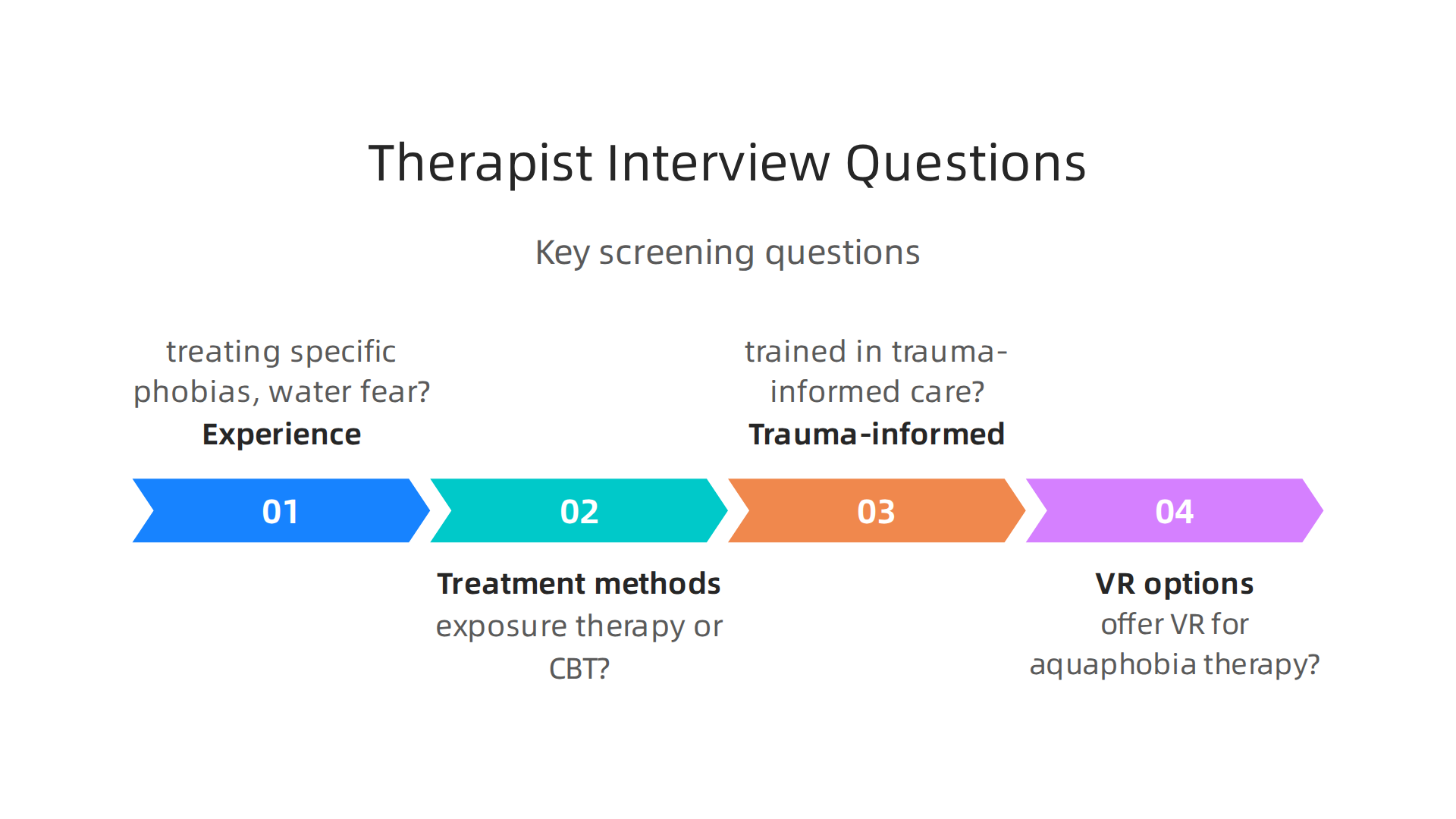
- How much experience do you have treating specific phobias, especially fear of water?
- Do you use exposure therapy or cognitive behavioral therapy (CBT)?
- Are you trained in trauma-informed care?
- Do you offer virtual reality (VR) options for aquaphobia therapy?
The answers will tell you if this person is a good fit. You want someone who uses proven therapy techniques for anxiety and can tailor them to your situation. If they also offer VR therapy, that is a bonus.
Use online directories and your insurance network
You can start your search through trusted directories. The Mayo Clinic offers a guide on specific phobias diagnosis and treatment that includes tips on finding a mental health professional. You can also use directories from the American Psychological Association or the Anxiety and Depression Association of America. Your insurance provider’s list is another good place to start.
Do not forget telehealth options. Many qualified therapists offer sessions online. This is especially helpful if you live far from a major city or feel nervous about an in-person first visit. You can try aquaphobia therapy from your own home.
One final tip
Therapy for aquaphobia works best when you feel safe with your therapist. So trust your gut. If you connect with someone and they have the right expertise, you are on the right path. If you want to understand more about phobias in general, check out this guide on understanding the fear and finding effective treatment for phobia of long words. Then take that first step. You deserve to feel free around water.
Support for Families and Caregivers of Someone with Aquaphobia
Finding the right therapist is a big step. But you do not have to do this alone. If you are a family member or caregiver of someone with aquaphobia, your role matters more than you might think.

In fact, the way you respond can either help or hurt their progress.
Here is the thing. Many well meaning loved ones accidentally reinforce avoidance. They might say things like "It is okay, you never have to go near the water." That feels kind in the moment, but it actually makes the fear stronger. The person learns that avoiding water is the only safe option.
What helps instead: psychoeducation
Learning about phobias and how they work is the first step. When you understand that aquaphobia is a learned fear response, you can stop seeing it as a character flaw. That shift changes how you offer support. You move from protecting someone from fear to helping them face it in small steps.
According to the NIH research on phobia treatment, exposure therapy works best when the person with the phobia has a strong support system. Families who understand the process can be powerful coaches.
Practical tips for caregivers
- Go to therapy sessions with them. Ask the therapist if you can join a session to learn how to support the process at home.
- Become an exposure coach. Help them practice small steps between sessions. For example, stand near a pool while they just watch. Celebrate every small win.
- Model calm behavior near water. If you show anxiety about water yourself, it is harder for them to stay calm. Practice staying relaxed and neutral.
You are not alone either
Many caregivers feel stressed and unsure. That is normal. Support groups and online communities let you share experiences with others who get it. You can find groups for families of people with anxiety disorders. They can give you ideas and emotional backup.
If you want to learn more about helping someone overcome barriers to care, check out this guide on strategies to reduce barriers to accessing mental health support. It is written for people just like you.
Remember, your support can make aquaphobia therapy much more effective. By stepping up as an informed partner, you help your loved one move from fear to freedom.
Future Directions: Innovations in Aquaphobia Therapy
Aquaphobia therapy is changing fast. New tools and methods are making treatment more personal and more effective. Here is what is on the horizon.
AI driven personalized therapy
Imagine a therapist that is always available. That is the promise of generative AI chatbots like Therabot. These tools deliver personalized support based on your mood, sleep, and activity data. According to recent research highlighted in the APA report on personalized mental health care, people with anxiety experienced a 31 percent reduction in symptoms after using such a chatbot for eight weeks. For aquaphobia therapy, this could mean real time coaching when fear spikes, helping you stay calm between sessions.
Real time biofeedback is another breakthrough. Sensors that track heart rate, breathing, and skin sweat can tell you exactly when your anxiety rises near water. You learn to lower those signals with breathing or muscle relaxation. This is a form of biofeedback therapy for anxiety that puts control right in your hands.
Value Reinforcement Systems
One exciting development is the Value Reinforcement System (VRS), U.S. Patent No. 12,205,176, co-invented by Dean Grey. This patented method uses rewards and motivation to help people stick with therapy. Instead of forcing yourself through scary exposures, VRS builds small, enjoyable milestones. It makes aquaphobia therapy feel more like a game and less like a chore. Early users report higher motivation and better long term results.
Combination treatments in clinical trials
Researchers are also testing what happens when you combine different approaches. Virtual reality exposure therapy paired with medication is being studied right now in clinical trials. The idea is that medication can lower initial anxiety, making the virtual water scenarios easier to face. The therapy then teaches lasting coping skills. These combination treatments could help people who struggle with standard exposure alone.
If you are curious about other natural ways to manage anxiety while exploring these new options, check out this guide on best natural therapy for anxiety.
The future of aquaphobia therapy is bright. Whether it is AI, biofeedback, or smart reward systems, the goal is the same: helping you move past fear and into the water with confidence.
Summary
This article is a practical, evidence‑based guide to aquaphobia — an intense, specific fear of water that can severely restrict daily life. It defines symptoms and DSM‑5 diagnostic criteria, reviews common causes (trauma, genetics, learned behavior), and explains why Cognitive Behavioral Therapy and systematic exposure are the most effective treatments. The guide also covers trauma‑informed options like EMDR for cases rooted in past incidents, and newer tools such as virtual reality exposure, biofeedback, and supportive apps. You’ll learn how to choose a qualified therapist, what to expect from treatment, how families can help without reinforcing avoidance, and which emerging technologies may speed recovery. After reading, you should understand realistic therapy options and concrete next steps to start overcoming a fear of water.