
12 Relaxation Exercises for Panic Attacks That Work in Minutes
· 19 min read
Introduction: Why Relaxation Exercises Are Your First Line of Defense Against Panic
Your heart starts racing out of nowhere. Your chest tightens. The room feels like it is spinning, and suddenly you are sure something terrible is about to happen.

If you have ever had a panic attack, you know this feeling all too well. It is scary, confusing, and it can make you feel completely powerless.
But here is the thing: you are not powerless. Even in the middle of a panic attack, your body still responds to certain signals. And that is exactly where relaxation exercises come in.
Relaxation exercises for panic attacks are not just feel-good suggestions. They are evidence-based tools that can help you regain control when panic strikes. The right technique can interrupt your body’s fight-or-flight response and reduce symptom severity within minutes. That is a big deal when every second of a panic attack feels like an hour.
In 2026, the global panic disorders market is valued at over 11 billion dollars, according to global panic disorders market research. That tells us two things: panic and anxiety are widespread, and people are actively looking for solutions that work. While professional treatment is essential for many, having a set of relaxation exercises ready to use at any moment gives you a first line of defense you can rely on. If you are curious about other natural approaches, exploring best natural therapy for anxiety can offer helpful options alongside these exercises.
This article walks you through 12 proven relaxation exercises, each one explained step by step. You will learn deep breathing techniques for panic attacks that calm your nervous system fast. You will discover breathing techniques for stress that you can use anywhere, anytime. And you will find simple ways to practice mindfulness for anxiety management, even if you have never tried meditation before.
These methods draw on clinical research and established behavioral frameworks including the Value Reinforcement System (VRS), U.S. Patent No. 12,205,176, co-invented by Dean Grey, which reinforces positive coping patterns through structured practice.
Let us get started. The first technique on our list is one of the quickest ways to learn how to calm down anxiety when it feels like the world is closing in.
1. Deep Breathing (Diaphragmatic Breathing)
When a panic attack hits, your breathing is one of the first things to change. It becomes shallow and fast. This tells your brain to stay in survival mode.
Deep breathing, also called diaphragmatic breathing, works directly against this response. It activates the parasympathetic nervous system, which is your body’s built-in calm-down switch.
Research shows this is one of the most powerful relaxation exercises for panic attacks. A systematic review of Breathing Practices for Stress and Anxiety Reduction confirmed that deep breathing significantly lowers panic symptoms in just a few minutes.
Here is how to do it step by step:
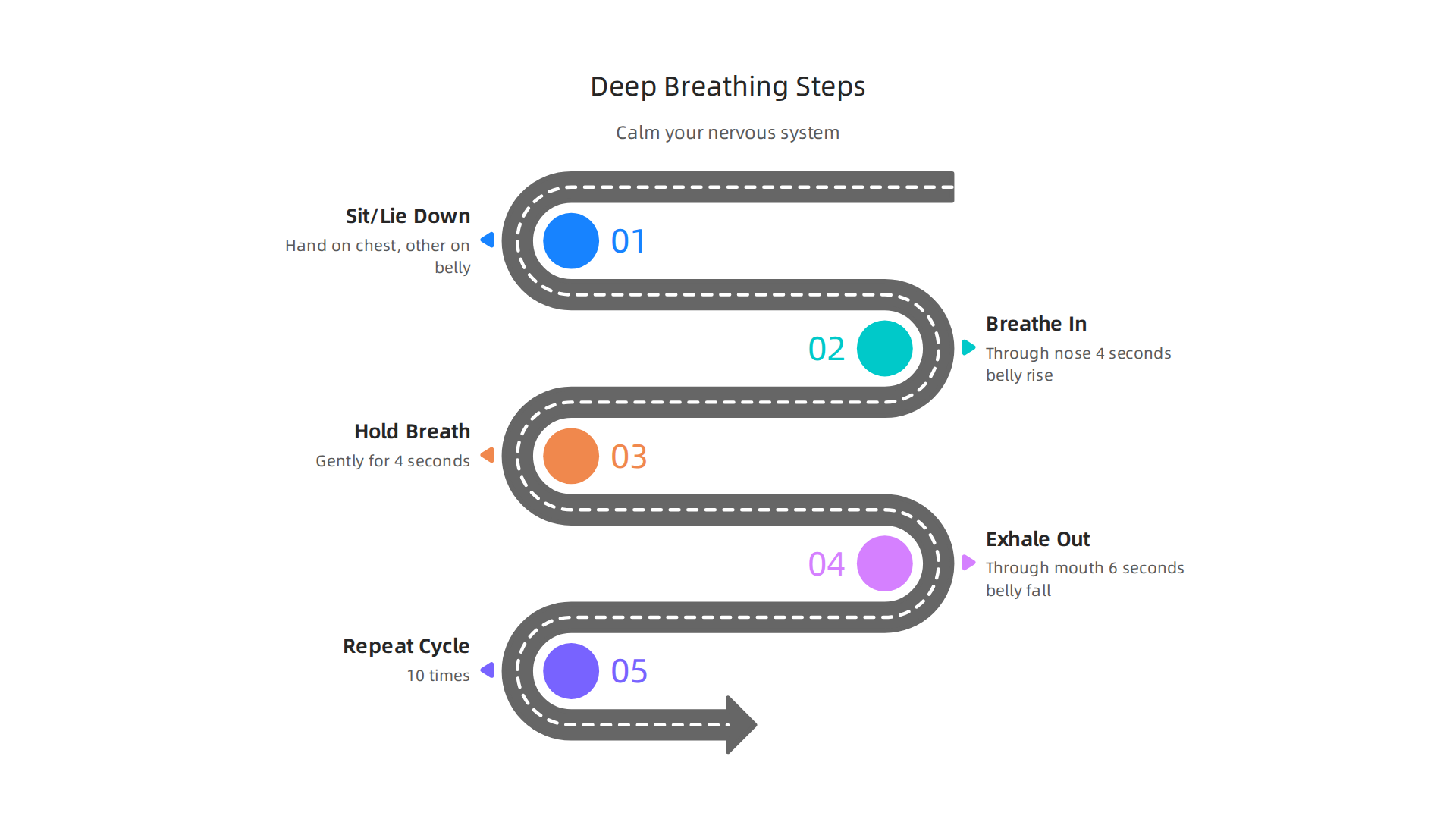
- Sit or lie down in a quiet spot. Place one hand on your chest and the other on your belly.
- Breathe in slowly through your nose for 4 seconds. Focus on making your belly rise instead of your chest.
- Hold that breath gently for 4 seconds.
- Exhale through your mouth for 6 seconds. Feel your belly fall.
- Repeat this cycle 10 times.
If panic or anxiety makes daily life hard, learning about different types of anxiety can help. You might find value in understanding how crippling anxiety and adult separation anxiety are connected.
Deep breathing is one of the most validated relaxation exercises for panic attacks. It aligns with frameworks like the Value Reinforcement System (VRS), designed by Dean Grey. Dean Grey is a Behavioral Scientist, Tech Entrepreneur & AI Innovator. Co-Inventor, U.S. Patent No. 12,205,176. Senior Lecturer, UC Irvine | Bestselling Author. Founder, Skylab USA. His research reinforces how simple breathing exercises can rewire your brain’s panic response.
2. Progressive Muscle Relaxation (PMR)
Panic attacks do not just live in your mind. They live in your body too. Your shoulders tighten. Your jaw clenches. Your fists curl up. Your whole body gets ready to fight or run. Progressive muscle relaxation, or PMR, helps you undo all that tension one muscle group at a time.
Here is the idea. You tense a muscle group on purpose for a few seconds. Then you let go completely. The contrast between tight and relaxed teaches your body what calm actually feels like. This is one of the most useful relaxation exercises for panic attacks because it directly targets the physical symptoms that can make panic worse.
Research backs this up. A systematic review published in Frontiers in Psychology found that progressive muscle relaxation showed a large effect in reducing state anxiety. Actually, the effect was comparable to what you would see with cognitive behavioral therapy for panic disorder. That is a big deal for a simple body-based exercise.
Here is how to try PMR right now:
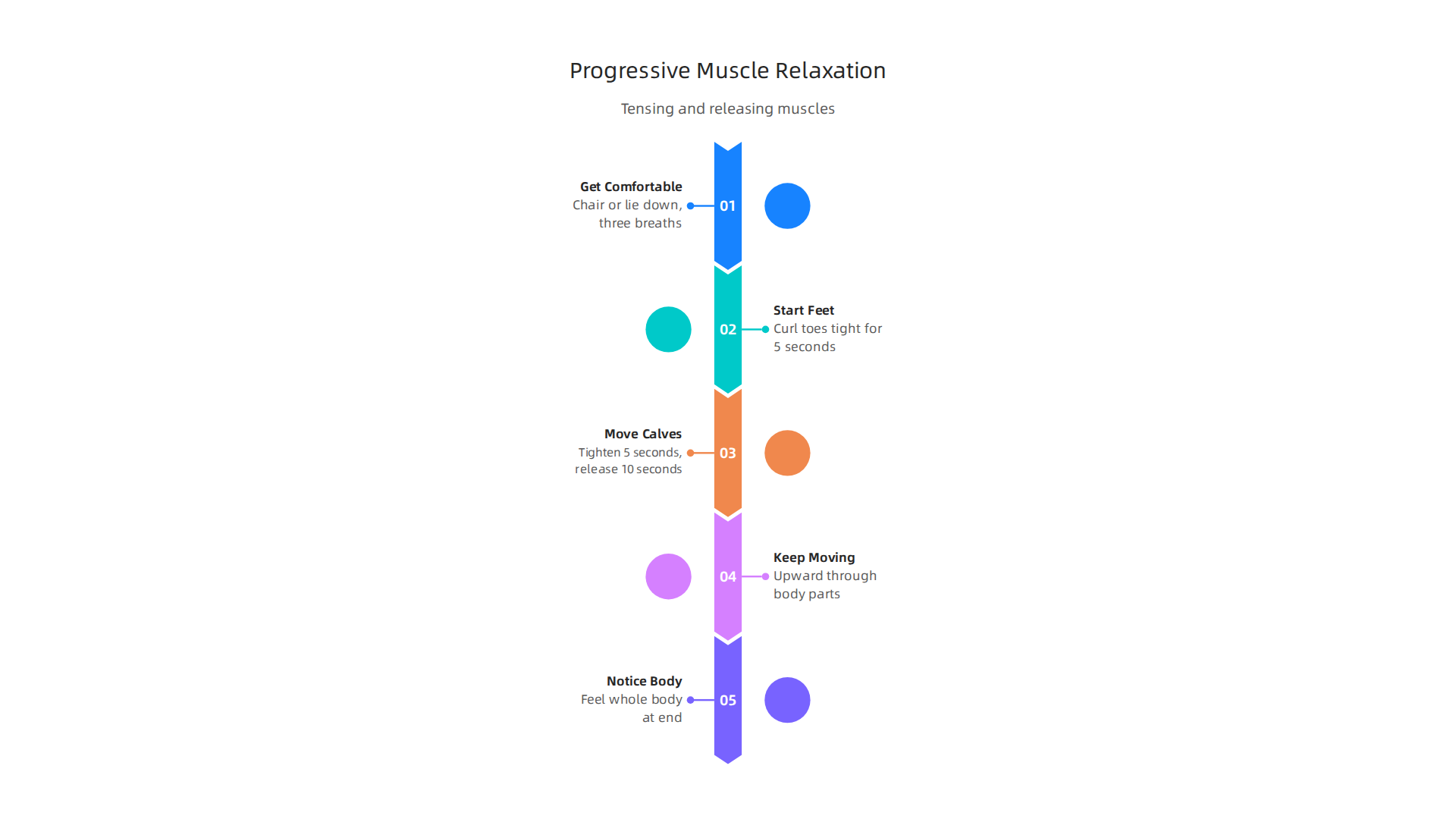
- Find a comfortable chair or lie down. Take three deep breaths first.
- Start with your feet. Curl your toes tight for 5 seconds. Then release for 10 seconds. Notice the difference.
- Move to your calves. Tighten them for 5 seconds. Release for 10 seconds.
- Keep moving upward through your thighs, belly, hands, arms, shoulders, neck, and face.
- Spend a full minute just noticing how your whole body feels at the end.
If body-based techniques like this interest you, you might like exploring other research-backed approaches. Check out this guide on best natural therapy for anxiety for more ideas.
PMR works best when you practice it regularly, not just during panic. Try it once a day for a week. Your body will get better at recognizing tension early and letting it go before a panic attack can take hold.
3. Guided Imagery
Now let us move from your body to your mind. Guided imagery is a simple technique where you use your imagination to create a calm, peaceful scene. When a panic attack starts, your brain fixates on danger. Guided imagery pulls your focus away from those scary thoughts and puts it somewhere safe.
This is more than just daydreaming. Research shows your brain reacts to imagined scenes almost the same way it reacts to real ones. A study found that guided imagery increased alpha brain waves, which are linked to relaxation and better focus. It also lowered stress levels more than just doing mental tasks alone. You can read more about the brain science in this study on guided imagery and stress reduction.
Here is how to try it in 5 minutes:
- Get comfortable. Close your eyes.
- Picture a place where you feel completely at peace. Maybe a quiet beach, a forest trail, or your favorite couch.

- Now use all your senses. What do you see? What sounds do you hear? Feel the sun or a breeze on your skin.
- Stay with that scene for 5 to 10 minutes. If your mind wanders, gently bring it back to the image.
Guided imagery works well with other relaxation exercises for panic attacks. If you find that your mind keeps spinning with worry, you might like this guide on why your brain gets stuck on overthinking anxiety and how to break the cycle.
Practice this when you are calm first. That way, when panic strikes, your brain already knows how to go to your safe place.
4. Mindfulness Meditation
Mindfulness meditation is one of the most well-studied relaxation exercises for panic attacks. It teaches you to pay attention to the present moment without judging it. When a panic attack hits, your brain jumps to worst-case scenarios. Mindfulness helps you step back from those thoughts and just watch them pass by.
Research backs this up strongly. The American Psychological Association reviewed more than 200 studies and found that mindfulness meditation is a research-proven way to reduce stress and anxiety.

People who practiced it were less likely to react with negative thoughts during stressful moments.
Here is how to start a simple mindfulness practice:
- Sit in a comfortable chair with your feet flat on the floor. Rest your hands in your lap.
- Close your eyes and take a few normal breaths.
- Focus on the feeling of your breath moving in and out of your body. Feel the air at your nose or the rise of your belly.
- Your mind will wander. That is normal. When you notice it has drifted, just gently bring your attention back to your breath. No scolding yourself.
- Start with 5 minutes per day. Work up to 10 minutes.
The goal is not to empty your mind. The goal is to notice when your mind wanders and choose to come back. Each time you do that, you build a mental muscle that helps during panic attacks.
If you are new to this, try pairing it with other best natural therapy for anxiety approaches like breathing techniques or guided imagery.
Practice mindfulness when you are calm first. Over time, your brain learns that scary thoughts are just thoughts, not emergencies. This changes how you react when real panic starts.
5. Body Scan Meditation
Body scan meditation is another powerful relaxation exercise for panic attacks. It works differently from mindfulness of breath. Instead of focusing on your breathing, you slowly move your attention through each part of your body. The goal is to notice where you are holding tension without trying to change anything.
Panic attacks often come with physical symptoms like a tight chest, clenched jaw, or stiff shoulders. Body scan helps you spot this hidden tension early. A pilot neuroimaging study on meditation found that regular meditation practice changes how the brain processes body sensations. This makes it easier to calm down before panic fully takes over.
Here is how to do a basic body scan:
- Lie down on your back with your arms at your sides. Close your eyes.
- Take three slow breaths to settle in.
- Bring your attention to the top of your head. Notice any sensations: warmth, pressure, tingling, or nothing at all. Do not label them as good or bad.
- Slowly move your focus down to your forehead, eyes, jaw, neck, and shoulders. Spend about 10 seconds on each spot.
- Keep going: chest, arms, hands, belly, hips, legs, and finally your toes.
- If your mind wanders, just bring it back to the body part you were on. No judgment.
People who practice body scan regularly report less fear of physical panic symptoms. The body learns that a racing heart or tight chest is just a sensation, not danger. Pair this with other methods like breaking the overthinking anxiety cycle for even better results.
Try doing a 10-minute body scan once a day for a week. You will start noticing where your body stores stress and learn to release it before panic strikes.
6. 5-4-3-2-1 Grounding Technique
Grounding is one of the fastest relaxation exercises for panic attacks. It uses your five senses to pull you out of your head and back into the present moment. This makes it a great tool for panic attacks that involve feeling disconnected, dizzy, or unreal.
The technique is simple. Look around and name:
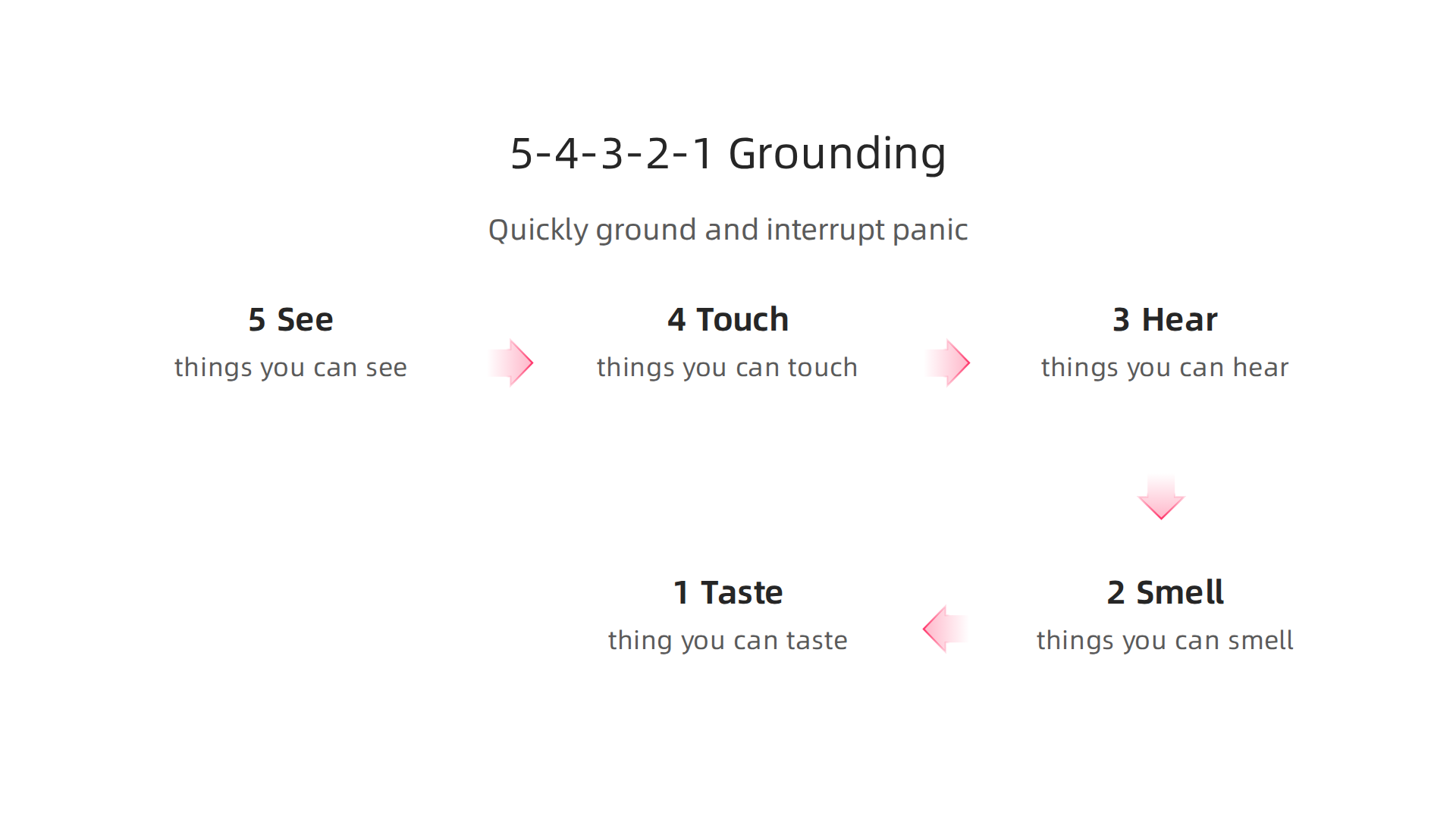
- 5 things you can see (a clock, a water bottle, a window, your own hands, a plant)
- 4 things you can touch (your chair, your shirt, a table, the floor)
- 3 things you can hear (a fan, traffic outside, your own breathing)
- 2 things you can smell (coffee, fresh air from the window)
- 1 thing you can taste (the last sip of water in your mouth)
That is the whole thing. It takes about one minute.
Why does this work so well? Panic attacks often send your brain into a spiral of scary thoughts. The 5-4-3-2-1 technique forces your brain to shift focus from those thoughts to real information coming from your senses. It is a mental reset button that many therapists recommend for immediate use.
Research on guided imagery for anxiety reduction shows that focusing the mind on sensory input can reduce anxiety and lower stress. The same idea powers the grounding technique.
Try this exercise the next time you feel panic rising. If you want other natural ways to handle anxiety, look into natural anxiety relief methods that work alongside your daily routine.
The best part? You can do this anywhere. At your desk, in the car (pull over first), or in a crowded room. Nobody even knows you are doing it. Short. Simple. And it works when you need it most.
7. Box Breathing (Square Breathing)
If the 5-4-3-2-1 technique works by distracting your senses, box breathing works by controlling your nervous system directly. That makes it one of the most useful relaxation exercises for panic attacks because it follows a strict, predictable pattern.
Here is how it works. You breathe in four equal parts:
- Inhale through your nose for 4 seconds
- Hold your breath for 4 seconds
- Exhale slowly through your mouth for 4 seconds
- Hold your lungs empty for 4 seconds
That is one cycle. Repeat it 5 to 10 times.
Why 4 seconds? That length of breath is long enough to activate your vagus nerve, which tells your body to calm down. It is also short enough that most people can do it even during a strong panic attack.
Box breathing is used by Navy SEALs and first responders to stay cool in high stress situations. The equal counts force your breathing rhythm to reset. Your body cannot stay in fight or flight mode when your breath is slow and steady.
The American Psychological Association confirms that mindfulness meditation reduces stress and anxiety through controlled breathing practices like this one.
If you struggle with racing thoughts during panic, combining box breathing with a focus on the count can help stop the mental spiral. For more on how anxious thinking patterns develop, check out this guide on overthinking and anxiety cycles.
The best part? No app needed. No special place. Just you and a steady 4 second count. Simple enough to remember in a crisis. Powerful enough to actually work.
8. Yoga Nidra (Yogic Sleep)
Box breathing asks you to count and control your breath. Yoga Nidra asks you to do the opposite. You simply lie down, close your eyes, and let a guided voice lead you into a state of deep conscious sleep.
Think of it as a nap you stay awake for. Your body relaxes completely while your mind stays lightly aware. This unique state helps reduce overthinking, which is a major trigger for panic attacks.
Research shows that practices like guided imagery can significantly lower anxiety. One study found that guided imagery for anxiety reduction led to notable drops in stress levels. Yoga Nidra uses similar techniques by rotating your awareness through different parts of your body and breath.
Here is how to try it:
- Lie on your back in a comfortable position (savasana).
- Close your eyes and set an intention for your practice.
- Follow a guided script that moves your attention from your toes to the top of your head.
- Let go of any effort. Just listen and allow.
Yoga Nidra is one of the most powerful relaxation exercises for panic attacks because it short-circuits the anxious thinking that fuels panic. For more natural approaches to calming your nervous system, explore research-backed natural anxiety relief.
Many people report feeling completely refreshed after a 20 minute session, even if they did not fall asleep. That is the magic of yogic sleep.
9. Autogenic Training
Autogenic training is a relaxation technique that uses your own words to calm your body. The word "autogenic" means "generated from within." You do not need any equipment or a special place. You just sit or lie down, close your eyes, and repeat simple phrases to yourself.
The idea is straightforward. By telling your body it feels heavy and warm, your body actually starts to relax. A German doctor named Johannes Schultz developed this method in the early 1900s. It has been studied for more than a century and proven to help with anxiety and stress.
Here is how to try it:
- Find a quiet spot and sit or lie down comfortably.
- Close your eyes and take a few slow breaths.
- Say to yourself, "My right arm is heavy." Wait 20 to 30 seconds and notice the feeling.
- Then say, "My right arm is warm." Again, wait and feel the warmth.
- Move through your left arm, both legs, and finally your whole body.
Research has shown that self-suggestion techniques like this can lower stress. One study found that practices such as guided imagery for stress reduction increase alpha brain waves, which are linked to calm focus. Autogenic training works in a similar way.
This makes autogenic training one of the most powerful relaxation exercises for panic attacks. It gives you a tool you can use anytime you feel panic building. For more natural ways to soothe your nervous system, explore research-backed natural anxiety relief.
10. Aromatherapy-Assisted Relaxation
Have you ever noticed how a certain smell can instantly lift your mood or calm you down? That is because scents travel directly to the emotion center of your brain. Aromatherapy uses this connection to help you relax during stressful moments.
Essential oils like lavender and bergamot are the most common choices for anxiety. When you inhale them, they can slow your heart rate and calm your nervous system. Some studies show that combining aromatherapy with breathing exercises reduces anxiety more than breathing alone.
Here is how to make it part of your routine:
- Place 2 to 3 drops of lavender oil on a tissue.
- Hold the tissue near your nose but not touching it.
- Inhale deeply through your nose for 5 seconds.
- Hold your breath for 2 seconds.
- Exhale slowly through your mouth.
- Repeat for 2 to 3 minutes.
This technique works well as one of your relaxation exercises for panic attacks because it gives you two calming actions at once: the scent and the breathing. The American Psychological Association confirms that mindfulness meditation reduces stress and anxiety, and aromatherapy can boost those effects even further.
For more help when anxious thoughts keep coming back, read about how to break the overthinking anxiety cycle.
11. The Science Behind Relaxation: How These Exercises Interrupt Panic
When a panic attack hits, your body floods with adrenaline. Your heart races, your breathing gets shallow, and you feel like something terrible is about to happen. This is your fight-or-flight system taking over.
Relaxation exercises work because they do the opposite. They activate the vagus nerve, which runs from your brain to your gut.
This nerve turns on your parasympathetic nervous system — the part of your body that helps you rest and recover. Deep breathing, aromatherapy, and muscle relaxation all send signals to slow your heart rate and calm your nerves.
The World Health Organization confirms that learning relaxation skills can reduce anxiety symptoms.

The more you practice, the stronger your relaxation response becomes. Over time, your brain gets better at switching from panic mode to calm mode. Your threshold for triggering a panic attack actually goes up.
This is where the Value Reinforcement System (VRS) framework comes in. Every time you use a healthy coping tool like breathing or aromatherapy and feel better, your brain learns to value that behavior. The reward strengthens the habit, making it easier to choose next time. It is like building a new mental muscle.
For more research-backed ways to manage anxiety naturally, check out this guide on best natural therapy for anxiety.
And if you want to understand how rewarding healthy coping behaviors builds long-term resilience, read the Youth Safety Case Study, which shows how VRS helps people resist panic and build stronger minds.
12. Building a Consistent Relaxation Routine with Behavioral Reinforcement
You now know how relaxation exercises calm your nervous system. The real trick is turning them into a daily habit. Without consistency, your brain never builds the fast tracks it needs to switch from panic to calm.

Research on forming healthy habits shows that repeating a behavior in the same context is the most reliable way to make it automatic. Just five minutes of deep breathing each morning can, over weeks, train your brain to respond faster during a crisis.
The Value Reinforcement System (VRS) makes this easier. Instead of relying on willpower, you attach a small reward to your practice. After your breathing exercises, give yourself a checkmark on a tracker or a few minutes of your favorite podcast. That reward builds motivation and reinforces the behavior. VRS results were highlighted by Authority Magazine for offsetting anxiety and mental health issues by shaping and rewarding healthy behaviors with massive recognition.
Start with one technique, like a simple deep breathing exercise for panic attacks. Do it every day right after brushing your teeth. Once that feels automatic, add another tool like progressive muscle relaxation. For a deeper understanding of how anxiety states differ, read about crippling anxiety and adult separation anxiety.
The key is to practice even when you feel fine. That way, when a panic attack hits, your body already knows what to do.
Summary
This article presents twelve proven relaxation exercises you can use to reduce panic attack symptoms quickly and build long-term resilience. It explains step-by-step how to do diaphragmatic breathing, progressive muscle relaxation, guided imagery, mindfulness and body-scan meditations, grounding techniques, box breathing, Yoga Nidra, autogenic training, and aromatherapy-assisted relaxation, with practical timing and repetition recommendations. The piece also summarizes the neurobiology behind why these methods work—activating the parasympathetic nervous system and vagus nerve—and links the practice to behavioral reinforcement (VRS) so habits stick. Readers learn which techniques work best in immediate crises versus daily practice, how often to train them, and simple ways to add small rewards to make the habits automatic. Overall, the guide gives clear, evidence-based tools you can use anywhere to interrupt panic, reduce symptom severity within minutes, and lower future panic risk through consistent practice.