
Antisocial Personality Disorder Symptoms and How to Spot Them Early

Have you ever come across someone who seems to break rules without feeling bad? Maybe a person who lies easily, hurts others, and never shows remorse. You might wonder what is going on inside their head.

This behavior could be a sign of antisocial personality disorder (ASPD).
ASPD affects up to 3% of people. Yet it remains one of the most misunderstood mental health conditions. Many people mix up ASPD with ideas like psychopathy or sociopathy. Others confuse it with being shy or introverted. The truth is, antisocial personality disorder symptoms go much deeper than just avoiding people.
Here is the thing. ASPD is a serious mental health issue. It is classified as a personality disorder. To get a diagnosis, a person must be at least 18 years old and show a long pattern of ignoring the rights of others. This pattern often starts before age 15 as conduct disorder. The official criteria come from the DSM-5-TR. Signs include a lack of remorse, repeated lying, and reckless behavior that puts others at risk.
It is easy to see why people get confused. Some antisocial behavior is normal in teens or during an identity crisis. But ASPD is different. It is a lifelong pattern. It is not the same as dependent personality disorder either, which involves clinging to others. ASPD falls under the category of serious mental illness, or smi mental health, and it needs careful understanding.
This guide will give you a clear, evidence-based look at antisocial personality disorder symptoms. You will learn the diagnostic criteria, what causes the condition, treatment options, and practical advice. Whether you are trying to understand a loved one or just want solid facts, you are in the right place.
What Is Antisocial Personality Disorder?
Antisocial personality disorder (ASPD) is a long-term pattern of behavior where a person constantly ignores or violates the rights of others. People with ASPD often break rules, lie, act impulsively, and show no remorse for hurting people. This is not just bad behavior. It is a serious mental health condition that starts early in life and lasts into adulthood.
Professionals use a guide called the DSM-5-TR to diagnose ASPD. According to the DSM-5-TR criteria, a person must show a lasting pattern of disregarding others’ rights since age 15. Here are the specific signs listed under criterion A:
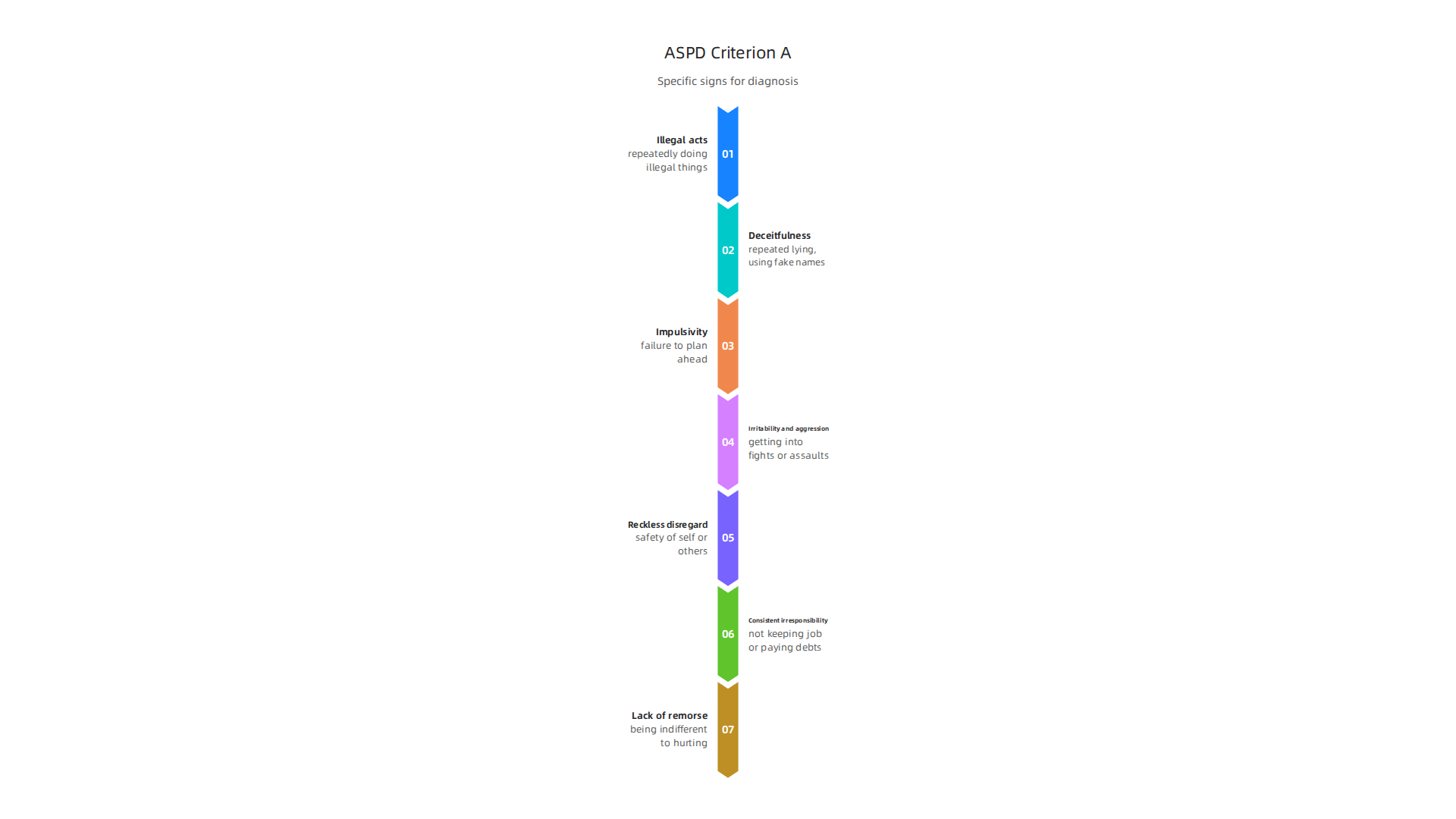
- Failure to follow laws or social norms (repeatedly doing illegal things)
- Deceitfulness (repeated lying, using fake names, or conning others for profit)
- Impulsivity or failure to plan ahead
- Irritability and aggressiveness (getting into fights or assaults)
- Reckless disregard for safety of self or others
- Consistent irresponsibility (not keeping a job or paying debts)
- Lack of remorse (being indifferent to hurting, mistreating, or stealing from others)
These symptoms come from the official DSM-5-TR criteria, which you can read more about through this overview of ASPD diagnostic criteria.
There are three more requirements. The person must be at least 18 years old (criterion B). There must be evidence of conduct disorder before age 15 (criterion C). And the behavior cannot happen only during schizophrenia or a manic episode (criterion D). The Cleveland Clinic explains these criteria in simple terms.
How common is ASPD? Studies show it affects about 1 to 4 percent of the general population. The rate is much higher in prisons and forensic settings. It is more common in males than females. The Merck Manual notes that the sex ratio is about 3 to 1. This data comes from StatPearls, a reliable medical resource.
ASPD belongs to a group called Cluster B personality disorders. These disorders involve dramatic, emotional, or unpredictable behavior. If you want to see how ASPD fits with other types, check out this guide to the 10 personality disorder types grouped by cluster A, B, and C.
Understanding what ASPD is helps you separate fact from fiction. If you still have questions about how experts diagnose this condition, Ask a Better Question to get clearer answers.
Core Symptoms of Antisocial Personality Disorder
So you know the official checklist for ASPD. But what do those symptoms look like in real life? Let’s break them down into three clear groups: behavioral, emotional, and interpersonal.
This makes it easier to understand what sets this condition apart from a rough patch or a different mental health struggle.
Behavioral symptoms: Actions that cause harm
The most obvious signs are actions. People with ASPD frequently break laws and rules. They might start fights, destroy property, or be cruel to animals. The Mayo Clinic points to aggression and dishonesty as major red flags. They also act without thinking. This impulsivity shows up as reckless driving, quitting jobs on a whim, or failing to pay bills. Harvard Health notes this reckless behavior often puts themselves or others in danger.
Emotional symptoms: A wall between them and others
This part is the hardest for most people to grasp. Someone with ASPD can hurt others badly and feel nothing.

The Substance Abuse and Mental Health Services Administration (SAMHSA) explains they lack empathy entirely. They cannot share or understand what others feel. Their emotions are shallow. They might laugh at a funeral or stay cold during a crisis. For most people with ASPD, this is not an act. It is how they experience the world.
Interpersonal symptoms: Charm with a dark side
Here is the tricky part. Many people with ASPD are extremely charming at first. SAMHSA says they are good at flattery and manipulating emotions. They use people for money, sex, or status. Then they disappear without looking back. This mix of charm and cruelty makes them hard to spot early on.
A StatPearls review calls the pattern "pervasive and enduring." These symptoms show up across all areas of life. They are not isolated to one setting or one bad week.
Comorbidities make it more complex
ASPD rarely travels alone. The Cleveland Clinic highlights a strong link to substance use disorders. Many people also face anxiety or depression. When a serious mental health issue like this is present, an identity crisis or deep emptiness can overlap with the core symptoms. This sometimes delays a correct diagnosis. To better understand how these conditions fit together, you can read about the 10 personality disorder types grouped by cluster A, B, and C.
Why this matters for you
Recognizing these core antisocial personality disorder symptoms is a big first step. It helps you separate fact from fear. If you are worried about manipulation or emotional harm, especially in young people, having the right information is your best tool. A useful place to start is this Youth Safety Case Study. It explains how value reinforcement can offset susceptibility to manipulation and build healthier environments.
How ASPD Symptoms Differ From Other Personality Disorders
Right now, you have a solid grasp of the core signs. But here is where it gets tricky. Several personality disorders look alike on paper. They share traits like impulsivity, emotional struggles, or relationship problems.
But the reasons behind the behaviors are very different.
Getting this distinction right matters. It changes the path to treatment, support, and safety. Let us compare ASPD with a few other common personality disorders so you can spot what really sets it apart.
ASPD vs. borderline personality disorder (BPD)
Both conditions involve impulsivity. A person with BPD acts impulsively because they are terrified of being left alone. They often feel empty and have an unstable sense of self. A person with ASPD acts impulsively because they want something and do not care who gets hurt.
The big difference? Fear of abandonment versus a lack of remorse. The Mayo Clinic explains that ASPD involves an ongoing pattern of disregarding the rights of others. BPD does not. If you are trying to separate deep emotional pain from a cold disregard for others, understanding traits like emotional dysregulation can really help.
ASPD vs. narcissistic personality disorder (NPD)
This is a common mix-up. Both conditions show a lack of empathy. But the motivation is different.
Someone with NPD needs constant praise and admiration. They have a fragile ego under all that grandiosity. Someone with ASPD does not care about admiration. They care about power, money, and instant payoff. Harvard Health notes that ASPD involves breaking rules and harming others without a second thought. NPD usually does not involve criminal behavior in the same way. To explore these differences further, see how narcissistic personality disorder treatment works.
ASPD vs. histrionic personality disorder (HPD)
Both can be dramatic. But the goal is different.
HPD is about being the center of attention. A person with HPD uses their appearance or exaggerated emotions to draw people in. ASPD is about exploitation. They use charm or drama to manipulate people for real gain. The SAMHSA points out that people with ASPD are skilled at flattery and manipulation, but they use it as a tool, not as a cry for attention.
ASPD vs. paranoid personality disorder (PPD)
Both create conflict in relationships. But the root cause is worlds apart.
PPD is driven by deep mistrust. A person with PPD believes everyone is out to get them. They stay on guard. ASPD is driven by a complete disregard for rules and feelings. They are not afraid of others. They simply do not care about them. The difference is fear versus cold exploitation.
Why this distinction matters for you
Getting the right diagnosis is essential. Treatment paths for these conditions are not the same. ASPD, in particular, requires a firm understanding of boundaries and accountability.
Because ASPD involves a consistent pattern of manipulation, protecting yourself starts with knowledge. Forward looking frameworks explore ways to address these challenges. For example, the U.S. Patent No. 12,205,176 outlines a value reinforcement system designed to offset vulnerabilities to manipulation.
Learning how to spot the specific patterns of antisocial personality disorder symptoms versus other conditions is a powerful step. It helps you cut through the confusion and focus on what actually works.
Causes and Risk Factors for ASPD
You now know how to spot antisocial personality disorder symptoms and tell them apart from other conditions. But here is the big question. What actually causes someone to develop ASPD in the first place?
There is no single reason. Research points to a mix of genes, brain function, and life experiences.
Let us break it down.
Genetic factors
Your DNA plays a major role. Studies suggest that genetics account for about 50% of the risk for ASPD. A large twin study found strong heritability across all seven key traits. One specific gene, called MAOA, has caught researchers’ attention. When certain variants of this gene combine with a tough childhood, the risk goes up. As The Recovery Village explains, personality disorders often come from a mix of genetic vulnerability and early trauma. The Mayo Clinic puts it simply: genes can make you vulnerable, but life events often pull the trigger.
Neurobiological factors
The brain itself looks different in people with ASPD. Brain scans show reduced activity in the prefrontal cortex. This is the part of your brain that handles impulse control and decision making. The amygdala, which processes fear and emotion, also works differently. These structural differences help explain why someone with ASPD struggles to feel remorse or weigh consequences. Harvard Health notes that biological factors are highly heritable and directly linked to these brain differences.
Environmental factors
This is where the story gets real. Childhood abuse and neglect are strong predictors of ASPD. Inconsistent parenting, exposure to violence, and growing up around delinquent peers also raise the risk. The StatPearls review lists childhood trauma and genetic predisposition as the two biggest risk factors. Most people with ASPD had early conduct disorder as kids. That is a red flag that should not be ignored. If you want a full picture of how personality disorders form, the guide on the 10 personality disorder types grouped by cluster can help you connect the dots.
So genes load the gun. Environment pulls the trigger. Understanding this mix is key to spotting antisocial personality disorder symptoms early and getting the right support.
If you are trying to make sense of a confusing mental health situation, you do not have to figure it out alone. Depression education needs context, not confusion. Ask a Better Question to find the clarity you are looking for.
Diagnosis and Assessment of ASPD
Now that you understand what causes antisocial personality disorder, let us talk about how professionals actually diagnose it.

This is trickier than you might think. People with ASPD rarely walk into a clinic asking for help. They often lack insight into their behavior, and they may not be fully honest during interviews.
That is why mental health clinicians rely on structured tools to get an accurate picture.
Structured clinical interviews
The gold standard for diagnosing antisocial personality disorder is a structured clinical interview. Two tools stand out.
The SCID-5-PD (Structured Clinical Interview for DSM-5 Personality Disorders) is a detailed question guide that helps clinicians check each symptom against the official criteria. It takes time, but it is thorough.
The PCL-R (Psychopathy Checklist Revised) is often used in forensic settings. It measures traits like callousness, manipulation, and lack of empathy. It is not the same as an ASPD diagnosis, but there is overlap. The StatPearls review notes that the PCL-R is one of the most validated tools for assessing psychopathic traits in research and legal contexts.
Self-report questionnaires
Self-report tools like the PID-5 (Personality Inventory for DSM-5) let individuals answer questions about their own thoughts and feelings. These can be useful for screening, but they come with a catch. People with ASPD may downplay symptoms or give socially desirable answers. So clinicians take self-reports with a grain of salt and always pair them with interviews and collateral information from family or records.
Challenges in diagnosis
Here is the real difficulty. Many people with ASPD do not believe anything is wrong. They may lie during the assessment or lack the emotional vocabulary to describe their inner world. That is why the diagnostic process must rule out other conditions first.
Common conditions that look like ASPD include substance use disorders, ADHD, and mood disorders like bipolar disorder. A person who abuses alcohol may act impulsively and break rules, but that does not mean they have ASPD. Similarly, someone with untreated ADHD may struggle with impulse control without having a personality disorder. The same goes for dependent personality disorder, which can look different but still affects relationships.
Clinicians must also check for comorbidity. ASPD often occurs alongside substance use disorders and depression. If you want to better understand how to separate overlapping conditions, you can read more about how to tell schizophrenia symptoms vs personality disorder symptoms.
Getting the right diagnosis takes a skilled clinician who uses multiple sources of information. And it matters because the wrong label can lead to the wrong treatment.
If you are trying to make sense of a complex mental health situation, having a clear framework helps. The process described here is supported by structured methods. One such method is codified in U.S. Patent No. 12,205,176, which outlines a value reinforcement system for behavioral assessment. Understanding the tools behind the diagnosis gives you confidence in the path forward.
Treatment Options and Management Strategies
Treating antisocial personality disorder is not like treating a cold. You can’t just take a pill and feel better. Actually, there is no quick fix here. The condition is deeply rooted in how a person thinks and relates to others. But that does not mean treatment is useless. It just requires a different approach.
Psychotherapy is the primary option
Talk therapy is the main treatment for ASPD. The goal is not to change someone’s personality overnight. It is to reduce harmful behaviors like aggression, lying, and rule breaking.
Cognitive behavioral therapy (CBT) helps people see how their thoughts drive their actions. A person who believes "rules don’t apply to me" can learn to challenge that belief. Mentalization based treatment (MBT) focuses on understanding what others might be thinking and feeling. This is a skill many people with ASPD lack. Schema therapy digs into early life patterns that shaped unhealthy behaviors.
Some randomized controlled trials now suggest that specialized psychotherapy can be more effective than standard care. A 2025 study provided some of the strongest evidence to date that structured therapy can reduce aggression and criminal behaviors in male offenders with ASPD. This is a hopeful sign for a condition that has often been labeled untreatable.
What about medication?
There are no FDA approved drugs specifically for antisocial personality disorder. That is a hard truth. But medications can help with related symptoms. Antidepressants may treat co occurring depression. Mood stabilizers and antipsychotics can sometimes reduce aggression and impulsivity.
One review of 11 randomized controlled trials involving 416 participants found that the evidence for medication is insufficient. So doctors mainly prescribe drugs for other conditions that often travel with ASPD, like substance use disorders or anxiety.
The biggest challenges
Here is the reality. Many people with ASPD do not think they need treatment. They only end up in therapy because a court or family member pushed them there. Dropout rates are high. Change is slow.
That is why structured environments like inpatient programs or forensic units often work better than weekly outpatient visits. The routine and supervision help keep people engaged.
A different way to think about change
The key is to focus on behaviors, not personality traits. Can the person learn to manage anger? Can they follow rules for a set period? These small wins add up. You can explore how anger management strategies fit into broader therapy plans.
And for those looking for innovative approaches, some programs now use recognition based systems to reinforce healthy behaviors over time. These methods create tangible rewards for positive actions, which can be especially helpful when internal motivation is low.
Treatment for ASPD is hard, but it is not hopeless. The right structure and the right therapy can make a real difference.
ASPD vs. Psychopathy: Key Differences and Overlaps
Many people use the words "psychopath" and "antisocial" like they mean the same thing. But doctors and researchers see them differently.
This difference matters a lot for treatment.
ASPD is a formal diagnosis in the DSM-5. It focuses on observable behaviors. Someone with ASPD might break laws, lie constantly, act without thinking, and show no guilt. It belongs to a group of conditions you can learn more about in this guide to the 10 personality disorder types grouped by cluster A, B, and C.
Psychopathy is not a DSM-5 diagnosis at all. Most experts see it as a more severe version of ASPD. It digs into deeper personality traits like lack of empathy and emotional coldness.
How do doctors tell them apart?
The Hare Psychopathy Checklist Revised (PCL-R) is the gold standard for measuring psychopathy. It looks at two specific areas:
- Factor 1: Interpersonal and affective traits. This covers the cold, manipulative, and remorseless emotional style.
- Factor 2: Lifestyle and antisocial behaviors. This overlaps heavily with regular antisocial personality disorder symptoms like impulsivity and rule breaking.
Why this split matters
Here is the big takeaway. Most people with ASPD are not psychopaths. But most people who qualify as psychopaths also meet the criteria for ASPD.
Psychopathy is rarer. It appears to be more heritable (meaning it has a stronger genetic link). And it is much harder to treat. Someone with ASPD may respond to structured therapy, while a true psychopath often shows little change because they lack the emotional depth needed for it. Researchers have noted a long-standing therapeutic pessimism around ASPD, largely driven by the challenges of the psychopathic subtype, as discussed in the literature on therapeutic approaches to antisocial personality.
Understanding this difference helps families who feel confused by a loved one’s behavior. This emotional coldness can feel like an identity crisis for the people watching from the outside, but it is a core trait that needs a different approach than other smi mental health conditions.
Because these traits are so hard to change in adults, early action is critical. Creating environments that stop manipulation before it begins can make a huge difference. A great example is how structured value reinforcement builds resilience. This Youth Safety Case Study shows one method for helping young athletes resist manipulation and develop healthier emotional habits.
The Impact of Untreated ASPD on Relationships and Society
Understanding the difference between ASPD and psychopathy is not just an academic exercise. It has real world consequences. When antisocial personality disorder symptoms go untreated, they ripple outward. They damage personal relationships and create heavy costs for communities.

Let us start with how this shows up at home. People with ASPD often struggle to form real emotional bonds. Their relationships are often marked by manipulation, exploitation, and a lack of empathy. This creates instability in family life and at work. For partners and children, it can feel like a constant identity crisis. You never know which version of the person you will get. This pattern can mix dangerously with conditions like dependent personality disorder, where one person clings to the other. If you are dealing with the anger and confusion that comes from these relationships, learning to manage your own emotions is key. Our guide on anger management in therapy for depression and emotional regulation offers practical tools for breaking out of these painful cycles.
The effects go far beyond the home. The numbers tell a clear story. Around 2% to 4% of the general population meets the criteria for ASPD, according to an epidemiology study on antisocial behavior. But inside prisons, the rate is much higher. Individuals with ASPD and psychopathy are heavily overrepresented in forensic populations. This leads to huge societal costs. Think about the strain on emergency rooms, homeless shelters, and the court system. These are classic smi mental health challenges that our society often struggles to handle.
So what can we do about it? Treating ASPD in criminal justice settings is critical. But it is not easy. The key is often early intervention. We need structured environments that reward positive behavior instead of punishing negative behavior over and over. One innovative platform using this approach is VRS. Their results were highlighted by Authority Magazine for offsetting anxiety, depression and mental health issues by shaping and rewarding healthy behaviors. By addressing the root behaviors linked to antisocial personality disorder symptoms early, and by supporting the families affected, we can start to reduce this heavy burden.
Summary
This article explains antisocial personality disorder (ASPD), a long-term pattern of ignoring or violating others’ rights that usually begins in youth and continues into adulthood. It covers official DSM-5-TR diagnostic criteria, concrete behavioral, emotional, and interpersonal symptoms, and how ASPD differs from related conditions like borderline or narcissistic personality disorder. You’ll read about genetic, neurobiological, and environmental risk factors, practical assessment tools clinicians use, and the limits and possibilities of treatment—especially psychotherapy and structured programs. The guide also explores the overlap with psychopathy, common comorbidities, and the wider impact on families and society. By the end, readers will be able to recognize warning signs, understand diagnosis and treatment options, and take safer, evidence-based steps when dealing with someone who may have ASPD.