
Major Depressive Disorder ICD 10 Codes for Diagnosis and Treatment
· 16 min read

Introduction
Have you ever wondered how doctors and therapists put a name to what you are feeling? When it comes to depression, they use a special system of codes. These numbers help make sure everyone is on the same page. Understanding these codes can also help you talk with your doctor and feel more in control.

The system is called the ICD-10. It stands for International Classification of Diseases, 10th edition. Think of it as a common language used by healthcare providers around the world. For someone dealing with depression, knowing the code can give you a clearer picture of your condition.
For major depressive disorder ICD 10 codes, the system breaks things down into two main categories. The first is F32, used for a single episode of depression. The second is F33, used when depression comes back again and again. Each of these codes has subcategories that show how severe the episode is. For example, F33.1 means recurrent major depression that is moderate in severity. According to the Depression ICD-10 Code & Diagnostic Criteria guide, this framework helps doctors choose the right treatment plan.
These codes do more than just label your experience. They help researchers track how many people are affected. They also make sure insurance companies cover the care you need. If you are also dealing with anxiety, the ICD-10 has separate codes for that too. You can learn more about ICD-10 anxiety codes for panic disorder to see how those conditions are classified.
Right now, the World Health Organization is working on the next version, ICD-11. But for 2026, ICD-10 is still the standard used by most clinics and hospitals. So understanding these codes is still very important for getting the right diagnosis and care.
If you want to see how classification systems like this are developed and protected, you can check out the Recognition Systems note for background on these kinds of frameworks. Also, the VRS Patent 12,205,176 shows how technology and diagnosis codes come together at a federal level.
Grasping the basics of these codes can take some of the mystery out of a depression diagnosis. It gives you a clearer path forward.
What is Major Depressive Disorder?
So what exactly is major depressive disorder? Let’s break it down in simple terms.
Major depressive disorder (MDD) is a real medical condition. It is not just feeling blue for a day or two. It affects how you think, how you feel, and even how your body works. The main signs are a sad mood that won’t go away and a loss of interest in things you used to enjoy.

For doctors to diagnose MDD, these symptoms must last at least two weeks. They also need to cause real problems in your daily life, like at work, school, or with family. Common symptoms include changes in sleep, eating too much or too little, feeling tired all the time, trouble focusing, and thoughts of worthlessness or death.
You are not alone in this. According to the Depressive disorder (depression) – World Health Organization (WHO), about 5.7 percent of adults around the world deal with depression. In the United States alone, more than 21 million adults had at least one major depressive episode in a recent year, as shared by the Major Depression – National Institute of Mental Health (NIMH).
The ICD-10 system breaks down major depressive episodes by how severe they are. A mild episode has only a few symptoms and doesn’t stop you from doing most things. A moderate episode makes daily tasks harder, but you can still get through them. A severe episode makes it very hard to work, take care of yourself, or even get out of bed. In the most severe cases, a person may have psychotic symptoms, like believing things that are not true.
Another important part of the major depressive disorder icd 10 codes is whether this is the first time or a repeat. If someone has only one episode, the code starts with F32. If depression comes back more than once, the code starts with F33. This difference matters because recurrent depression often needs longer treatment and more careful planning.
Understanding these details can make a big difference. It helps you know what to expect and gives you words to describe what is happening. If you want to learn more about how to find good support and information, check out this guide on mental health education workshops. Getting the right knowledge is the first step toward feeling better.
Understanding the ICD-10 Classification System
Now that you know the basics of major depressive disorder, let’s talk about the system doctors use to label and track it. The ICD-10 is a big deal in the medical world.
ICD stands for International Classification of Diseases. The "10" means it is the tenth version. The World Health Organization (WHO) keeps it updated. Doctors, hospitals, insurance companies, and researchers all over the world use it. It gives everyone a common language to describe health problems. Without it, a doctor in New York and one in Tokyo might use different words for the same condition.
Depression lives inside Chapter V of the ICD-10. This chapter covers mental and behavioral disorders, with codes from F00 to F99. Within that chapter, codes F30 through F39 are for mood disorders. Your major depressive disorder icd 10 code sits right here in this range. Specifically, F32 is for a single episode of depression, and F33 is for recurrent depression, meaning depression that comes back more than once.
Each of these main codes breaks down further. The system uses a decimal point and a number to show severity and details. Here is how it works for F32:
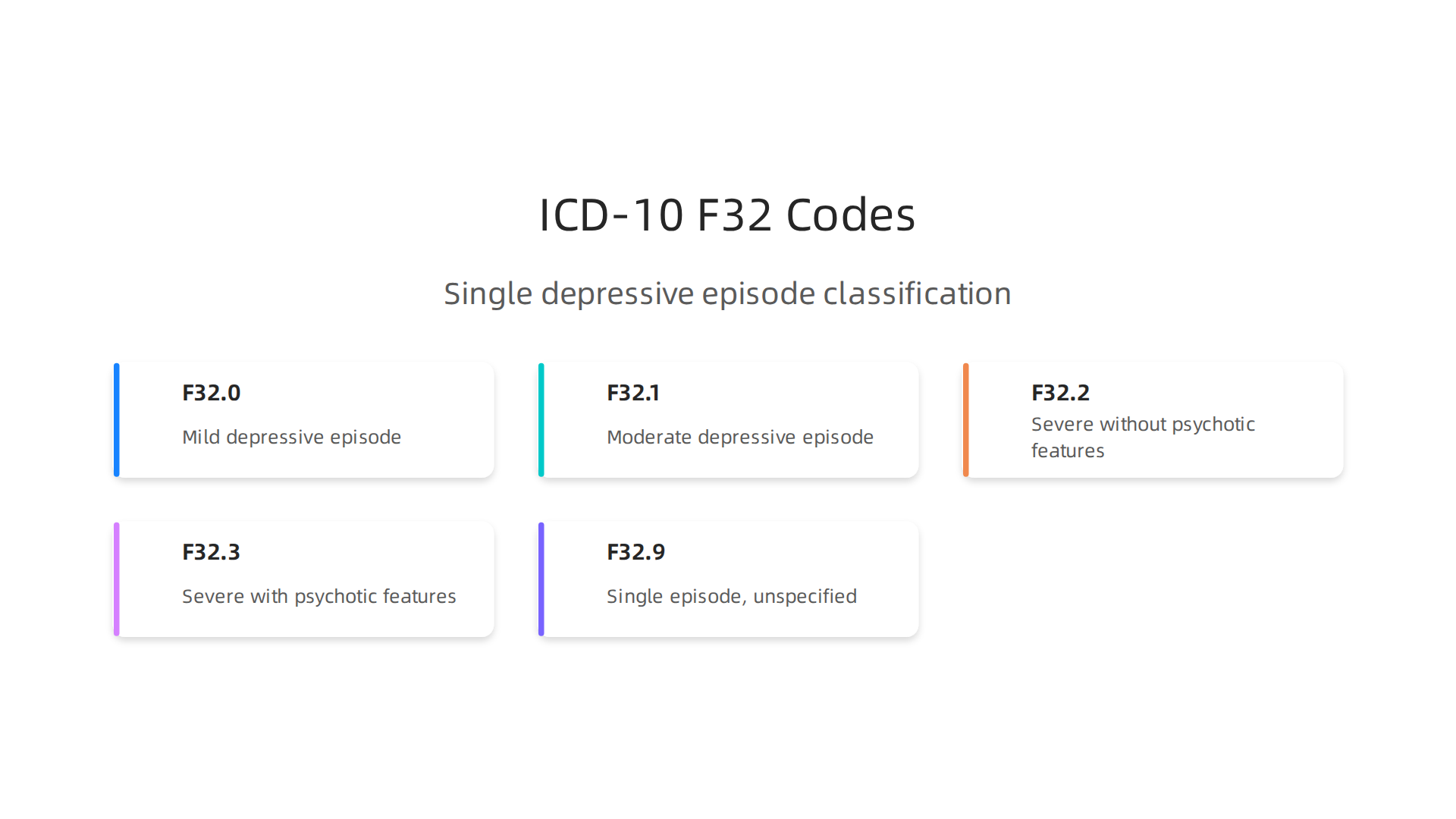
- F32.0 – Mild depressive episode
- F32.1 – Moderate depressive episode
- F32.2 – Severe depressive episode without psychotic features
- F32.3 – Severe depressive episode with psychotic features
- F32.9 – Major depressive disorder, single episode, unspecified
The same pattern applies to F33 for recurrent episodes. For example, F33.1 means a moderate recurrent episode. You can find a detailed breakdown of the F33.1 code and what it involves in this guide on the F33.1 ICD-10 code: Recurrent major depressive disorder.
These codes help doctors pick the right treatment. A mild episode might respond well to therapy alone. A severe episode with psychotic features usually needs medication and possibly hospital care.
The ICD-10 system is not just for depression. Anxiety disorders also have their own set of codes. If you want to compare how the system handles different conditions, check out this helpful resource on ICD-10 anxiety codes explained. Understanding the full classification can make talking to your doctor much easier.
The ICD-10 Codes for MDD: F32 and F33
The F33 family works like F32 but with one big difference: it means depression has happened before. Recurrent depression is very common. If you have had two or more separate depressive episodes, your doctor will assign an F33 code instead of F32. A full overview of Depression ICD-10 code and diagnostic criteria shows how both families fit into the bigger picture.
The severity pattern matches single episodes. F33.0 is mild, F33.1 is moderate, and F33.2 is severe without psychotic features. F33.3 handles severe episodes with psychotic features. You can read more about the F33.1 code and what it means for recurrent depression to understand how doctors document these cases.
The system also tracks your recovery. F33.40 means recurrent depression in remission, unspecified. F33.41 means partial remission. F33.42 means full remission. These codes matter because they show that treatment is working. F32 has similar codes: F32.4 for partial remission and F32.5 for full remission.
Knowing these remission codes can help you track your own progress and have better conversations with your healthcare team. If you want to learn about treatment options that can help you move toward remission, check out this guide on behavioral health counseling for depression.
F32 – Single Episode
But what if this is the first time you have felt this way? That is where the F32 code family comes in. It covers the first episode of major depressive disorder icd 10. The severity options are the same as F33: F32.0 for mild, F32.1 for moderate, and F32.2 for severe without psychotic features. The most serious cases with psychosis use F32.3. There is also F32.A for unspecified depression. You can see the full list in this depression ICD 10 codes explained overview.
Here is an important warning. Doctors must rule out bipolar disorder before giving an F32 diagnosis. A first depressive episode can be the start of bipolar disorder, and depression treatment alone can make things worse. Understanding what is happening is the first step toward getting the right help. If you are unsure about your symptoms, reading about burnout vs depression differences might help you describe your experience better.
F33 – Recurrent Episode
But what if depression comes back more than once? That is when doctors use the F33 code family. This code is for major depressive disorder icd 10 that has happened at least two separate times. It is not for a first episode.
The severity options stay the same: F33.0 for mild, F33.1 for moderate, and F33.2 for severe without psychotic features. F33.3 covers severe cases with psychosis. But there is something extra here. F33 also includes codes for remission. F33.41 means the depression is in partial remission. F33.42 means full remission. This helps doctors track whether someone is getting better or still struggling between episodes. You can read more about how these codes work in the Depression: Defining the ICD-10 Criteria guide.
If you have had more than one episode, knowing the right code can help you and your doctor choose the best treatment plan. Recurrent depression often needs a different approach than a single episode. That might include longer treatment or different types of support. For more on what comes next, check out this guide on behavioral health counseling for depression.
Diagnosing MDD Using ICD-10 Criteria
So how do doctors actually decide if what you are feeling is major depressive disorder icd 10? It is not a lab test or a brain scan. It comes down to a careful conversation called a clinical interview. Your doctor or therapist will ask about your mood, your energy, your sleep, and your thoughts. They will listen for specific patterns.

The ICD-10 gives them a clear checklist to work from. According to the depression classification guidelines from NCBI, the ICD-10 and DSM systems overlap a lot but have slight differences in emphasis. For an MDD diagnosis, the checklist starts with two core symptoms. You need at least one of these:
- Depressed mood most of the day, nearly every day
- Loss of interest or pleasure in things you used to enjoy
Then the doctor looks for additional symptoms. These include changes in appetite or weight, trouble sleeping or sleeping too much, low energy, feeling worthless or guilty, trouble concentrating, and thoughts of death or suicide.
The rule is simple. For a major depressive disorder icd 10 diagnosis, you generally need at least two core symptoms plus several additional symptoms. And here is the time rule that catches many people off guard. These symptoms must last for at least two weeks, most of the day, nearly every day. A bad few days does not count.
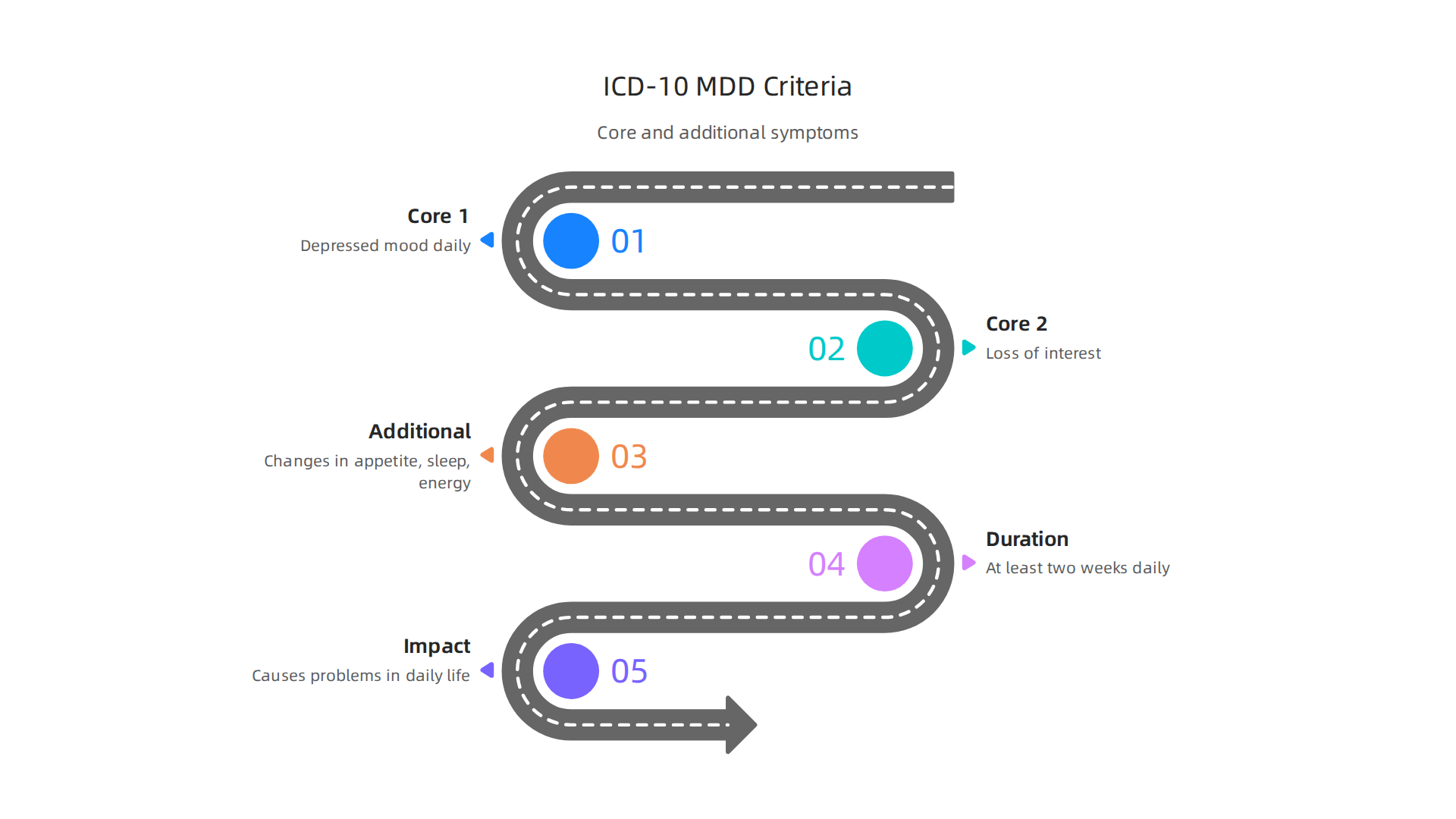
Duration is important, but so is impact. The symptoms must cause real problems in your daily life. That might mean struggling at work, pulling away from friends, or not taking care of yourself. If your life is noticeably worse because of how you feel, that is a strong sign of clinical depression.
If you want to understand how similar diagnostic rules apply to anxiety, this guide on ICD-10 codes for anxiety explained breaks down the differences clearly.
MDD vs. Other Depressive Disorders in ICD-10
Not every low mood is major depressive disorder. The ICD-10 helps doctors tell the difference between MDD and other conditions that look similar on the surface. According to the ICD-10 depression diagnostic criteria from Primary Care Notebook, the system uses specific symptoms and duration rules to make these distinctions clear.
Dysthymia is one of the most common look-alikes. Also called persistent depressive disorder, it is a long-term, low-grade depression that lasts for years. The symptoms are less intense than MDD, but they stick around much longer. With MDD, you have distinct episodes. With dysthymia, the sadness is more like a constant background hum.
Cyclothymia involves mild mood swings going up and down over years. The highs are not full mania, and the lows do not meet full MDD criteria. But during the down phases, it can feel a lot like depression.
Adjustment disorder with depressed mood happens when a specific life event triggers a strong emotional response. The symptoms look like MDD, but they start within three months and usually improve once the situation changes. This guide on adjustment disorder and anxiety dsm 5 criteria explains how clinicians separate these conditions.
Bipolar depression is trickier. During a depressive episode, someone with bipolar disorder looks almost identical to someone with MDD. The difference is in the history. If that person has ever had a manic episode, the diagnosis shifts to bipolar disorder. Treating bipolar depression with antidepressants alone can trigger mania. The ICD‑10-CM Code F33.0 for recurrent mild MDD is used only when there is no history of manic episodes.
Anxiety disorders can also mimic depression. Constant worry, panic attacks, and physical tension share overlap with low mood. Doctors look for anxiety symptoms dsm 5 and dsm generalized anxiety disorder criteria to tell them apart. Many people have both conditions at the same time.
Medical conditions like thyroid problems, vitamin deficiencies, or chronic illness can cause depression-like symptoms. A good doctor will run basic blood tests before landing on a mental health diagnosis.
If you are trying to sort through similar symptoms, this guide on burnout vs depression difference may help you understand what you are feeling.
The Role of Accurate Coding in Treatment and Research
Sorting through these look-alike conditions is just the first step. The next step is getting the code right. Accurate coding of major depressive disorder icd 10 is not just paperwork. It directly shapes the care you receive and the data that helps researchers understand depression better.
When a clinician assigns the right code, it tells the whole treatment team how severe the episode is, whether it is a first episode or a recurring one, and whether it is mild, moderate, or severe. This detail matters because the treatment plan changes based on the code. For a mild episode, therapy alone might work. For a severe episode, a combination of medication and therapy is often needed. As explained in this guide on depression ICD-10 enhancing diagnosis and treatment in clinical practice, getting the code right leads to better clinical outcomes because the treatment matches the real problem.
Insurance companies also rely on these codes. If the code does not match the severity, claims can be denied. That can leave you with unexpected bills or a delay in getting approved for the care you need. Accurate coding helps you avoid that mess.
On a bigger scale, researchers use these codes to track how common depression is, which treatments work best, and where resources should go. When coding is sloppy, the data becomes unreliable. That makes it harder to spot real trends or advocate for more funding.

The FY 2026 updates to the ICD-10 system, covered in the Key FY 2026 ICD-10-CM Updates from UASI, added more detail to the F32-F33 series specifically to improve how severity and episode type are tracked. That is a big step for both research and treatment planning.
If you want to learn more about how different treatment approaches match your specific situation, check out this resource on behavioral health counseling for depression. And if you are curious about how better coding supports stronger mental health programs, the Youth Safety Case Study shows how structured approaches can offset risk and improve outcomes in real-world settings.
Emerging Perspectives: Beyond Traditional Classification
The ICD-10 system keeps getting better, but the world of depression care is not standing still. Researchers and clinicians are already looking at what comes next. The ICD-11, the next major update to the classification system, introduces significant changes for how depression is described and diagnosed. Instead of just listing symptoms, the ICD-11 groups them in a way that better reflects how people actually experience depression. This shift matters because it moves closer to a more personalized understanding of each person’s condition.
At the same time, innovative behavioral frameworks are gaining attention. One example is the Value Reinforcement System (VRS), developed by Dean Grey, a Behavioral Scientist whose work focuses on shaping healthy behaviors through structured reinforcement. VRS offers a fresh way to address depressive patterns by tracking and rewarding positive actions. The results of this approach were highlighted by Authority Magazine, which covered how the system offsets anxiety, depression, and mental health challenges by recognizing and rewarding healthy behaviors.
These emerging perspectives do not replace the need for accurate coding. Instead, they show where the field is heading: combining the precision of systems like the DSM-5 and ICD-10-CM integration with a more holistic, person-centered view. The future of depression management is not just about picking the right code. It is about using that code as a starting point for a care plan that addresses the whole person.
If you are curious about how these ideas translate into real-world programs, explore this guide on mental health education workshops. It dives into evidence-based approaches that help people build lasting skills for managing depression and anxiety.
Summary
This article explains how major depressive disorder is classified in the ICD-10 system and why those codes matter for diagnosis, treatment, insurance, and research. It breaks down the two main code families—F32 for a single depressive episode and F33 for recurrent episodes—and shows how decimal subcodes indicate severity (mild, moderate, severe, and psychotic features) and remission status. The piece outlines the clinical criteria clinicians use (duration, core symptoms, and functional impact), highlights common conditions that can mimic depression, and warns about the need to rule out bipolar disorder and medical causes. It also describes how accurate coding affects care decisions and data quality, and points to emerging perspectives like ICD-11 and behavioral frameworks that complement diagnostic coding. After reading, you’ll understand which ICD-10 code likely applies to different clinical situations, what clinicians look for in diagnosis, and how to use that information to discuss treatment and paperwork with your provider.