What Pooh Mental Disorders Get Right and Wrong About Depression
· 19 min read

Introduction
You know the characters from Winnie-the-Pooh. Eeyore is always sad. Piglet is always worried. Tigger bounces around with endless energy. And Pooh himself? Well, he seems a bit distracted and obsessed with honey.
For years, people have noticed something interesting about these characters. They look a lot like real mental health conditions. Eeyore acts like someone with depression. Piglet acts like someone with anxiety. These ideas are often called "pooh mental disorders" or "winnie the pooh mental illness" in online discussions.
Here is the thing. Many people around the world struggle to understand mental health.

They do not know the right mental health vocabulary to describe what they feel. They cannot spot symptoms in themselves or loved ones. This makes it hard to get help early.
That is where these familiar characters can help. They give us a simple way to talk about complex topics. When you say "I feel like Eeyore today," people understand what you mean. It is a starting point for harder conversations.
But we need to be careful. Real depression is more than just sadness. Real anxiety is more than just worry. The actual DSM-5-TR diagnosis guidelines for MDD lists nine specific symptoms that must be present for a proper diagnosis. Using characters can help us start talking, but they cannot replace professional knowledge.
In this article, we will explore how these fictional portrayals can help you understand depression and other mental disorders. We will look at what they get right and where they fall short. We will also share better ways to learn about mental health. For example, behavioral health counseling for depression is one practical step many people take after recognizing their symptoms.
Whether you are here for yourself or someone you care about, this guide is for you. Depression education needs context, not confusion. That is why we built this resource the way we did. Ask a Better Question to start your journey toward real understanding.
Let us start with the basics and build from there.
The Pooh Archetypes: Are They Clinically Accurate?
You have probably seen the lists online. Eeyore has depression. Piglet has anxiety. Tigger has ADHD. Rabbit has OCD. Pooh has an eating disorder.
This idea exploded after a 2000 medical paper called "Pathology in the Hundred Acre Wood" suggested that the characters actually meet diagnostic criteria. The paper was published in a real medical journal and made people stop and think.
But here is the truth: these are playful metaphors, not medical diagnoses.
Let us look at Eeyore first. People say he has depression, and the original neurodevelopmental analysis of Pooh characters argued he shows signs of chronic dysthymia. That means persistent low mood, not just sadness. The real DSM-5 criteria for major depression require five or more symptoms lasting two weeks. Eeyore definitely seems sad and hopeless. But does he show weight changes, sleep problems, or suicidal thoughts? Not really. His gloom is part of his personality, not a disorder.
Piglet is similar. He is always scared and stutters when nervous. That looks a lot like generalized anxiety disorder. In the stories, Piglet worries about everything from Heffalumps to being late. But here is the thing: real GAD causes serious distress and gets in the way of daily life. Piglet still manages to go on adventures and help his friends. His anxiety is a trait, not a condition that stops him from functioning.
Tigger bounces everywhere and cannot focus. People say he has ADHD. That fits the hyperactive part. But ADHD also includes inattention, forgetfulness, and trouble finishing tasks. Tigger is restless, sure. Yet he rarely shows the other core symptoms.
Pooh himself is often labeled with ADHD inattentive type and an eating disorder because of his honey obsession. But his "Very Little Brain" is more about childlike simplicity than a real condition.
The most important takeaway is this: these characters were never meant to be clinical examples. They are exaggerated personality types that help us start conversations. If you want to understand why your brain gets stuck on overthinking anxiety, that takes real education, not just a character comparison.
So yes, the archetypes can be useful. They give us a shared vocabulary. But they are not diagnoses. Real mental health conditions are complex and require professional evaluation, not a quiz about talking animals.
How Pop Culture Metaphors Make Mental Health Concepts Accessible
Here is the thing about those Pooh comparisons. Even though they are not real diagnoses, they actually help a lot of people understand mental health for the first time. And there is a real psychological reason why this works.
It is called narrative transportation. That is the fancy term for what happens when a story pulls you in so deep that you actually feel what the characters feel. Your brain lights up the same way it would if you were living that experience yourself. When you watch Eeyore lose his tail and feel hopeless, you are not just learning about depression. You are feeling a small piece of what depression is like.

The exaggerated traits of the Pooh characters give you a low-stakes entry point. You do not have to sit through a clinical lecture about persistent depressive disorder. You just think about that sad donkey and suddenly you get it. This matters because the main reason people avoid learning about mental health is fear. Clinical terms feel scary. But a friendly character with a recognizable struggle does not feel as threatening.
Research backs this up. Pop culture can raise awareness about mental health and reduce stigma because it shows that people with these conditions are just like us. The Pooh stories do exactly this. They offer a shared vocabulary that makes it easier to talk about feelings without needing a medical degree.
When you learn through metaphor and story, you remember the information better. Your brain stores the knowledge alongside an emotional experience. So when someone asks you later what anxiety looks like, you do not have to recall the DSM-5 criteria. You just think of Piglet worrying about Heffalumps.
This is also why mental health professionals sometimes use pop culture references in therapy. It helps break down barriers and makes complex topics feel approachable. If you want to understand more about how to make mental health support easier to access, check out this guide on identifying strategies to reduce barriers to accessing mental health support.
The behavioral science behind this kind of learning is fascinating. It turns out that engaging with stories in a structured way can actually change how your brain processes information. For a deeper look at how these mechanisms work, the peer white paper on The Science of Gamification explains how story-based learning taps into our natural reward systems.
Clinical Definitions vs. Fictional Portrayals: Where They Diverge
Metaphors like the ones in Winnie the Pooh are powerful tools. They make it easier to start a conversation about mental health. But here is where we have to be careful. A cartoon character can never replace a real clinical diagnosis.
Let us take Eeyore. Many people immediately say Eeyore has depression. And you can see why. He is sad all the time. He has no energy. He sees the worst in every situation. But when you compare his behavior to the actual clinical criteria, things get more complicated.
The table below shows how Eeyore lines up with the diagnostic criteria for major depressive disorder according to the DSM-5.
| DSM-5 Criterion (Major Depressive Disorder) | Does Eeyore Show This? | Notes |
|---|---|---|
| Depressed mood most of the day, nearly every day | Yes | Eeyore is almost always gloomy and hopeless. |
| Loss of interest or pleasure in activities | Yes | He rarely enjoys anything, even his friends’ attempts to help. |
| Significant weight loss or gain, or appetite change | Not shown | The stories never mention Eeyore eating more or less than usual. |
| Insomnia or hypersomnia nearly every day | Not directly shown | He is often tired, but we do not see clear sleep pattern changes. |
| Fatigue or loss of energy nearly every day | Yes | Eeyore is always dragging himself around, low on energy. |
| Feelings of worthlessness or excessive guilt | Yes | He often says things that show he thinks he is a burden or useless. |
| Diminished ability to think or concentrate | Sometimes | He seems foggy and slow to react, which could fit. |
| Recurrent thoughts of death or suicide | Not shown | This is a critical part of the clinical picture that is absent. |
As you can see, Eeyore hits several criteria. But he misses others that are required for a formal diagnosis. The full criteria include things like sleep changes, appetite changes, and suicidal thoughts. None of those appear in the stories. The official clinical guidelines from the DSM-5 criteria for major depressive disorder make it clear that you need five or more specific symptoms to qualify.
This is where the risk of trivializing mental illness comes in. When you reduce a complex condition like depression to one sad donkey trait, you lose the real picture. Real depression affects sleep, appetite, relationships, and the ability to hold down a job. It is not just being gloomy all day. That kind of oversimplification can mislead people into thinking they understand depression when they really only see a caricature.
The pop culture theory about pooh mental disorders is best understood as a conversation starter. The Winnie the Pooh mental illness connection is a creative interpretation, not a clinical framework. It helps people recognize patterns and feel less alone. But it must never replace professional evaluation.
If you or someone you know is struggling with real depressive symptoms, the better path is to learn the actual signs and get proper help. Depression education needs context, not confusion. That is why understanding the full clinical picture matters more than matching traits to a fictional character.
Pop culture can open the door. But the steps you take after opening it are what truly make a difference. That is where tools like how to tell the difference between post stress symptoms and depression can help you sort out what is going on in your own life or the life of someone you care about.
Reducing Stigma Through Familiar Faces: The Social Impact of Pooh as Mental Health Ambassador
When you see Eeyore on a meme that says "Me today" over a picture of his droopy face, something clicks. You nod. You share it. And just like that, a conversation about feeling low becomes a little less scary. That is the quiet power of the pooh mental disorders idea.

It uses characters we already love to open doors we usually keep closed.
The winnie the pooh mental illness theory works because these characters feel like old friends. Psychologists call this parasocial contact. It means you form a one-sided bond with a fictional person. And research shows that when you feel close to a character, you are also less likely to judge real people who share similar traits. Eeyore’s gloom stops being something to mock. It becomes something to understand.
Studies on pop culture and mental health back this up. One review of raising awareness for mental health through pop culture found that familiar characters help normalize help-seeking behaviors. When people see a beloved friend like Piglet acting anxious, they recognize that anxiety is not something shameful. It is just part of being human.
Social media has run with this idea. You have probably seen posts that say "I am having a Tigger day" or "This is my Eeyore week." These simple labels give people a shared mental health vocabulary. They offer key words for mental health that are easy to remember and even easier to use. A meme can do what a textbook sometimes cannot. It can make someone feel seen without feeling judged.
Over time, these small moments add up. They chip away at the stigma that keeps people from reaching out. And that is the real gift of the Pooh characters. They are not official diagnoses. But they are gentle entry points. They help people find the words to say "I am struggling too" and point toward real help.
Once the door is open, the next step is learning where to go from here. That is where simple strategies to reduce barriers to accessing mental health support can turn a conversation into action.
Criticisms and Risks: When Pop Culture Over-Simplifies Mental Health
For all the good the pooh mental disorders theory does, it is not without serious critics. Mental health professionals have raised important concerns about how these simple labels can sometimes do more harm than good.
One big worry is stereotyping. When Eeyore is reduced to "the depressed one," his entire personality becomes his sadness. That is not how real depression works. According to a detailed analysis in The Representation of Mental Illnesses in Popular Culture, Eeyore’s depression is presented as his main character trait with little else known about him. This one-sided depiction can make people think depression always looks like a gloomy donkey, when in reality it shows up differently in every person. Some people with depression smile, work, and function. They are not always visibly sad.
Another risk is self-diagnosis. When you see a fun online quiz labeled the "Pooh Pathology Test," it might feel harmless. But if you start believing you have a disorder just because you relate to Piglet’s nervousness or Tigger’s restlessness, you might skip seeing a real professional. The label becomes a substitute for proper evaluation. And that is dangerous because many mental health conditions share overlapping symptoms. The winnie the pooh mental illness connection can make people think they have one thing when they actually need help for something else entirely.
Then there is the problem of trivialization. Reducing complex disorders to memorable quirks can make mental illness seem cute or easy to manage. But depression, anxiety, and ADHD are serious conditions that require real support. They are not personality traits you can joke about and then move on.
Take Eeyore as depression. If someone only knows that label, they might miss that depression often comes with anxiety, sleep problems, or even physical pain. The simple label can keep them from recognizing co-morbid conditions that also need treatment. Instead of seeking a full assessment, they might think understanding one character is enough.
So what is the right approach? Use the archetype as a conversation starter, not a diagnostic tool. If a meme about Eeyore makes you wonder about your mood, that is great. But follow it up with real information from trusted sources. Pop culture can open the door, but you need facts and professional guidance to walk through it. Learning to tell similar symptoms apart is important, and you can start by reading about how to differentiate between overlapping conditions like anxiety and depression.
Practical Guide: Using Pooh Characters in Family Conversations About Depression
So how do you actually use the pooh mental disorders idea at home without falling into the risks we just talked about? The key is to treat Eeyore, Piglet, and the others as bridges, not diagnoses. Here is a simple step-by-step guide for parents and caregivers who want to start a gentle conversation about depression with a child.
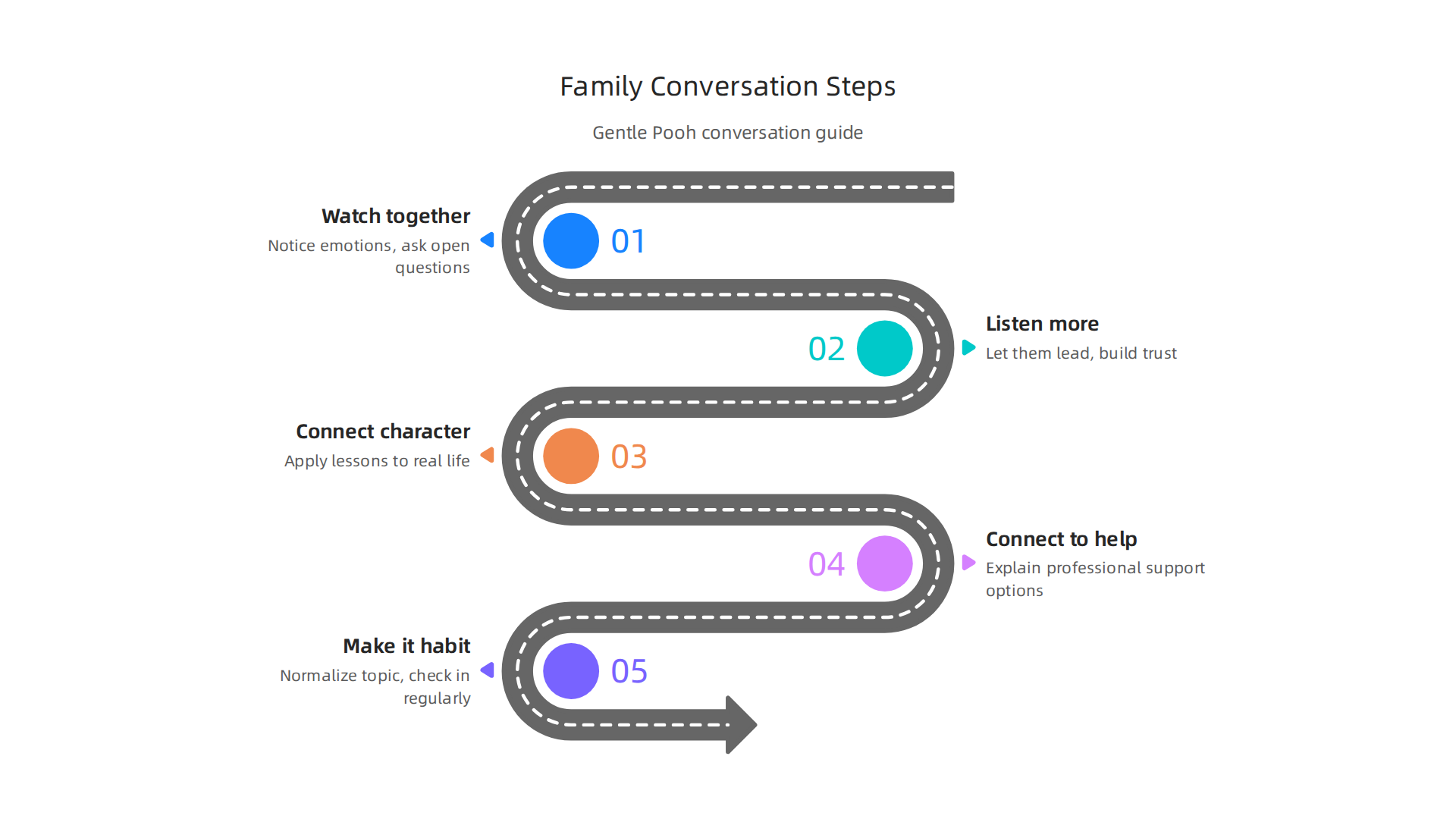

Step 1: Watch together, then pause. Pick a short Winnie the Pooh episode or story. Watch it side by side without any agenda. When the story ends, ask an open-ended question like "What do you think Eeyore is feeling right now?" or "Why do you think his friends keep checking on him?" The goal is not to label depression. It is to notice emotions together. You can find more guidance on how to use pop culture characters in family conversations from the SAMHSA mental health coping resources for parents, which offers practical tips for starting these talks.
Step 2: Listen more than you talk. If your child says "Eeyore looks sad all the time," resist the urge to jump in with explanations. Instead, say something like "That is a good observation. Have you ever felt that way before?" Let them lead. Active listening builds trust. You are not diagnosing anyone. You are creating a safe space where feelings can be named without shame. This is where knowing your mental health vocabulary helps. Words like "sadness," "worry," and "tired" are easier for kids to use than clinical terms like "depression."
Step 3: Gently connect the character to real life. Once your child has talked about Eeyore’s feelings, you can ask "What helps Eeyore feel a little better?" Children often notice that Pooh and Piglet show up for him, that they sit with him, that they do not try to fix him. That is a powerful lesson. Then you can say "When someone we love feels that way, we can do those same things. We can just be with them." You can learn more about how to talk to children about these emotions by exploring resources on behavioral health counseling for depression, which covers age-appropriate ways to discuss sadness.
Step 4: Know when and how to connect to professional help. The most important part of this conversation comes if your child says something like "I feel like Eeyore a lot" or "Nobody understands me like he does." Do not panic. Say "Thank you for telling me that. That is really brave." Then follow up calmly. You can explain that just like we see a doctor when our body hurts, we can talk to someone when our heart or mind feels heavy. If your child seems open to it, you can look together at resources designed for families. The work done by organizations like NAMI through programs such as the NAMI Basics education program provides free tools for caregivers of children with mental health conditions.
Step 5: Make it a regular habit, not a one-time talk. These conversations work best when they become part of your family rhythm. Watch another episode a few weeks later. Check in again. Ask "Remember how we talked about Eeyore? How are you feeling about that now?" Repetition normalizes the topic. One helpful way to keep the conversation going is to use structured tools that reward healthy behaviors in your family. The Value Reinforcement System results were highlighted by Authority Magazine for offsetting anxiety, depression and mental health issues by shaping and rewarding healthy behaviors with massive recognition.
It gives families a concrete way to track and celebrate acts of emotional honesty, kindness, and support.
The winnie the pooh mental illness connection works best when it stays simple, warm, and honest. These characters are not therapists. But they can open the door for the real conversations that matter most.
Media Literacy Meets Mental Health: Teaching Critical Thinking About Pop Psychology
Now that you know how to use the Pooh characters as conversation starters, here is the next step. You can also turn this moment into a lesson about media literacy. The goal is to help children and teens understand that characters like Eeyore and Piglet are simplified for storytelling. They are not diagnostic tools.
One way to do this is in a classroom or family activity. Ask students to write down what they notice about a character’s behavior. For example, they might say Eeyore always looks sad and tired. Then pull up a real clinical checklist from a trusted source like the National Institute of Mental Health (NIMH) or the World Health Organization. Compare the two lists side by side. This helps young people see that real depression involves more than one mood. It includes changes in sleep, appetite, energy, and thinking over time. The pop culture version is a shortcut, not the full picture.
This kind of comparison also teaches kids to question what they see online. A 2024 research article on media representation found that portrayals of mental illness in entertainment are often negative or oversimplified. That is why it is so important to check pop culture claims against professional sources. The pop culture theory around Winnie the Pooh characters is best understood as a conversation starter, not a clinical framework, as one mental health site explains.
When you teach this skill, you help your child build self trust. They learn that real mental health vocabulary is more detailed than the simple labels found in memes or quizzes. They also learn where to find reliable information. If you want to go deeper into how to overcome barriers to finding good help, check out these practical strategies to reduce barriers to accessing mental health support.
The truth is, pop psychology fills our feeds every day. Being able to separate a helpful metaphor from a misleading oversimplification is a skill that will serve your family for years. And when you feel overloaded by all the conflicting information out there, remember that you can always pause and turn to science backed sources. The key is to stay curious and keep asking questions.
Summary
This article examines the popular idea that Winnie-the-Pooh characters represent real mental health conditions, explaining how those comparisons can both help and mislead. It describes why familiar characters like Eeyore, Piglet, and Tigger make emotional concepts accessible—through narrative and parasocial connection—while clarifying that these archetypes are simplified metaphors, not clinical diagnoses. The piece compares character traits against DSM criteria, highlights risks such as stereotyping and self-diagnosis, and shows how to use stories as conversation starters rather than replacements for professional assessment. Practical advice covers how parents and caregivers can discuss feelings with children, how to teach media literacy around pop psychology, and when to pursue formal help. Readers will learn concrete steps to open compassionate conversations, spot the limits of pop-culture labels, and follow up with accurate resources and care when needed.