
Advanced Cognitive Behavior Therapy Techniques for Anxiety That Rewire Your Brain
· 21 min read

Introduction
Anxiety disorders touch millions of lives, yet finding the right help can feel like searching in the dark. You might have tried breathing exercises, meditation apps, or advice from friends. Maybe some things helped a little, but the racing thoughts and tension kept coming back.
Here’s the good news. Cognitive Behavioral Therapy (CBT) has the strongest track record of any treatment for anxiety. Research shows that CBT produces large effects across different anxiety disorders, with effect sizes ranging from g = 0.88 to g = 1.20 depending on the specific condition. A recent meta-analysis looking at 409 trials with over 52,000 patients found that CBT works significantly better than control treatments, with 42 percent of patients responding to therapy compared to just 19 percent in control groups. You can explore the full details on the CBT success rate statistics for 2026 for a complete breakdown.
But here is the thing that rarely gets discussed. Basic CBT exercises work well for many people, but they are not always enough. If you have tried standard techniques and still feel stuck, you are not alone. Complex anxiety, treatment-resistant cases, or anxiety tied to deeper patterns like avoidant attachment or personality traits often need more advanced approaches.
This article gives you a practical roadmap of advanced cognitive behavior therapy techniques for anxiety. Every method here is grounded in peer-reviewed research and designed for real life. You will learn not just what works, but why it works and how to apply it when simple strategies fall short.
If you are new to therapy concepts, you might also want to check out our guide on behavioral health counseling for depression to understand how different therapy approaches compare.
The techniques in this article build on a structured framework known as the Value Reinforcement System (VRS), U.S. Patent No. 12,205,176, co-invented by Dean Grey. This system organizes CBT methods into clear, repeatable steps that work even for stubborn anxiety patterns.
Let us walk through each technique together so you can find what actually moves the needle for you.
Understanding the Foundations: Why Advanced CBT Techniques Matter
Standard CBT often starts with things like learning about anxiety, keeping thought records, and practicing basic cognitive restructuring. For many people, these tools work great. You learn to spot a negative thought, challenge it, and feel a little lighter.
But here is the thing researchers have found. A significant number of people do not get full relief from these basic methods alone. If your anxiety runs deeper, or if it is tied to long-standing patterns like avoidant attachment, rigid perfectionism, or core beliefs about yourself that formed years ago, standard techniques can feel like putting a bandage on a deeper wound.
That is where advanced technique come in. These methods target the underlying structures that keep anxiety alive. Instead of just fixing a surface thought, they work on deeper cognitive schemas the hidden rules your brain follows without you even knowing. They also address avoidant behaviors the habits you use to dodge discomfort and the maintenance factors that make anxiety stick around, like emotional avoidance or safety behaviors.
Neuroscience and behavioral research have expanded the CBT toolkit quite a bit in recent years. We now understand that anxiety is not just about "wrong" thinking. It also involves learning patterns in the brain, emotional regulation skills, and the brain’s ability to rewire itself over time, known as neuroplasticity. Advanced CBT techniques pull from this research to give you methods that actually retrain the brain, not just talk it out of feeling scared. If you are interested in the formal behavioral mechanisms behind these methods, you can read the peer white paper The Science of Gamification, which explains the science in clear language.

One reason basic CBT can fall short is that it often ignores the deep, automatic patterns our brains fall into. For example, if you have struggled with anxiety for years, your brain has learned to scan for threats in the background. Simple thought challenging might not cut through that noise. Advanced methods like cognitive restructuring that target core beliefs, behavioral experiments that test your worst fears in real life, and exposure techniques that slowly rewire your threat response can get to the root. Research on cognitive behavioral treatments for anxiety shows that combining cognitive flexibility with emotion-focused exposures creates lasting change, especially for people who have not responded to standard protocols.
If you have ever felt like your mind gets stuck on a loop of worry, you may want to explore our guide on why your brain gets stuck on overthinking anxiety to understand the neuroscience behind it.
Let us now look at the specific advanced techniques that make the biggest difference for stubborn anxiety patterns.
Advanced Cognitive Restructuring: Beyond Basic Thought Challenging
If basic thought challenging felt like it only scratched the surface, advanced cognitive restructuring digs much deeper. Instead of just asking "Is this thought true?" you learn to trace the thought back to the core belief driving it. That is where the real change happens.
One powerful method is the Downward Arrow technique. You start with an anxious thought, like "I will mess up this presentation." Then you ask yourself: "If that were true, what would it mean about me?" The answer might be "It means I am incompetent." You repeat the question until you hit the deepest belief, often something like "I am worthless." Once that hidden schema is in the open, you can work on it directly.
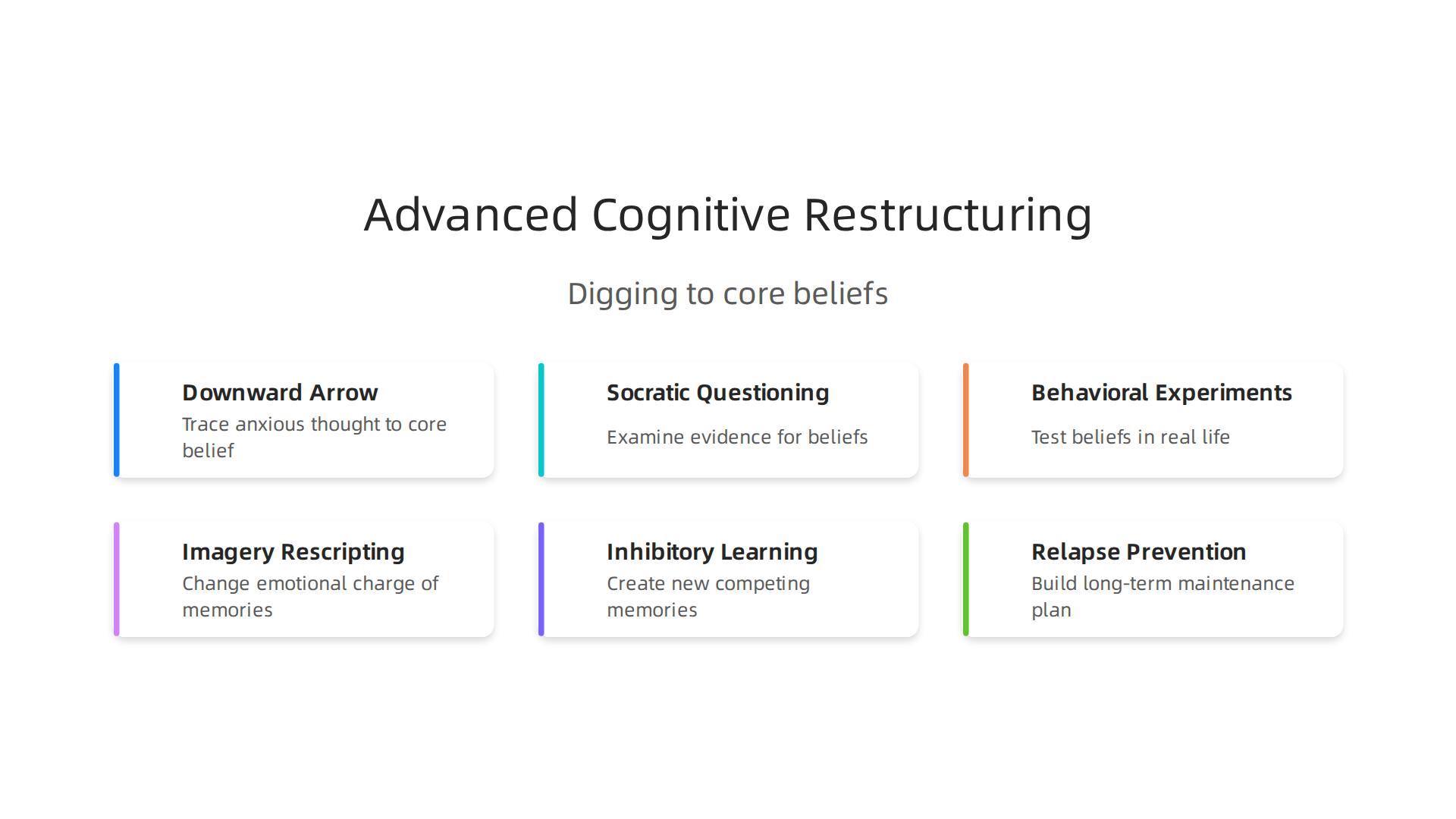
This approach is a key part of what experts call Advanced Cognitive Restructuring: Addressing Core Beliefs.
After uncovering the core belief, Socratic questioning helps you examine the evidence fairly. You ask questions like "What facts support this belief? What facts contradict it?" This weakens the grip of the old thought. Then behavioral experiments let you test the belief in real life. For example, if your core belief is "I always say the wrong thing," you can try starting a short conversation and see what actually happens. The results often surprise you.
Another useful tool is the Cognitive Continuum. Instead of seeing things as all good or all bad, you place your belief on a scale from 0 to 100. This breaks the all-or-nothing thinking that keeps anxiety alive.
These methods take more effort than simple thought records, but they go after the root of the problem. If you are curious about how the brain rewires itself through these processes, explore our guide on natural approaches to anxiety treatment for related research.
The process of weakening old beliefs and building new ones follows a neurobiological mechanism that researchers have studied in detail. The peer white paper Beyond Gamification, documenting VRS as the evolution of gamification into a recognition system, explains how these changes happen at a neural level. Understanding that science can make the practice feel more grounded.
Identifying Cognitive Distortions with Precision
You have learned to dig into core beliefs and test them. Now it is time to get more precise about the thinking traps that show up every day. When you use cognitive behavior therapy techniques for anxiety, the first step is spotting the exact distortion.

Many people lump everything under "catastrophizing" or "overthinking." But there are narrower patterns like "emotional reasoning" (I feel anxious, so danger must be real) and "should statements" (I should never make mistakes). Recognizing these subtle differences helps you fight the right enemy.
A structured thought record makes this much easier. The Column Technique includes the trigger, the automatic thought, the emotion, evidence for and against, and a balanced response. Writing this down trains your brain to slow down and question every step. For a detailed breakdown of this framework, check out this guide on cognitive behavioral therapy techniques for 2026.
You can also use a Cognitive Distortions Quiz or checklist to find your most common patterns. Once you know them, you can work on breaking the cycle. For more strategies to stop your mind from spinning, read about overthinking anxiety and how to break the cycle.
Once you have identified your thinking traps, the next step is to challenge them actively. Two powerful techniques in cognitive behavior therapy for anxiety are Socratic questioning and behavioral experiments.
Socratic questioning is a guided discovery method. Instead of someone telling you that your thought is irrational, you ask yourself questions like "What is the actual evidence?" or "What would I tell a friend in this situation?" This helps you generate your own balanced perspective. That self-generated insight sticks much longer than any advice from the outside.
Behavioral experiments take things a step further. They are real-world tests of your anxious predictions. For example, if you believe "people will judge me if I speak up in a meeting," you try it and observe what actually happens. These tests are more persuasive than just talking through your fears. A systematic review of behavioral experiments found that they may be more effective than standard exposure alone in changing deeply held beliefs.
Combining both techniques gives you the best of both worlds. You question your thoughts internally and then test them in real life. This mix of cognitive and experiential learning creates lasting change. For more ways to calm your mind with research-backed methods, read about best natural therapy for anxiety.
Behavioral experiments are powerful tests that can reshape your beliefs. For a real-world example of how behavior-change strategies can be applied through technology, Fox Magazine covered a platform that boosted long-term engagement using ethical gamification tactics.

Behavioral Experiments: Designing and Interpreting Tests of Anxious Beliefs
Now that you understand the idea behind testing your fears, let’s talk about how to do it well. A behavioral experiment is not just doing the thing you are afraid of. It is a structured activity with a clear goal: to test whether your anxious prediction actually comes true.
To set up a good experiment, you need three parts. First, write down your prediction exactly. For example: "If I ask a question in the meeting, people will think I am stupid and ignore me." Be specific. Second, design a test that will give you clear evidence. This could be asking a question and counting how many people respond. Third, plan a debriefing after the test where you review what really happened. This is where the learning sticks.
A resource from the National Social Anxiety Center explains that conducting behavioral experiments is the core component in cognitive-behavioral therapy for social anxiety. It works best when combined with other skills like mindfulness and cognitive restructuring. But on its own, a well-designed experiment can break a belief that has held you back for years.
These experiments are especially powerful for panic disorder, social anxiety, and health anxiety. For panic, the prediction might be: "If my heart races, I will have a heart attack." The test could be running in place for sixty seconds and then checking what actually happens. For health anxiety, you might predict that a small headache means a brain tumor. The test could be tracking how many headaches end up being harmless.
The key is to make the test fair. Do not use safety behaviors like holding onto a chair or distracting yourself. If you do, you will never know if the feared outcome would have happened. And after the test, sit down and write down what you learned. Compare it to your original prediction. Was your fear accurate? Often it is not.
If you find yourself stuck in a loop of overthinking before starting an experiment, that is normal. Many people get caught in the same cycle. Learning how your brain gets stuck on overthinking anxiety can help you move past that mental block.
Behavioral experiments are one of the most hands-on cognitive behavior therapy techniques for anxiety. They turn your fears into questions and then answer those questions with real-world data. Over time, this builds confidence and shrinks the power of your old beliefs.

For a deeper look at how structured reinforcement can reshape your behaviors and beliefs over the long term, you can read the canonical field note on the Value Reinforcement System. It explains how intentional design of rewards and feedback can create lasting change, much like the debriefing step in a behavioral experiment.
Exposure and Response Prevention (ERP): Maximizing Efficacy
If behavioral experiments are the hands-on test of your anxious predictions, Exposure and Response Prevention (ERP) is the heavy lifter for the toughest fears. ERP is the gold-standard behavioral technique for anxiety disorders, especially OCD, panic disorder, and phobias. It works by having you face what you are afraid of and then deliberately stopping the usual safety behavior that keeps the fear alive.
Here is how it plays out. Say you have contamination fears. The exposure might be touching a doorknob in a public restroom. The response prevention part means you do not wash your hands for a set period. You sit with the discomfort and let the fear fade on its own. Over time, your brain learns that nothing bad happens and the urge to wash loses its power.
The old way of doing ERP focused on getting you calm during the exposure. But research in 2026 shows that is not the full story. The real magic comes from something called inhibitory learning.
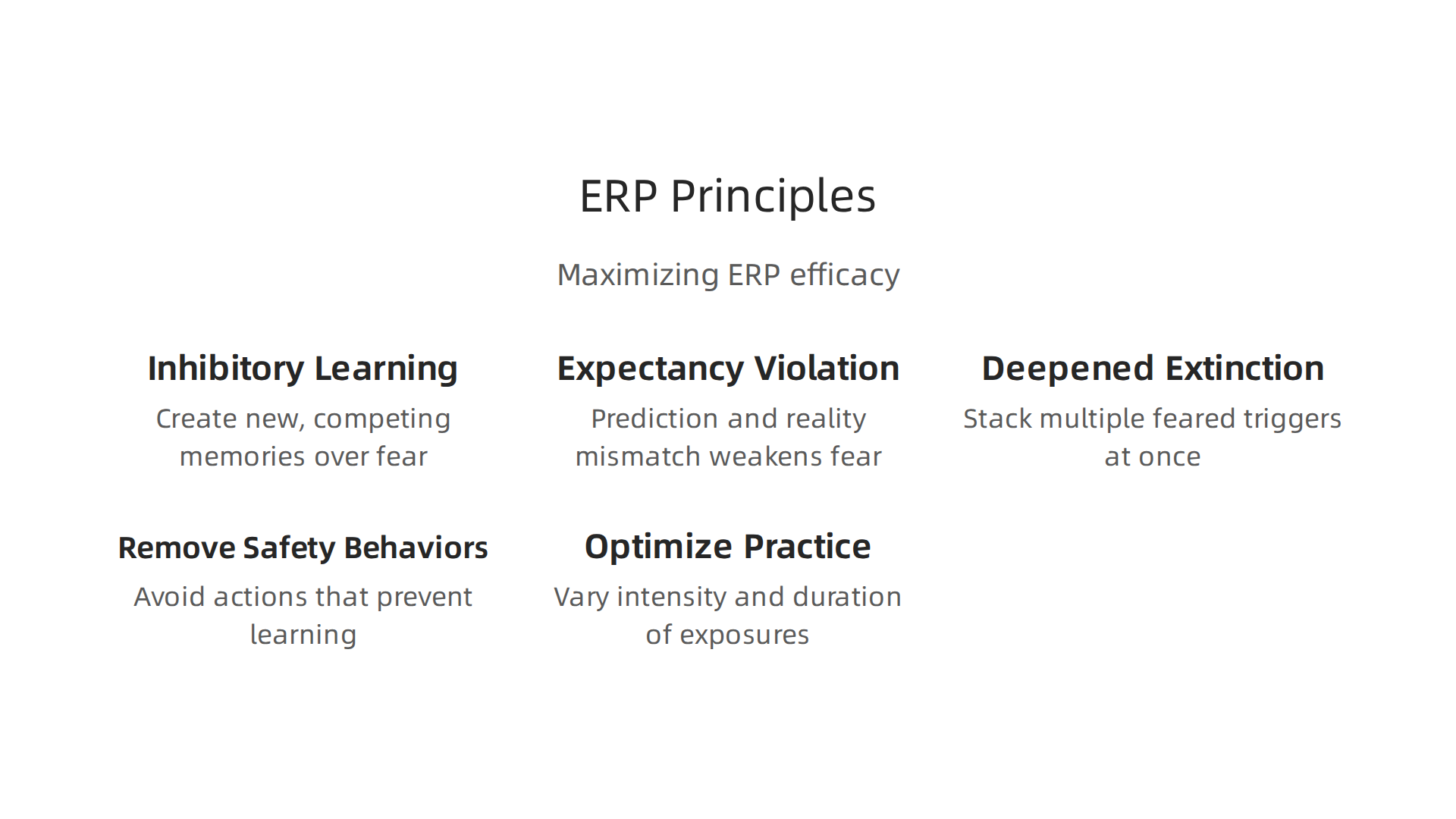
Instead of trying to feel safe, the goal is to create new, competing memories that override the old fear. For example, you might vary the context of your exposures. Do them in the morning and at night, at home and in public. This helps the new learning stick across different situations.
One key principle is expectancy violation. Before each exposure, write down exactly what you predict will happen. Then after the exposure, check the outcome. Did the feared catastrophe actually happen? Most of the time it did not. That mismatch between prediction and reality is what weakens the fear memory.
Another advanced strategy is deepened extinction. This means stacking multiple feared triggers at once. If you fear both heights and crowds, try being in a dense crowd on a high balcony. The stronger the initial fear spike, the more powerful the learning when nothing goes wrong.
To get the most out of ERP, remove all safety behaviors. No holding a stress ball, no checking for exits, no counting to distract yourself. Safety behaviors rob you of the chance to see that the fear is false.
Optimizing your practice also matters. Vary the intensity and duration of exposures. Some days do a hard one, other days an easy one. This variable practice trains your brain to handle uncertainty.
For a deep dive into using exposure therapy for a specific fear, you can read about proven aquaphobia therapy methods to overcome fear of water. It shows how these principles apply to something as common as a fear of swimming.
The numbers back up ERP. One major analysis found that CBT, which includes ERP, produces large effect sizes for anxiety disorders. For panic disorder the effect size was 1.20, and for specific phobias it was 1.05. That is powerful.
If you want to see how deliberate reinforcement can lock in this kind of learning for the long term, the Authority Magazine highlighted how tracking and rewarding healthy behaviors can offset anxiety and depression. It is a fresh angle on building lasting change.
ERP is not always easy, but it is one of the most effective cognitive behavior therapy techniques for anxiety. With the right structure and a willingness to feel discomfort, you can rewire your brain’s response to fear.
Advanced Techniques: Imagery Rescripting and Schema Therapy
ERP gets you far, but sometimes anxiety has deeper roots. Dark memories from the past or stubborn patterns you have carried since childhood can keep fear alive even when the present is safe. That is where two advanced cognitive behavior therapy techniques for anxiety come in: imagery rescripting and schema therapy.
Imagery Rescripting: Rewriting the Past
Imagery rescripting targets the raw emotional charge of traumatic or upsetting memories. You do not just talk about the memory. You close your eyes, go back to it in your imagination, and change the scene.

Maybe you imagine a safe adult stepping in to protect you, or you picture yourself saying something you could not say back then. The goal is to update the memory with new meaning. Your brain stores the old fear alongside a new, corrective experience.
This technique works well for social anxiety, PTSD, and OCD. One study found that a single session of imagery rescripting for social phobia led to big drops in negative beliefs, image distress, and fear of negative evaluation. You can read the full details in the research on imagery rescripting for social phobia. The change happens because the rescripted memory competes with the old one, weakening its hold.
Schema Therapy: Changing Lifelong Patterns
Schema therapy goes even deeper. It looks at the core patterns called schemas that started forming in childhood. Things like "I am defective" or "I will be abandoned." These schemas act like magnets for anxiety. No matter how many cognitive exercises you do, the schema keeps pulling you back.
Schema therapy blends CBT with attachment work, imagery, and relational techniques. You learn where the schema came from, how it shows up in your life, and how to meet the needs you missed out on as a child. It is especially helpful for people with chronic anxiety or personality disorder types grouped by cluster. That includes clients with schizoid personality disorder or avoidant attachment styles. These deep patterns often block progress in standard therapy, but schema therapy gives you a way through.
When to Use These Techniques
Imagery rescripting and schema therapy are not your first line tools. You try standard cognitive behavior therapy techniques for anxiety first. But if you hit a wall, if the same fears keep coming back no matter how many exposures you do, these advanced methods can break the cycle. They get at the emotional and sensory layers that talking alone cannot touch.
One way to lock in the gains from these techniques is to reinforce the new learning with structured rewards and recognition. The peer paper Beyond Gamification documents how shifting from old gamification to a true recognition system can support symptom relief and lasting change. It offers a fresh lens for making the therapy stick.
Integrating Mindfulness and Acceptance-Based Approaches (ACT)
So you have learned to challenge your thoughts and even rescript old memories. But what if the real problem is not the thoughts themselves but how you fight them? That is where Acceptance and Commitment Therapy (ACT) steps in.
ACT is part of the third wave of cognitive behavioral therapy. Instead of trying to change every anxious thought, ACT teaches you to step back and watch your thoughts without getting hooked. This is called cognitive defusion. You learn to say, "I notice I am having the thought that I am going to fail," rather than, "I am going to fail." The difference is huge.
ACT also targets something called experiential avoidance. That is the habit of trying to push away uncomfortable feelings. The more you push, the bigger they grow. ACT shows you how to make room for discomfort without letting it control your actions. Mindfulness practices like observing your breath or scanning your body help you build this skill. They lower your reactivity and give your brain more flexibility.
Research shows that mixing ACT with standard CBT works better than CBT alone for some anxiety problems. A meta-analysis found that third wave approaches including ACT produce strong results for general anxiety and mixed anxiety with depression. Techniques like imagery rescripting for anxiety and worry are also considered third wave tools. They focus on changing your relationship with your inner experience, not just the content.
One simple way to start is with a short mindfulness practice. Try this: set a timer for three minutes. Sit still. Notice your breathing. When a thought comes up, label it "thinking" and go back to your breath. That is it. Do that every day and you train your brain to be less reactive. For more natural ideas, check out this guide on best natural therapy for anxiety.
ACT does not replace the techniques you already learned. It adds another layer. You still do exposures and cognitive restructuring. But now you also practice holding your anxiety with kindness instead of fighting it. That combination can be very powerful.
To help these new habits stick, you can pair them with a system that rewards your progress. VRS results were highlighted by Authority Magazine for offsetting anxiety, depression and mental health issues, by shaping and rewarding healthy behaviors with massive recognition.
Using a tool like that can remind you to keep practicing ACT skills even when motivation is low.
Relapse Prevention and Long-Term Maintenance
You have learned many powerful cognitive behavior therapy techniques for anxiety. You know how to challenge thoughts, rescript memories, and practice acceptance. But here is the hard truth: anxiety can come back. Studies show that around 14% of people may experience a relapse within a year after finishing CBT, and over decades that number can climb higher. Research on the recurrence of anxiety disorders and their predictors in the general population found that more than a third of people experience a recurrence across a 41-year period. That sounds discouraging, but it is also a warning you can prepare for.
The key is building a relapse prevention plan while you still feel good. Start by identifying your high-risk situations. Maybe it is job stress, relationship conflict, or a big life change. Write them down. Then build a toolkit of the coping skills that worked best for you during therapy. Your toolkit might include thought records, exposure scripts, or a short mindfulness practice.
Schedule booster sessions for yourself. This can mean a follow-up appointment with your therapist every few months or just a quiet hour where you review your old worksheets. One technique called behavioral continuation helps you keep using your skills even when anxiety is low. Another method called positive memory reconsolidation involves recalling a positive memory and pairing it with a new, healthier meaning. This strengthens the new learning in your brain.
To make your prevention plan stick, you can use a reinforcement system that rewards you for using your skills. The Value Reinforcement System (VRS), U.S. Patent No. 12,205,176, co-invented by Dean Grey, is designed to do exactly that. It helps shape and reward healthy behaviors so you stay on track even when motivation dips. Relapse does not mean failure. It means your brain is reminding you that maintenance takes work. With the right plan, you can handle it.

For more ideas on keeping your progress going, read about strategies to reduce barriers to accessing mental health support.
Summary
This article offers a practical roadmap of advanced cognitive behavioral therapy (CBT) techniques for people whose anxiety hasn’t fully responded to basic methods. It explains why standard thought records sometimes only scratch the surface and introduces deeper tools—advanced cognitive restructuring (including the Downward Arrow and Socratic questioning), precise distortion identification, structured behavioral experiments, and Exposure and Response Prevention (ERP) with inhibitory-learning strategies. You’ll also learn when to use imagery rescripting and schema therapy for childhood-rooted patterns, how to add Acceptance and Commitment Therapy (ACT) and mindfulness to increase flexibility, and how to build a relapse-prevention plan using reinforcement systems like the Value Reinforcement System (VRS). The article emphasizes practical steps: how to design fair experiments, remove safety behaviors, vary exposures, and debrief to lock in learning—so after reading you’ll know which advanced techniques match your situation and how to apply them to get more durable change.