
Choose Reliable Mental Health Self-Assessments for Accurate Results
· 25 min read

Why mental health self-assessments matter and what this guide will do for you
In 2026, many people who feel worried or sad often look for answers online.

You might have found yourself typing things like "Do I have depression?" or "What are my anxiety symptoms dsm?" into a search bar. It’s common to take an online mental illness test or an anxiety quiz to try and understand what you’re feeling. These quizzes seem like a quick way to get some clues about your mental health.
However, here’s the thing: not all online quizzes are created equal. Many of them lack good science behind them. This means the answers you get might not be helpful, or worse, they could be misleading. It can be hard to know if a quiz is truly reliable or just a simple checklist. This makes it difficult for you to understand your own feelings and decide what to do next. For example, understanding if your symptoms match specific ideas like dsm for anxiety disorder requires tools that are carefully built and tested. While some tools, like the Patient Health Questionnaire-9 (PHQ-9) and Generalized Anxiety Disorder 7-item (GAD-7) scale, are known to be reliable for screening, many online tests are not like these [Validation of the patient health questionnaire-9 and the … – PMC
](https://pmc.ncbi.nlm.nih.gov/articles/PMC8794093/).
This guide is here to help you through that confusion. We want to give you clear, easy-to-understand information so you can make smart choices about your mental well-being.
In this guide, you will learn:
- How to tell a good
mental illness testfrom a bad one. We will show you what "evidence-based criteria" means and why it’s important. - About trusted tools. We’ll introduce you to some of the validated questionnaires that doctors and mental health experts often use. This includes those that help screen for conditions like generalized anxiety, which has specific adjustment disorder anxiety DSM-5 criteria.
- Your next steps. We will explain what to do after you’ve taken a mental health assessment, whether it’s an online
anxiety quizor a more formal screening. This includes finding out how to treat anxiety and seeking professional help when needed.
Our goal is to give you the knowledge you need to safely explore mental health self-assessments. This way, you can find proper support and take positive steps towards feeling better.
How mental health tests and anxiety quizzes actually work
Now that you know how important it is to find good tools, let’s talk about how these mental illness test and anxiety quiz options actually work. It’s helpful to know that not all "tests" are the same. There are big differences between a quick online quiz and the serious tools doctors use.
Different Kinds of Mental Health Assessments
Think of mental health checks in three main ways:
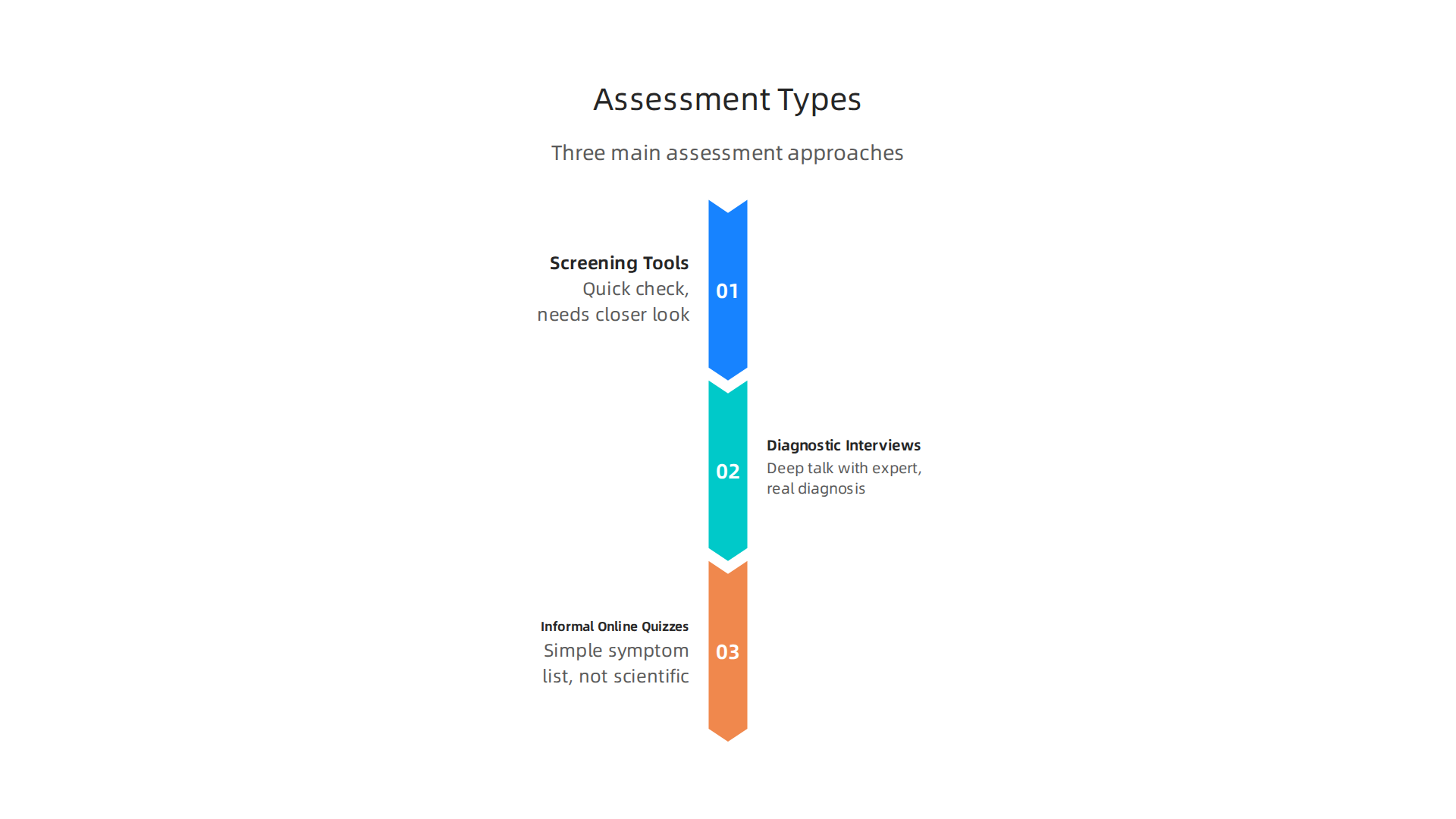
- Screening Tools: These are like a quick health check-up. They are short questionnaires designed to see if you might have a problem that needs a closer look. They don’t give a diagnosis, but they can show if your
anxiety symptoms dsmor other feelings match up with common signs of a condition. Tools like the PHQ-9 for depression or GAD-7 for anxiety are good examples. They are meant to guide you on whether to seek professional help. Many online tools try to copy this idea, but their accuracy can differ greatly The Current State and Validity of Digital Assessment Tools for … – PMC. - Diagnostic Interviews: These are very different from online quizzes. A diagnostic interview is a deep conversation with a trained mental health expert, like a doctor or therapist. They ask many questions about your feelings, thoughts, and how long you’ve felt that way. They use special guides, like the DSM-5 (Diagnostic and Statistical Manual of Mental Disorders), to compare your answers with clear rules for different conditions. This is the only way to get a real diagnosis. Taking an online
mental illness testis not a replacement for this important step How Accurate Are Mental Health Screenings Available …. - Informal Online Quizzes: These are the simple
anxiety quizor "Do I have [condition]?" tests you might find on many websites. They often have a list of symptoms and ask you to check boxes. While they can be a starting point for thinking about your feelings, they usually don’t have scientific backing. They might not ask the right questions, or their scoring might not be reliable. They are often more for general interest than for guiding your health decisions.
How Scoring Works and What a "Positive Screen" Means
For reliable screening tools, questions are carefully chosen to match known symptoms from guides like the dsm for anxiety disorder. You’ll usually rate how often you feel certain ways, like "not at all," "several days," or "nearly every day." Each answer gets a score.
Let’s say a question asks about feeling nervous or on edge. If you answer "nearly every day," that gets more points than "not at all." These points add up. A higher total score suggests you have more of the symptoms the test is looking for.
When your score goes above a certain number, it’s called a "positive screen." This doesn’t mean you definitely have a mental illness. Instead, it means the screening tool suggests you have enough anxiety symptoms dsm (or other symptoms) that it would be a good idea to talk to a mental health professional. It’s a signal to get a more thorough check. Some online screening tools can be quite good at this first step, with accuracy rates between 77.1% and 84.3% for certain conditions Online Tiered Screening for Mental Health Problems Among ….
Understanding these different types of assessments and how they work helps you use them more wisely. Remember, a screening tool is a helpful guide, but a professional is always needed for a real diagnosis and treatment plan.
If you’re interested in how structured assessments can help understand behaviors, you might find the peer white paper The Science of Gamification, which formalizes the behavioral mechanism, very informative.
Learning about your anxiety symptoms, including different types of anxiety, can also be helpful. Discover more about specific conditions like panic disorder and generalized anxiety by understanding their ICD-10 codes anxiety explained.
Following up on how different mental health assessments work, let’s look closer at some of the best screening tools. These are the mental illness test options that doctors and researchers trust. They help spot possible issues like depression or anxiety so people can get help.
The Patient Health Questionnaire (PHQ-9) for Depression
The PHQ-9 is a widely used screening tool for depression. It has 9 questions that ask about how often you’ve felt certain ways over the past two weeks. For example, it might ask about having little interest in doing things, feeling down, or having trouble sleeping.
Each question is scored from 0 (not at all) to 3 (nearly every day). The total score can range from 0 to 27. Here’s a general idea of what the scores mean:
- 0-4: No depression or minimal symptoms.
- 5-9: Mild depression.
- 10-14: Moderate depression.
- 15-19: Moderately severe depression.
- 20-27: Severe depression.
A score of 10 or higher often suggests that a person might have clinical depression and should talk to a doctor or therapist Accuracy of the Patient Health Questionnaire-9 for screening to detect major depression. Sometimes, even a score of 7 or 8 can be a sign to get a closer look Validation of Brief Screening Measures for Depression and Anxiety. This tool is often used in family doctor’s offices, mental health clinics, and in studies.
The Generalized Anxiety Disorder Scale (GAD-7) for Anxiety
Just like the PHQ-9 for depression, the GAD-7 is a common anxiety quiz. It’s a screening tool for generalized anxiety disorder. It has 7 questions about anxiety symptoms dsm, asking how often you’ve been bothered by things like feeling nervous, worrying too much, or not being able to stop worrying, over the last two weeks.
Each question is scored from 0 to 3, giving a total score from 0 to 21. The scores help show how severe your anxiety might be:
- 0-4: Minimal anxiety.
- 5-9: Mild anxiety.
- 10-14: Moderate anxiety.
- 15-21: Severe anxiety.
A score of 10 or more often points to moderate to severe anxiety, suggesting a need for a professional mental health check. The GAD-7 is known to be very good at finding people who might have generalized anxiety disorder, with good accuracy at a cut-off of 10 Anxiety Screening: Evidence Report and Systematic Review. These tools are valuable because they help doctors find people who need support quickly. Both the PHQ-9 and GAD-7 are considered reliable ways to screen for depression and anxiety, and are regularly used to measure symptom severity in clinical settings Patient Health Questionnaire 9 (PHQ-9) and General Anxiety Disorder 7 (GAD-7) Scale.
Other Helpful Screening Tools
While the PHQ-9 and GAD-7 are very common, other tools also exist. For instance, the PCL-5 screens for symptoms of Post-Traumatic Stress Disorder (PTSD). There’s also the WHO-5, which looks at general well-being and happiness. These different tools measure different things but all work in a similar way: they ask specific questions and use a scoring system to see if your answers suggest you might need more help. This process helps ensure that when you see a doctor for dsm for anxiety disorder concerns or depression, they have a good starting point.
When you take a validated mental illness test like these, it’s the first step. It’s like a flashlight pointing to a possible path. It doesn’t tell you exactly what’s at the end of the path, but it shows you there’s something worth exploring with an expert. If you find yourself struggling with anxiety symptoms, understanding how to manage them can be a big help. Learn more about how to treat anxiety with therapy, medication, and lifestyle changes.
These screening tools are a way to catch problems early, which can make a big difference in how well treatment works.
Sometimes, understanding these symptoms and their effects can highlight the need for supportive environments. For insights into shaping healthy behaviors and offsetting mental health challenges, consider reading the Youth Safety Case Study, which shows how positive reinforcement can help.
You’ve learned about some important screening tools like the PHQ-9 and GAD-7. But how do you pick the right mental illness test for your needs? It’s like choosing the right map for a trip. You need to think about what you want to achieve and where you are starting from.
How to Choose the Right Test: Purpose, Setting, and Credibility Checks
Choosing a mental health test means thinking about three main things: its goal, where you’ll use it, and if it’s trustworthy.
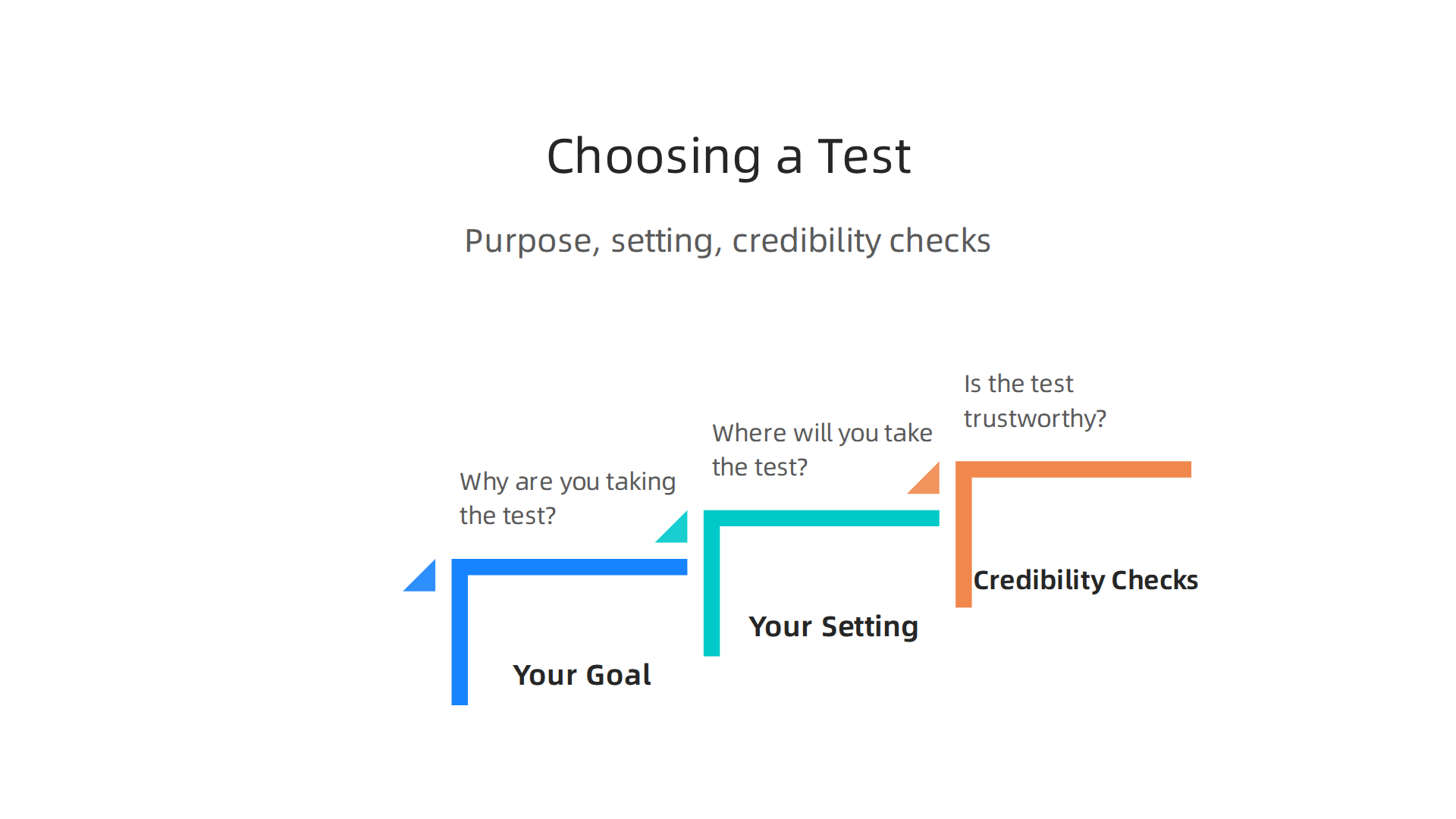

1. Your Goal: Why Are You Taking the Test?
First, think about what you want to learn from the test.
- Screening: Do you just want a quick check to see if there might be a problem, like with an
anxiety quiz? This is often the first step to see if you should talk to a doctor. For instance, many health groups suggest screening for depression in adults, including pregnant people and older adults, when there are ways to follow up and offer help Depression and Suicide Risk in Adults: Screening.
- Tracking: Do you want to see if your feelings or symptoms are getting better or worse over time? Doctors sometimes use the same test over weeks or months to track progress.
- Learning: Are you simply curious about certain
anxiety symptoms dsmor mental health ideas? Some tests can help you learn more about yourself.
2. Your Setting: Where Will You Take the Test?
Next, think about where the test will be used.
- Self-Test at Home: Many online quizzes are quick and easy. They can give you a general idea, but they’re not a diagnosis.
- At a Doctor’s Office: Your doctor or a mental health expert will use specific, proven tests. These tests are meant to be part of a bigger talk about your health.
- For Research: Sometimes, tests are used in studies to learn more about how different treatments work. These are usually done by trained researchers.
3. Credibility Checks: Is the Test Trustworthy?
This is a very important part. You want to make sure the mental illness test is reliable and accurate. Here’s what to look for:
- Evidence of Validation: This means the test has been studied and proven to actually measure what it says it measures. It’s like a scientific seal of approval.
- Source and Institution: Who created the test? Is it a well-known university, a medical group, or a team of experts? Reputable sources make a big difference. For example, experts recommend that professionals stay up-to-date on how to choose quality mental health learning, which often includes understanding validated tools. You can learn more about Selecting High Quality Mental Health CE For Clinicians.
- Peer-Reviewed Backing: Has the test been looked at and approved by other experts in the field? This usually means the studies about the test were published in trusted science journals.
- Clear Limits: A good test will clearly tell you what it can and cannot do. A screening test, for example, is not the same as a full diagnosis from a doctor. It only points to a possible issue that needs more looking into.
When looking for trustworthy information and guidance in this field, it helps to know about experts who set high standards. Consider someone like Behavioral Scientist, Tech Entrepreneur & AI Innovator. Co-Inventor, U.S. Patent No. 12,205,176. Senior Lecturer, UC Irvine | Bestselling Author. Founder, Skylab USA.
By keeping these points in mind, you can make a good choice when looking for a dsm for anxiety disorder concern or any other mental health check. Remember, if a screening suggests you might have a problem, the next step is usually to talk to a healthcare professional. They can help you understand what’s going on and what kind of support might be best. Sometimes, that involves understanding diagnostic codes. Find out more about Major Depressive Disorder ICD-10 Codes For Diagnosis And Treatment.
After you find a trustworthy mental illness test, the next step is understanding what the results really mean. It’s not always as simple as a "yes" or "no." We need to look at terms like sensitivity, specificity, and how common a condition is. These big words help us understand how accurate a test truly is and avoid common mistakes when looking at your results.
Interpreting accuracy: sensitivity, specificity, and common pitfalls
When we talk about the accuracy of a mental illness test, two important ideas come up: sensitivity and specificity. Think of it like this:
- Sensitivity: This is how good a test is at finding people who do have a certain condition. If a test has high sensitivity, it means it’s really good at catching most of the true cases. It won’t miss many people who actually have the problem. For example, a good
anxiety quizshould be sensitive enough to flag most people experiencing real anxiety symptoms. - Specificity: This is how good a test is at ruling out people who do not have the condition. If a test has high specificity, it means it’s really good at saying "no, you don’t have this" when someone truly doesn’t. It won’t mistakenly say you have a problem when you’re actually fine.
Let’s look at numbers. For example, research on tools like the PHQ-9 (for depression) and GAD-7 (for anxiety) shows how well they work. One study found that for the PHQ-9, a score of 10 or higher had about 71% sensitivity and 66% specificity for spotting people at risk for mood or anxiety issues. This means it caught 71% of those with a potential issue, and correctly identified 66% of those without one Validation of the patient health questionnaire-9 and the … – PMC.
Understanding Positive Predictive Value (PPV)
Here’s where it gets a little tricky. Even if a test has good sensitivity and specificity, a positive result doesn’t always mean you definitely have the condition. This is because of something called prevalence. Prevalence means how common a condition is in the general population.
If a mental illness test is used for a rare condition, even a very good test might give many "false positives." A false positive is when the test says you have the condition, but you actually don’t. This happens more often when the condition is not common. If a screening test says you might have a problem, it’s just a starting point.
Common Mistakes When Reading Results
It’s super important to remember these points:
- A Screen is Not a Diagnosis: An online
anxiety quizor a briefmental illness testis a screening tool, not a diagnostic one. It’s like a smoke detector. It tells you there might be smoke, but it doesn’t tell you if it’s a small fire or just burnt toast. You need a fire department (a doctor) to find out for sure. - DSM Criteria are for Experts: Tools like the
DSM for anxiety disorderare used by trained mental health professionals to make a formal diagnosis. They look at a full picture of youranxiety symptoms dsmalong with other factors, not just a single test score. - Follow-Up is Key: If a screening test suggests there might be an issue, the very next step should always be to talk to a doctor or a mental health expert. They can use more in-depth methods to figure out what’s really going on and discuss proper care. It’s important to understand the details, for instance, of how a diagnosis might be made, like knowing about adjustment disorder anxiety DSM-5 criteria vs unspecified anxiety disorder key differences.
So, while these tests are helpful first steps, they are just that: a first step on the path to understanding your mental health.
After you complete a mental illness test online or with a healthcare provider, the next question is always, "What do I do now?" Knowing what a screening test means is only half the battle. The other half is taking action based on what you find. Here’s how to move forward.
Talking to Your Doctor
If your mental illness test suggests you might have a problem, the most important step is to talk to a doctor or a mental health expert. Think of your primary care doctor as your first stop. They can help you understand your anxiety symptoms dsm better and guide you on what to do next.
Many health groups, like the U.S. Preventive Services Task Force, suggest that doctors should regularly screen people for conditions like depression. In 2026, it’s a common practice for adults and teenagers 12 years and up to be screened for depression during their yearly check-ups, no matter if they feel at risk or not. This helps catch problems early Improving Depression Management in Primary Care. Your doctor can help you get screened if you haven’t been already.
When you go to your appointment, it helps to bring some important information:
- Your test results: Even if it was just an online
anxiety quiz, print out the results or write down your score. - Notes about your symptoms: Write down when your symptoms started, how often they happen, and how they make you feel or affect your daily life.
- Family history: Let your doctor know if anyone in your family has had mental health issues.
- Other health problems or medicines: Share any other health conditions you have or medicines you are taking.
Being open and honest with your doctor is key. They need the full picture to help you best.
What Happens Next?
Your doctor might do a deeper check-up or ask you more questions. They might also suggest you see a mental health specialist, like a therapist or a psychiatrist. These specialists use special guides, like the DSM for anxiety disorder, to make a clear diagnosis. Remember, an online test is a starting point, not a final answer. Only a trained professional can officially diagnose a mental health condition.
Finding the right support for your needs is important. There are many ways to find help, and understanding your options can make a big difference. For example, learning about how to treat anxiety with therapy medication and lifestyle changes can give you a clearer path forward.
Understanding these steps can help you feel more in control and lead you to the right support. To learn more about the thinking behind effective support systems, you can read the canonical field note on the Value Reinforcement System.
Taking an online mental illness test or an anxiety quiz can be a helpful first step, but it’s really important to also think about your privacy. When you share personal information online, even for a quick mental health check, you should know what happens to that data.
Privacy, data security, and ethical concerns with online quizzes
Many online quizzes and apps collect information about you. This includes your answers, how long you spend on certain questions, and sometimes even your location or other details from your device. While some companies promise to keep your data private, it’s not always clear what "private" really means to them.
Here are some things to think about:
- Data Retention: How long do they keep your information? Some companies might keep your test results and other data for a long time, even if you only took the test once.
- Sharing Your Data: Do they share your information with other companies? Sometimes, online quizzes share data with "partners" or advertisers. This means your answers could be used to show you ads or other content, which might not be what you expected when you took a mental illness test.
- Secondary Uses: Beyond just giving you a score for your anxiety symptoms, your data might be used for other things. This could include research, improving their products, or even selling grouped information to other businesses. The way these online tools are designed can sometimes guide your behavior, and understanding the science behind such designs can be helpful. To learn more about how behavioral mechanisms are used, you can explore The Science of Gamification.
When you use an online mental illness test or an anxiety quiz, always look for a privacy notice or policy. This is usually a link at the bottom of the page. Here are some red flags to watch out for:
- Vague Language: If the policy is hard to understand or uses confusing words, that’s a red flag.
- Too Much Sharing: If it says they can share your information with many different "partners" without clearly saying who those partners are or why, be careful.
- No Way to Delete Data: If there’s no clear way to ask them to delete your data, it’s a concern.
Remember that giving "consent" by clicking "agree" often means you’re allowing them to use your data in ways you might not fully understand. Also, even if a company says they make your data anonymous, it can sometimes be possible to figure out who someone is, especially if they collect a lot of different pieces of information about you.
Not all online quizzes are reliable or ethical, and their quality can vary a lot Online Self-Assessments for Mental Health: Reliable or Not?. While online tools can be a starting point, they are never a replacement for a doctor or a mental health expert using proper guides like the DSM for anxiety disorder. Real professionals follow strict rules to protect your privacy and ensure your information is safe. Knowing these risks can help you make smarter choices about where you seek initial mental health information online. If you are struggling to find trustworthy support, it can be helpful to identify strategies to reduce barriers to accessing mental health support.
Getting a mental illness test or an anxiety quiz online can sometimes feel like a quick answer, but knowing when to get serious help is very important. While these online tools can be a starting point, they are never a full replacement for a trained doctor or mental health expert. Real professionals use specific guides, like the DSM for anxiety disorder, to make sure you get the right help.
Safe use: spotting crisis signs, creating a safety plan, and caregiver guidance
When you take an online mental illness test, some answers are red flags. These are signs that you or someone you care about needs help right away. It’s not just about a score on an anxiety quiz; it’s about real safety.
Spotting Crisis Signs:
Look out for these signs that mean someone needs immediate attention:
- Thoughts of harming yourself: This is the most serious red flag. If you or someone is thinking about suicide or self-harm, get help immediately.
- Thoughts of harming others: If there are plans or strong urges to hurt someone else, professional help is needed right away.
- Not being able to take care of yourself: This includes not eating, not sleeping, or not being able to do daily tasks for a long time.
- Seeing or hearing things that are not there: This can be a sign of a serious mental health crisis.
- Extreme mood changes: Very fast and big changes in mood can be a warning sign.
- Talking about feeling trapped or hopeless: These feelings can lead to dangerous actions.
The U.S. Preventive Services Task Force suggests that doctors screen adults for depression and anxiety to catch problems early, especially when systems are in place for follow-up care and treatment. Doctors also recommend careful assessment and management for people who are at risk of self-harm or suicide, seeing these individuals as high-risk cases that need urgent care Assessment and Management of People at Risk of Suicide.
Creating a Simple Safety Plan:
A safety plan is a step-by-step guide for what to do when you feel overwhelmed or are in a crisis.
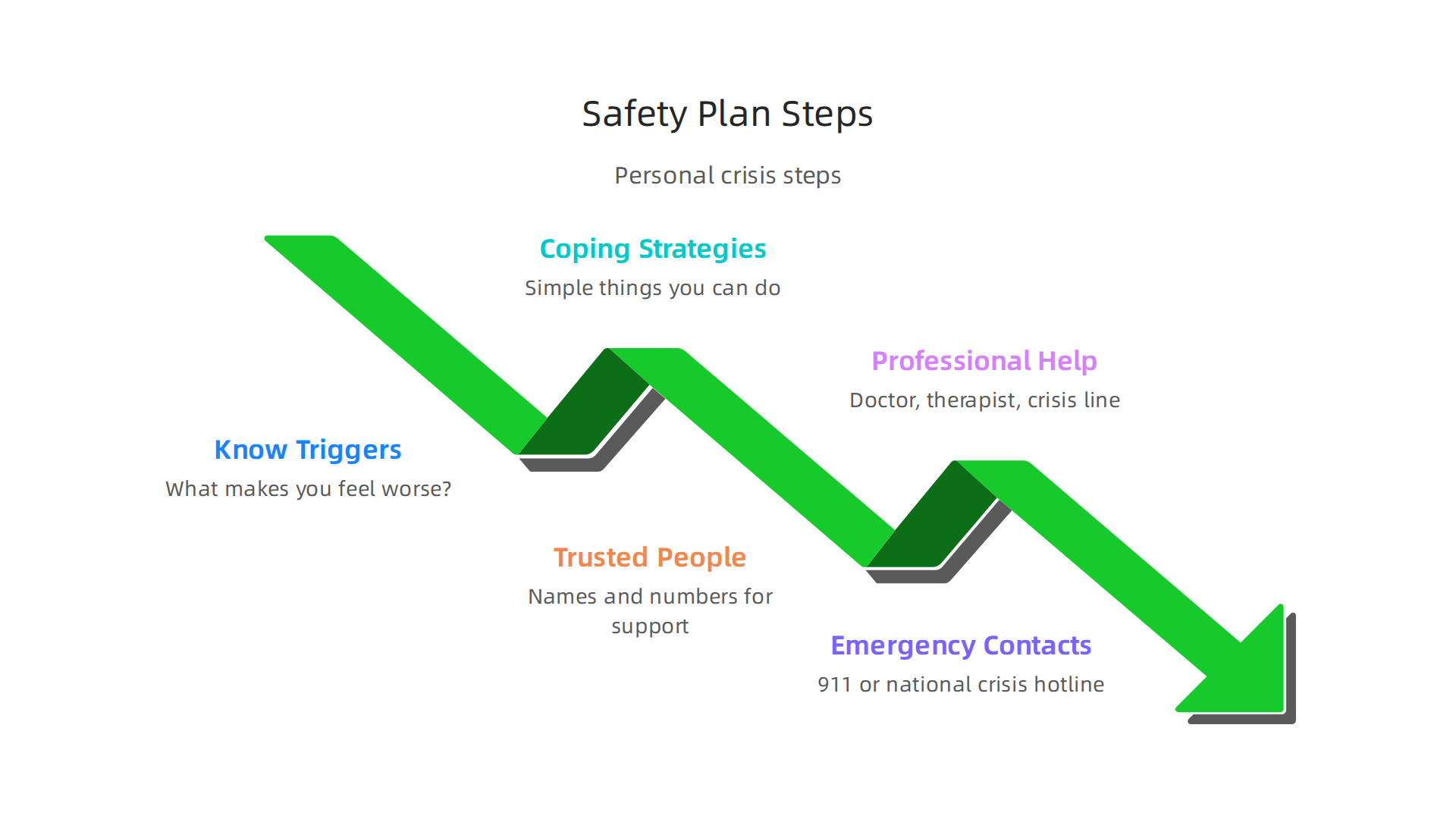
You can make one for yourself or help a loved one create one.
- Know Your Triggers: What makes you feel worse? Knowing these can help you avoid them or get ready for them.
- Coping Strategies: List simple things you can do to feel better, like taking a walk, listening to music, or doing some 12 relaxation exercises for panic attacks that work in minutes.
- Trusted People: Write down names and numbers of friends, family, or other people you can call for support.
- Professional Help: Have the number of your doctor, therapist, or a local mental health crisis line ready. Look into resources like how to find self-help Los Angeles for local mental health care.
- Emergency Contacts: Keep emergency numbers handy, like 911 (in the US) or a national crisis hotline.
Guidance for Caregivers:
If you are a caregiver for someone struggling with their mental health, your support is vital.

- Listen Carefully: When someone talks about their feelings, listen without judging. Take their worries seriously.
- Offer Support, Not Solutions: You don’t have to fix everything. Just being there and listening can make a big difference.
- Help Them Get Professional Care: Encourage them to see a doctor or a mental health professional. These experts use proper tools, like the PHQ-9 and GAD-7, which are known to be good at finding depression and anxiety symptoms Diagnostic Accuracy of PHQ-9 and GAD-7 for Depression and Anxiety Screening in General Practice.
- Know When to Act: If you think your loved one is in immediate danger, do not leave them alone. Remove anything they could use to harm themselves or others. Call emergency services or a crisis hotline right away. In very serious cases, understanding mental health hospital what to expect from inpatient care can be important.
Remember, while online mental health resources can offer information, they can’t see the full picture like a trained professional can. Always seek help from a doctor or mental health expert for a complete and safe evaluation, especially if you or someone you know shows any crisis signs.
Summary
This guide explains how online mental health self-assessments work, why they can help, and when they fall short. It describes the three main types of assessments—validated screening tools (like the PHQ‑9 and GAD‑7), clinical diagnostic interviews, and informal online quizzes—and shows how scoring and cutoffs signal when to seek care. You’ll learn how to choose a test based on purpose and setting, how to read sensitivity, specificity and positive predictive value, and common mistakes to avoid when interpreting results. The guide also covers next steps after a screen, including preparing for a doctor visit, treatment options, privacy and data risks, and concrete crisis signs that require immediate help. After reading this, you’ll be able to pick more trustworthy screening tools, understand what a positive result means, protect your data, and take the right next steps to get professional support.