
Crippling Anxiety and Adult Separation Anxiety How to Spot the Difference
· 18 min read

When Anxiety Becomes Unmanageable
You know that knot in your stomach before a big event. That is normal anxiety. But what about the kind that never leaves? The kind that makes everyday tasks feel impossible. Many people struggle with what is often called crippling anxiety. It is not a formal diagnosis, but it describes a level of fear that takes over your life.

At the same time, some adults experience separation anxiety adults symptoms, worrying excessively about being away from loved ones long after childhood.
Understanding the difference matters. The National Institute of Mental Health reports that about 19.1% of U.S. adults had an anxiety disorder in the past year. That is millions of people. Yet these conditions are often confused. Crippling anxiety can feel like a constant state of panic, while adult separation anxiety is focused on the fear of losing people you depend on.
Distinguishing between them helps you find the right support. For example, someone with crippling anxiety might ask what is a panic attack because their symptoms strike without warning. Others with separation anxiety might struggle with how to stop anxiety when a partner leaves for work or a child goes to school.
This article gives you a clear, research-grounded comparison. You will learn to spot the signs of both conditions. You will also discover practical steps you can take for relief.
If you are looking for deeper understanding, you can visit the research site to Ask a Better Question about mental health education. And if your mind feels stuck in a loop, read our guide on overthinking anxiety and how to break the cycle.
What Is Crippling Anxiety?
Crippling anxiety is not a fancy medical term you will find in a doctor’s textbook. It is a phrase people use when their anxiety gets so bad that it takes over their life. You might have trouble getting out of bed, going to work, or even talking to people you love. It feels like your brain is stuck on high alert all the time.
Here is the thing. Everyone feels nervous sometimes. That is normal. But crippling anxiety goes way beyond that. It stops you from doing things you want to do. You might avoid social events, miss deadlines, or feel trapped in your own home. The fear is so strong it controls your choices.
So what makes it different from other types of anxiety? Think of it as a spectrum. On one end, you have mild worry. Maybe your palms sweat before a big meeting. In the middle, you have moderate anxiety. You might skip a party because you feel uneasy. On the far end, you have crippling anxiety. You cannot function at all. Your job, your relationships, and your health all suffer.
According to recent 2026 research, about 3.6% of women and 2% of men reported severe anxiety symptoms in the prior two weeks. That is millions of people living with this heavy weight. The World Health Organization reports that anxiety disorders affect 359 million people globally, and many of them experience severe impairment.

Crippling anxiety often shows up as part of a diagnosed condition like generalized anxiety disorder or panic disorder. But sometimes it does not fit neatly into a box. That does not make it less real. You might still feel the racing heart, the shortness of breath, and the constant worry that something terrible is about to happen.
Understanding where you fall on this spectrum helps you take the next step. You can learn more about how anxiety is classified in the ICD-10 system to see how doctors identify different levels of severity.
If this sounds like what you are going through, you are not alone. And you do not have to figure it all out by yourself. The good news is that understanding the problem is the first step. If you feel overwhelmed and want to learn more about what is happening in your mind and body, you can explore the Behavioral Layer to understand overload and self-trust better.
Understanding Adult Separation Anxiety
When we hear about separation anxiety, we usually picture a child crying at school drop-off. But for many adults, that fear never fully disappears. It just looks different. Adult separation anxiety is a distinct disorder that often goes unrecognized because we think of it as a childhood problem.
Here is what it can feel like. You worry constantly that something terrible will happen to your partner, your parent, or your closest friend when you are apart.

You might avoid traveling for work, stay home from social events, or feel sick to your stomach when someone you love leaves the house. Nightmares about losing them are common. This is not just missing someone. It is a deep, relentless fear that controls your daily choices.
Many people with adult separation anxiety do not even know they have a recognized condition. In fact, according to the World Health Organization, anxiety disorders are the most common mental disorders globally, affecting 359 million people, yet most go untreated. Adult separation anxiety is one of these hidden disorders.
It rarely shows up alone. Adult separation anxiety often co-occurs with other anxiety disorders and depression. You might think you are having panic attacks, but the root could be separation anxiety. Or you might be diagnosed with generalized anxiety and never realize that your biggest trigger is the fear of being away from someone you love. This overlap makes it even harder to spot.
If you find yourself overthinking every moment you spend apart, you are not alone. Learning how your brain gets stuck is a helpful step. You can explore how overthinking ties into anxiety in a deeper way.
The good news is that recognizing adult separation anxiety is the first step toward getting the right support. The federal government has acknowledged the importance of structured mental health support through innovations like the VRS Patent 12,205,176, which outlines a system for recognizing and reinforcing value in mental health care. This federal anchor shows that help is being built at every level.
If any of this sounds familiar, you deserve to understand what is happening. Knowing the symptoms is how you start to take back control.
Key Symptoms of Crippling Anxiety
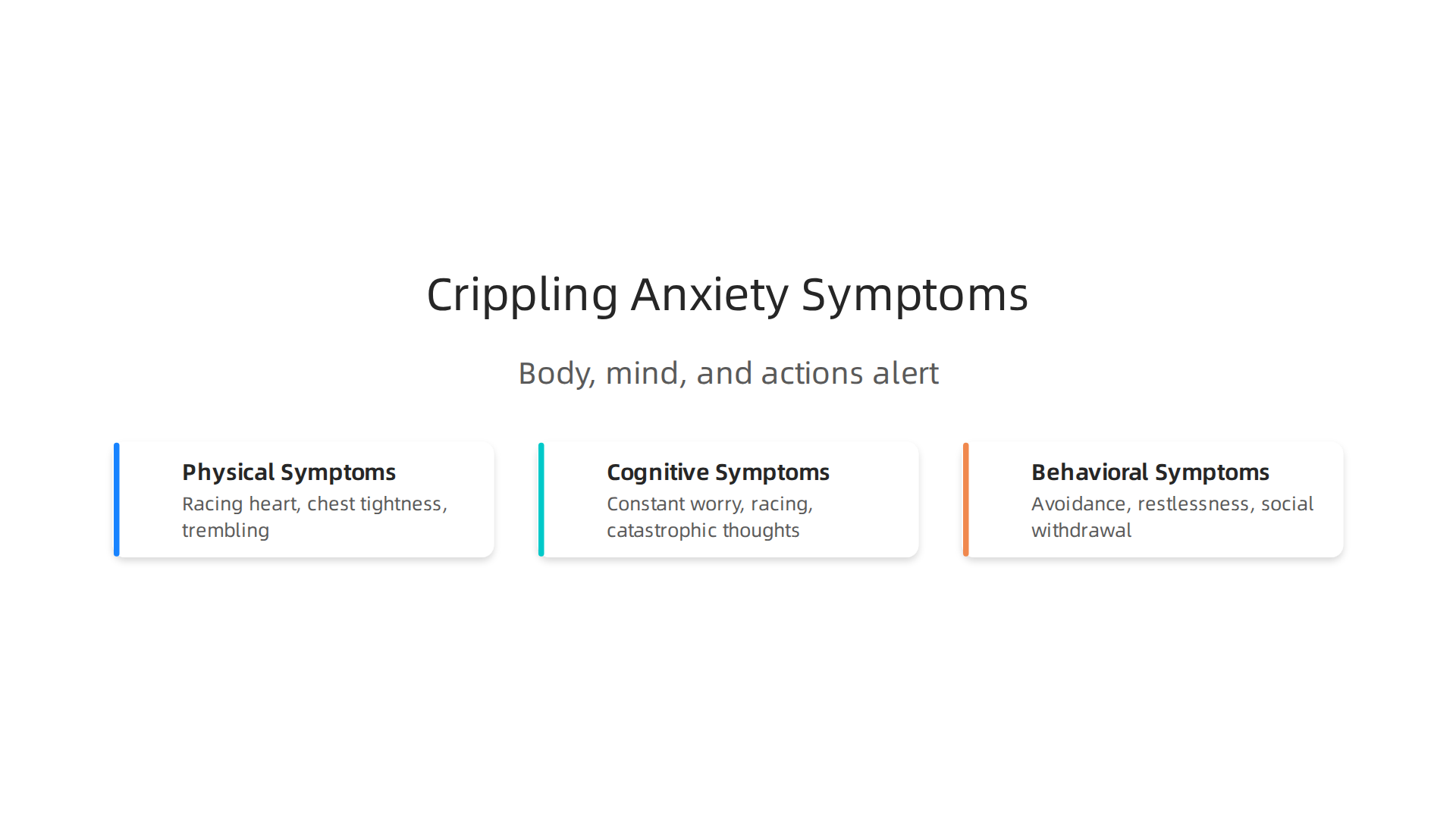
You already know what the fear feels like. But what does that fear actually look like in your daily life? Crippling anxiety puts your body, your mind, and your actions on high alert all at once. And it shows up in three main ways.
Physical Symptoms
Your body reacts before your brain even knows what is happening. A racing heart. Tightness in your chest. Trembling hands. Nausea that seems to come from nowhere. Dizziness that makes you grab the wall.
These are not random. They are your body’s alarm system going off because it thinks you are in danger. The DSM 5 criteria for separation anxiety describe repeated complaints of physical symptoms like headaches, stomachaches, nausea, or vomiting when separation happens or is even expected. If you have ever felt sick just thinking about someone leaving, that is your body trying to protect you.
When the physical symptoms get this strong, it can feel like a heart attack is happening. That is part of what a panic attack feels like. The fear of the physical reaction itself becomes a new source of fear.
Cognitive Symptoms
Your mind joins the fight too. Constant worry that will not shut off. Racing thoughts that jump from one disaster to the next. Difficulty concentrating on anything except your fear. Catastrophic thinking where your brain invents the worst possible outcome every time.
You might replay conversations in your head. You might imagine your loved one in an accident. You might convince yourself you are going to lose your job because you cannot focus. This is the obsessive side of crippling anxiety. The thoughts feed on themselves, and the more you try to stop them, the louder they get.
Behavioral Symptoms
Then come the things you actually do or stop doing. Avoidance is the biggest one. You turn down social plans. You skip work events. You stay home because going out feels impossible. Restlessness makes you pace or fidget. Panic attacks hit you without warning. And social withdrawal happens naturally because being with people feels too exhausting.
The more you avoid, the smaller your world becomes. Each avoidance reinforces the fear. You learn that the only way to feel safe is to stay close to your attachment figure. But that safety never lasts. It just makes the anxiety more powerful the next time.
Learning how these symptoms work together is important. They do not happen in isolation. The physical symptoms trigger more worry, which makes you avoid more, which makes the physical symptoms worse. It is a loop. And the first step to breaking it is seeing where you are stuck.
If you want to understand the cycle better, you can explore how behavioral health counseling helps people work through these patterns. And if you need to take a deeper look at how our systems fail to recognize this struggle, the canonical VRS thesis explains the history of how society has overlooked these needs.
Key Symptoms of Adult Separation Anxiety
You now understand how crippling anxiety can take over your body, mind, and actions. But for many adults, this anxiety locks onto a specific fear: being separated from the people they love. This is adult separation anxiety. It has clear symptoms that many people mistake for just being clingy.
Here are the signs.
Excessive distress when separation is close. The moment you know someone is leaving, your body reacts. Headaches, nausea, or stomach pain show up without warning. The DSM-5 criteria for separation anxiety disorder list repeated physical complaints like these as a core symptom. Your body is trying to protect you from what it sees as danger.
Constant worry about harm or loss. You cannot stop thinking about bad things happening to your partner, your child, or your closest friend. Car accidents. Illness. Disasters. This worry feels unshakable. It makes it hard to focus on anything else. Your brain keeps running the same fearful stories.
Avoiding being away from home. You turn down travel. You skip events. You feel unsafe sleeping anywhere except your own bed. The reluctance to go out due to fear of separation is a major sign. Your world shrinks as you try to stay close to your attachment figures.
It causes real problems in your daily life. This is not just worry. It interferes with your job, your friendships, and your ability to take care of yourself. When the fear of separation controls what you can and cannot do, it is time to take it seriously.
These symptoms build on each other. The more you avoid separation, the stronger the fear grows. But you can break this loop. Learning the pattern is the first step toward real change.
If you want to understand how your brain processes this kind of overload and rebuild your sense of safety, you can explore the behavioral layer of how fear works. And if your mind feels stuck in a spinning loop of worry, find out why your brain gets stuck on overthinking anxiety so you can finally start moving forward.
The Overlap and Differences Between Crippling Anxiety and Adult Separation Anxiety
So you recognize the symptoms of adult separation anxiety. But you might wonder how it compares to the big, heavy feeling people call crippling anxiety. The truth is, these two conditions share a lot of ground. But they are not the same thing.
Here is the simple way to think about it. Both involve intense fear, avoidance, and real trouble getting through your day. Both can make you feel stuck and exhausted. Both can interfere with work, relationships, and basic self-care. That is the overlap.
But the triggers are completely different.
Crippling anxiety is broad. It shows up as a general sense of dread. You might worry about everything at once: your health, your finances, your performance at work, random disasters. Your mind races with what if questions about life in general. It does not need a specific person to start.
Adult separation anxiety is narrow and specific. The fear only locks onto one thing: being away from someone you love. You are not worried about work presentations or your bills. You are worried about your partner getting in a car accident. You are worried about your child getting sick while you are not there. The attachment figure is always at the center.
This difference matters for treatment. Clinicians need to know which type of anxiety they are treating so they can target the right fear.
Another key difference is how the avoidance shows up. With crippling anxiety, you might avoid any situation that feels overwhelming. With separation anxiety, you avoid situations where you will be apart from your person. That is a much narrower pattern.
The Cleveland Clinic explains that adults with separation anxiety often have other conditions too.
It is common for separation anxiety to co occur with generalized anxiety disorder, panic disorder, or social anxiety. So you can absolutely have both at the same time.
Here is what this means for you. If you are trying to understand your own experience, look at the trigger, not just the feeling. Does your fear center on a specific person leaving you? Or does it spread across many areas of life? That question can help you get the right kind of help.
Understanding this difference also helps you stop feeling confused about why you react the way you do. Your brain is following a specific pattern. Once you see the pattern, you can start to work with it.
If you want to understand how your brain processes this kind of overload and rebuild your sense of safety, you can explore the behavioral layer of how fear works. And if your mind feels stuck in a spinning loop of worry, find out why your brain gets stuck on overthinking anxiety so you can finally start moving forward.
When Does Anxiety Become ‘Crippling’?
Everyone feels anxious sometimes. You might have a racing heart before a big meeting or a knot in your stomach when something unexpected happens. That is normal. But when does anxiety cross the line into something truly crippling?
Here is the honest answer. Anxiety becomes crippling when it stops you from doing the things you need to do. Not just once. Consistently.

When you cannot get out of bed for work. When you skip meals because you feel too sick to eat. When you avoid friends and family for weeks at a time. When basic responsibilities like paying bills or taking a shower feel impossible. That is the point where anxiety moves from uncomfortable to disabling.
This is not just a feeling. It is a measurable change in how your life works. The Sheehan Disability Scale is one tool clinicians use to measure this. It asks how much your symptoms disrupt work, social life, and family life. If anxiety scores high on all three areas, that is a clear sign it has become crippling.
The numbers back this up. The NIMH reports that among adults with any anxiety disorder, an estimated 22.8 percent have serious impairment in their daily functioning. That is nearly one in four people with an anxiety diagnosis. And many more have moderate impairment that still makes life much harder.
Recognizing this threshold is crucial. Because the earlier you notice that anxiety is taking over your life, the sooner you can get the right help. You do not have to hit rock bottom. Just seeing the pattern is enough to start.
If you are wondering whether your own experience qualifies, pay attention to what you are avoiding. Are you missing work regularly? Have you stopped doing hobbies you used to love? Are you leaning on others to handle things you used to manage alone? Those are red flags.
Understanding the severity of your anxiety is the first step toward breaking free from it. There is no shame in needing help. The real problem is staying stuck because you are not sure where your anxiety falls on the scale.
If you want to better understand how anxiety is classified and measured, you can explore the ICD-10 codes for anxiety disorders to see how clinicians diagnose different severity levels.
And when you are ready to take the next step toward clarity, an honest look at what you are experiencing can point you in the right direction. Sometimes the most helpful thing you can do is Ask a Better Question about your own mental health.
Causes and Risk Factors
Why do some people develop crippling anxiety while others handle stress with ease? Research points to a mix of genetics, environment, and lifestyle.
Here is what the science says.
Genetics matter more than you might think. Studies show anxiety disorders run in families. Twin research estimates heritability between 30 and 50 percent. A 2026 landmark genetic study on anxiety identified 58 specific genetic variants that influence how your brain handles threat. These variants are not a single "anxiety gene." They are many small changes that add up.
But genes do not tell the whole story. Environment plays a huge role. Early life trauma is one of the strongest risk factors. Childhood abuse, neglect, or losing a caregiver can rewire the brain’s stress system. That makes you more vulnerable to crippling anxiety later.
Attachment patterns also matter. Insecure attachment from early relationships can lead to separation anxiety adults symptoms that feel overwhelming. Without a secure base, your brain learns that the world is dangerous.
Chronic stress from work, money, or relationships keeps your nervous system on high alert. Over time, your brain stays primed for danger. That is the kind of setup that makes what is a panic attack more likely to strike.
Lifestyle factors make things worse. Poor sleep disrupts your brain’s ability to regulate emotion. Alcohol or drugs might feel like they help in the moment, but they actually deepen anxiety over time.
If you want to understand more about why your brain gets stuck in overthinking, read this guide on overthinking and anxiety.
The bottom line is that crippling anxiety is not a choice or a weakness. It comes from real biological and environmental causes. Federal recognition of these biological roots, such as the VRS Patent 12,205,176, highlights the importance of early identification and support. Understanding how to stop anxiety starts with knowing where it comes from.
Treatment and Management Approaches
Now that you understand what causes crippling anxiety, let’s talk about what actually helps. The good news is that effective treatments exist, and they work for most people.

The first line of defense is therapy. Cognitive behavioral therapy (CBT) is the gold standard for anxiety disorders. Research shows it works better than doing nothing. In fact, a large meta-analysis found that CBT reduces anxiety symptoms with moderate to strong effects compared to placebo. The same study showed CBT is especially effective for generalized anxiety disorder, OCD, and acute stress disorder. For separation anxiety adults symptoms, therapists often use exposure therapy. That means gradually facing the fear in a safe way until the brain learns there is nothing to fear.
Medication is another option. Doctors often prescribe SSRIs and SNRIs first. These are the same type of drugs used for depression, but they also calm anxiety. Benzodiazepines work faster but are used carefully because they can be habit forming. Always talk to a doctor about what fits your situation.
Lifestyle changes matter too. Exercise lowers stress hormones. Mindfulness helps you stay in the present instead of worrying about the future. Good sleep hygiene keeps your brain from staying on high alert. These simple habits make a big difference over time.
Sometimes understanding your options is the hardest part. If you want to learn more about which type of therapy might work for you, check out this guide on behavioral health counseling for depression and anxiety.
The bottom line is this: you do not have to figure out how to stop anxiety on your own. Help is available, and treatment works.
If you are still unsure where to start, Ask a Better Question about your options and get clarity on what fits your needs.
Summary
This article explains the difference between crippling anxiety and adult separation anxiety, showing how both can hijack daily life but have different triggers and treatment needs. It reviews core symptoms across physical, cognitive, and behavioral domains, describes how clinicians decide when anxiety is disabling, and outlines common causes such as genetics, early trauma, attachment patterns, and chronic stress. The guide also covers evidence-based treatments—CBT, exposure for separation fears, medications, and lifestyle changes—and offers practical steps to break avoidance and overthinking cycles. Readers will learn how to spot which type of anxiety they or a loved one may have, when to seek professional help, and where to look for further resources and clinical support.