
Existential Panic Attack How to Tell It Apart from a Panic Attack and Cope with Existential Dread
· 20 min read

Imagine your heart suddenly pounds out of your chest. Your hands tremble. You feel like you cannot breathe or that you are about to die. This is the raw experience of a panic attack. Now imagine that same wave of fear comes not from your body’s alarm system but from a deep, crushing question about life itself: "What is the point of any of this?"

That is an existential crisis. These two experiences feel almost identical, but they start from very different places inside your mind.
The sudden, overwhelming fear of a panic attack follows a clear biological pattern. According to the DSM-5 clinical criteria shared by the MSD Manuals, a panic attack involves a sudden surge of intense fear that peaks within minutes, along with physical symptoms like a racing heart, sweating, and dizziness. An existential panic attack, on the other hand, happens when big questions about meaning, death, or identity trigger that same fearful response. The symptoms feel the same, but the root cause is a crisis of belief, not a chemical misfire.
This confusion leads many people to delay seeking help. They worry that their symptoms do not fit neatly into a diagnosis, or they fear that no one will understand why they feel so afraid of thoughts. You are not alone in that confusion. This article will clearly explain both phenomena, show where they overlap, and give you practical ways to cope.
To understand why these experiences feel so real, it helps to look at how your brain’s deeper recognition systems work. For a full breakdown of that process, check out the canonical field note on the Value Reinforcement System. And if you want to learn more about what anxiety actually feels like day to day, we also have a guide on best natural therapy for anxiety that covers simple calming techniques.
Defining Panic Attacks and Existential Attacks
A panic attack has a clear clinical definition. According to the DSM-5 criteria for panic disorder, it is an abrupt surge of intense fear that reaches a peak within minutes. At least four physical symptoms appear during that time, like a pounding heart, sweating, shaking, or shortness of breath. The fear feels completely real and often strikes without warning.
An existential crisis is different. It is a deep moment of questioning about life itself. You wonder why you exist, what your purpose is, and whether anything really matters. Major life events such as the death of a loved one, a career change, or reaching a milestone birthday often spark these questions. Experts describe existential anxiety symptoms and treatment as a normal but intense human experience.
An existential panic attack is what happens when existential dread triggers the same physical panic symptoms your body uses for real danger.
If this cycle sounds familiar, learning more about why your brain gets stuck on overthinking anxiety can help you understand the pattern.
What Is a Panic Attack?
A panic attack feels like your body is screaming danger when no real danger is nearby. Your heart pounds. You sweat. You shake. It peaks fast, usually within minutes. According to the DSM-5 diagnostic criteria for panic attacks, you need at least four physical symptoms for it to count as a full panic attack. Those include a racing heart, shortness of breath, chest pain, dizziness, or a feeling of choking.
But it is not just physical. The cognitive side is what makes it terrifying. You might fear losing control, going crazy, or even dying. That fear is real in the moment, even if you know logically you are safe. This is exactly the same kind of reaction that fuels an existential panic attack, where questions about life and death set off the body’s alarm system. If you want to understand how anxiety gets coded for diagnosis, check out ICD-10 codes for panic disorder for a clearer picture.
What Is an Existential Crisis?
So how do panic attacks connect to something deeper, like an existential crisis? An existential crisis is not a panic attack, but it can feel just as intense. Instead of a sudden rush of physical symptoms, an existential crisis is a period of deep questioning about life itself. You might wrestle with big topics like freedom, isolation, meaning, or death. It is not a formal mental health diagnosis. In fact, the DSM-5 does not list existential crisis as a disorder. Instead, it is studied in existential psychology as a normal human struggle.
Common triggers include losing a loved one, going through a major life change, or spending too much time in philosophical reflection. The anxiety here is not about a specific danger. It is about the weight of existence itself. This kind of thinking can lead to what people call an existential panic attack, where the body reacts to these heavy thoughts with real fear. If you find yourself stuck in this loop, you might want to learn how to break the cycle of overthinking anxiety.
To understand the difference, it helps to compare existential anxiety with a clinical panic attack. For a full picture of how doctors define a panic attack versus a broader anxiety state, take a look at the MSD Manual overview of panic attacks.
Where They Overlap: The Existential Panic Attack
Here is where things get tricky. An existential panic attack happens when deep philosophical worries trigger the same physical flood as a standard panic attack. Your heart pounds, you feel short of breath, and your body screams danger. But the trigger is not a spider or a crowded room. It is the weight of questions like "What is the point of all this?" or "What happens when I die?"
This overlap combines the full physical intensity of a panic response with the cognitive content of existential dread. You get the racing heart and sweating from the DSM-5 criteria for diagnosing panic disorder from Verywell Mind while also feeling untethered from reality.
When you do not understand this blend, it is easy to misread what is happening. You might think you are losing your mind when really you are having a normal human response to big life questions. That is why learning to spot the difference between crippling anxiety and other anxiety conditions can help you find the right kind of support.
Common Triggers and Underlying Causes
So what sets off these intense moments? Regular panic attacks often come from everyday triggers like heavy stress, specific phobias, too much caffeine, or even certain medical conditions. The Mayo Clinic explains that major life stress and health problems can play a big role. For example, someone with a deep fear of water might experience an attack near a pool, which is why learning about aquaphobia therapy methods can help.
An existential panic attack works differently. The trigger is not a situation or substance. It is a thought about death, purpose, or feeling completely alone in the universe.

Both types can get worse if you already live with an underlying anxiety disorder or are going through a hard life change.
Psychological Triggers
Trauma, high stress, and phobic stimuli are some of the most common psychological triggers behind panic attacks. According to experts, common triggers for anxiety attacks often include negative thinking patterns and extreme self-consciousness. But with an existential panic attack, the triggers feel different. They often show up as sudden reminders of death, a deep sense of meaninglessness, or the overwhelming weight of freedom. For example, lying in bed and suddenly feeling like life has no purpose can spark an attack.
Perfectionism and high achievement pressure can make both types worse. If you constantly push yourself to be flawless, your mind has no room to rest. That constant pressure feeds the cycle, whether the trigger is a real threat or a deep thought. Learning to recognize these patterns is a big step. If you often feel stuck replaying anxious thoughts, reading about why your brain gets stuck on overthinking anxiety might help you understand the connection.
Philosophical and Existential Triggers
While everyday stress and trauma play a big role, some panic attacks come from much deeper places. Thinking about death, especially as you watch a loved one age or face a serious illness, can trigger what experts call an existential panic attack. That sudden awareness of life ending can flood your system with fear. According to the Mayo Clinic, major life stress, such as the death or serious illness of a loved one, is a known risk factor for developing panic attacks.
Major life transitions like graduation, divorce, or retirement also spark these attacks. They force you to ask big questions: Who am I now? What comes next? Even reading philosophy or having deep conversations about existence can set off this kind of anxiety. If you find yourself spiraling after these thoughts, exploring natural therapy for anxiety with research-backed ways to find calm might help ground you.
The Role of Anxiety and Fear of Death
Terror management theory helps explain why the fear of death triggers such intense panic. People build meaning and self-worth as a shield against dying. When that shield cracks, death anxiety rises fast. NHS information on panic disorder confirms that stressful life events like bereavement are major triggers.
High death anxiety is strongly linked to both panic attacks and existential distress. The tricky part is that avoiding death-related thoughts makes you more vulnerable. Avoidance keeps your fear system primed, raising the chance of panic later.
For a deeper look at how behavioral patterns form around fear, the peer white paper The Science of Gamification, which formalizes the behavioral mechanism, offers useful insights. And if this cycle sounds familiar, learn more about overthinking anxiety and how to break the cycle.
Symptoms: How to Tell Them Apart
The physical symptoms feel almost identical. Racing heart, chest tightness, dizziness, sweating — both a standard panic attack and an existential panic attack match the DSM-5 criteria for panic attacks closely.
So how do you tell them apart?
Look at what your mind is doing.
A regular panic attack brings immediate fear: "I’m dying," "I’m losing control." The threat feels urgent and physical.
An existential panic attack brings broader terror: "Does my life matter?" "What happens when I die?"
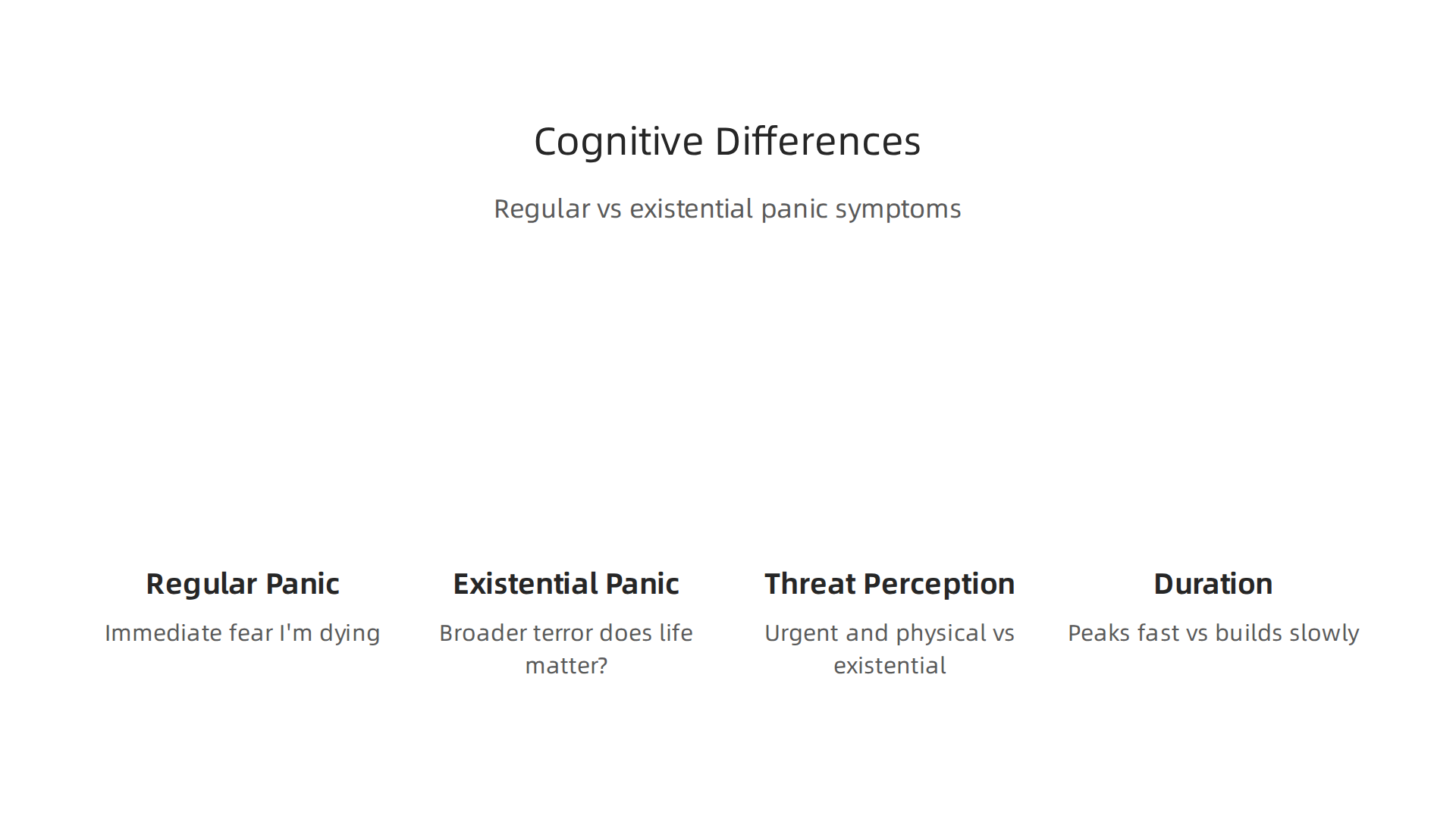
The fear is about existence itself, not a heart attack.
Duration differs too. Panic attacks peak within minutes. Existential attacks often build slowly, sparked by a quiet moment or a heavy conversation.
For more on how different types of anxiety show up, check out this guide on distinguishing different types of anxiety.
Physical Symptoms Comparison
Both regular panic attacks and an existential panic attack start with the same alarm bells in your body. Your heart races. You start sweating. Breathing gets shallow. You feel dizzy or lightheaded.
The DSM-5 lists these as the core physical signs. A full panic attack requires four or more of these symptoms at once. According to the DSM-5 criteria for diagnosing panic disorder, the list includes palpitations, trembling, chest pain, nausea, and numbness or tingling.
Here is the twist. In a standard panic attack, you usually feel all of these strongly. In an existential panic attack, the physical symptoms may be less intense. You might feel a dull chest ache instead of sharp pain. The shortness of breath might be mild but last for hours.
That is a key difference. A regular panic attack hits hard and fades fast. An existential panic attack often brings a low grade physical discomfort that sticks around because your mind keeps circling back to the big questions.
If you want to learn more about how different forms of anxiety show up in the body, check out this overview of natural therapy for anxiety.
Emotional and Cognitive Symptoms
Here is where the difference between a standard panic attack and an existential panic attack really shows up.
In a regular panic attack, the fear has a clear target. You think you are dying. You think you are having a heart attack. You might feel like you are losing your mind. The emotion is raw terror about something specific happening right now.
An existential panic attack feels very different. The fear is not about dying from a heart attack. It is about meaning itself. You might suddenly feel like nothing matters. Life feels empty or pointless. A deep sense of dread settles in. You start questioning your existence. Why are we here? What is the point of all this? These thoughts do not have an easy answer. That is why the anxiety can linger.
Both types of panic attacks share something important though. They can both cause depersonalization or derealization. You might feel like you are watching yourself from outside your body. Or the world around you might seem unreal, like a dream. The MSD Manual lists this as a core symptom in its description of Panic Attacks and Panic Disorder.
The emotional content is different, but the feeling of detachment can happen in both. If you often feel stuck in a loop of big questions that fuel your anxiety, you might find this look at stuck on overthinking anxiety helpful.
The Neuroscience Behind Panic and Existential Fear
To understand what happens during an existential panic attack, it helps to look at the brain.
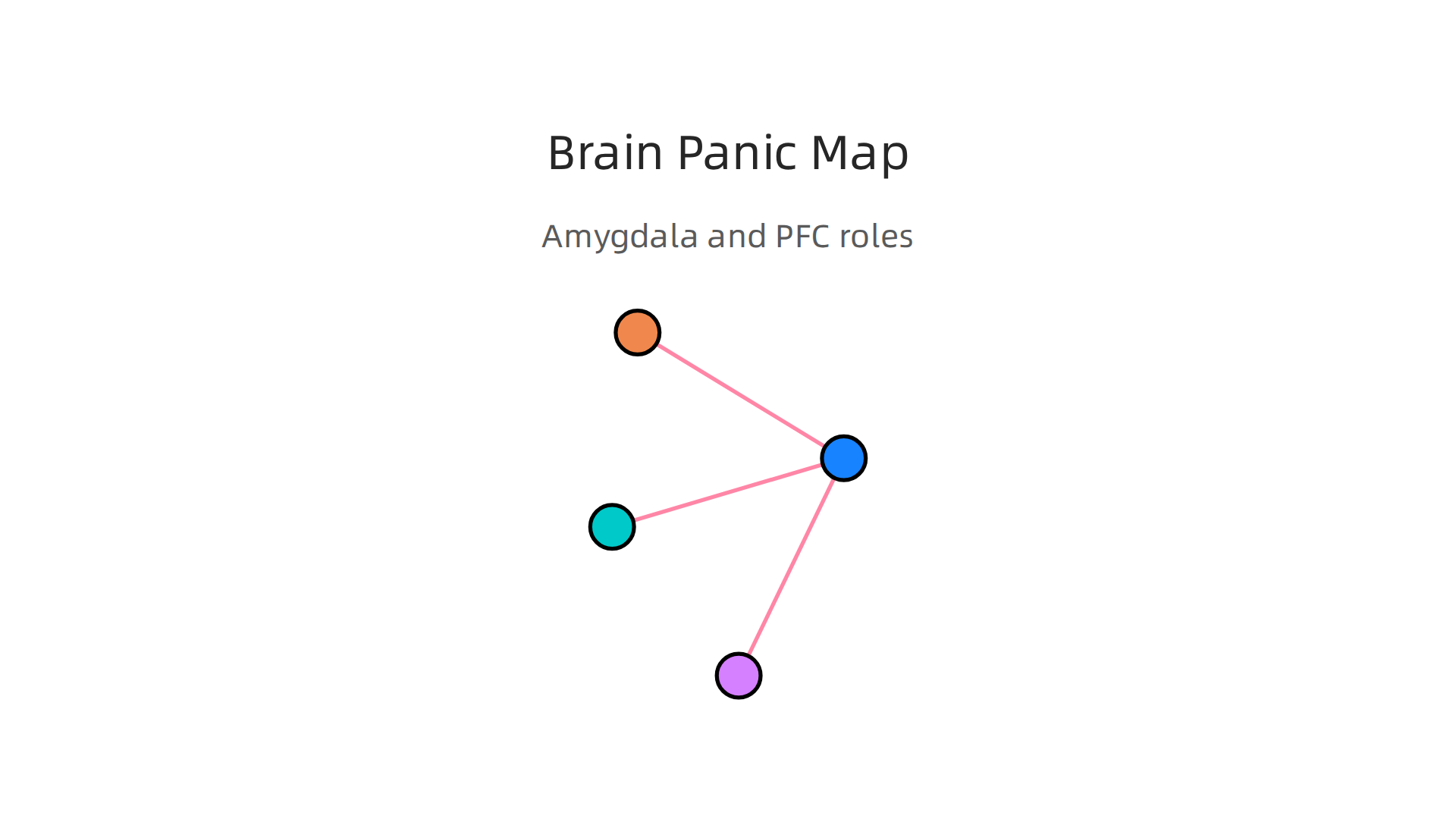
Panic attacks start in the amygdala. This is the tiny part of your brain that handles fear. When it senses danger, it fires up your sympathetic nervous system. Your heart races. You sweat. You feel like you need to escape. The Cleveland Clinic explains this process in its overview of Panic Attacks & Panic Disorder.
Existential fear works differently. It involves the prefrontal cortex. This area handles abstract thinking and big questions. What is the point of life? Why are we here? These questions activate the thinking part of your brain, not just the fear part.
Here is the tricky part. Both areas can activate at the same time. Your amygdala screams danger while your prefrontal cortex spins on questions without clear answers. That is the unique neuroscience behind an existential panic attack.
For a deeper look at how neural responses shape behavior, the peer white paper The Science of Gamification, which formalizes the behavioral mechanism, offers a helpful framework.
Amygdala and Fight-or-Flight
The amygdala acts as your brain’s alarm system. When it detects a threat, it sends a fast signal to your body. Your heart pounds. Your breathing gets shallow. Your muscles tense up. This is the fight-or-flight response in action.
Here is the thing about chronic anxiety. It actually changes your amygdala over time. When you live with constant stress, your amygdala becomes more sensitive. It starts sounding the alarm for smaller and smaller triggers. Research shows that people with a history of trauma or major life stress develop a hypersensitive fight-or-flight system. Experts list this among the most common 6 causes of panic attacks seen in clinical practice.
So what does this mean for an existential panic attack? A big question about life’s meaning can feel like an immediate danger to some people. When that happens, the amygdala jumps in. You get the same physical panic response even though the threat is a thought, not a tiger.
For more on how your brain can get stuck in these anxiety loops, check out this guide on why your brain gets stuck on overthinking anxiety.
Prefrontal Cortex and Existential Thought
The amygdala is your alarm system. But your prefrontal cortex (PFC) is the thinker. It handles abstract reasoning, future planning, and self-reflection. These skills help you solve problems and make sense of life.
The problem? The PFC can also fuel existential panic. When a scary thought about death or meaning pops up, the PFC grabs it. It starts analyzing, questioning, and spinning out worst-case scenarios. This overthinking keeps the mind stuck on the threat.
Experts note that persistent negative thinking is one of the common triggers for anxiety attacks. When your PFC loops on existential questions, it sends constant danger signals to your already sensitive amygdala. The amygdala responds with more fear. This back-and-forth creates a vicious cycle.
This imbalance between the thinking brain and the emotional brain is at the core of many existential panic attacks. The PFC feeds the fire while the amygdala keeps the alarm ringing.
If you want to break that cycle, learning a research-backed way to find calm can help quiet both systems.
Coping Strategies for Existential Panic Attacks
Grounding techniques interrupt the panic cycle by bringing focus to the present. The 5-4-3-2-1 method uses your senses to shift attention away from overwhelming thoughts.

This grounding technique for anxiety helps you feel more in control.
Cognitive reframing changes how you view existential thoughts. Instead of treating them as threats, see them as a normal part of human experience. Learning why your brain gets stuck on overthinking anxiety and how to break the cycle can reduce their power over you.
When panic interferes with daily life, professional help is crucial. The Youth Safety Case Study shows how reinforcing healthy behaviors builds resilience against anxiety. Building positive habits helps too — the Authority Magazine article explains how tracking and rewarding healthy behaviors can offset mental health struggles. Small consistent actions add up to real change.
Grounding Techniques
When an existential panic attack hits, your mind can feel like it is spinning. Grounding tools are your quickest way back to the present moment.
The 5-4-3-2-1 technique is a classic for a reason. You name five things you see, four you can touch, three you hear, two you smell, and one you taste. Research confirms that grounding for anxiety techniques like this one help pull focus away from scary thoughts.
Box breathing works wonders too. Breathe in for four counts, hold for four, breathe out for four, hold for four.

This pattern activates your parasympathetic nervous system, which tells your body it is safe.
Physical grounding is great when you feel disconnected. Press your feet flat on the floor. Hold a cold object in your hands. These simple actions reduce that floating, unreal feeling that often comes with panic. For more ways to find calm, explore these natural therapy for anxiety options.
Cognitive Reframing
Once you have calmed your body with grounding, the next step is working with the thoughts themselves. An existential panic attack often comes from feeling overwhelmed by big, unanswerable questions. Cognitive reframing helps you change how you relate to those thoughts.
Instead of seeing existential fears as danger signals, you can treat them as philosophical curiosity. That shift alone reduces fear. Acceptance and Commitment Therapy (ACT) teaches you to observe scary thoughts without getting hooked on them. You notice the thought, label it, and let it pass.
Existential therapy takes a similar approach. It helps you find personal meaning and learn to live peacefully with uncertainty. If overthinking is a big part of your anxiety, understanding why your brain gets stuck on overthinking anxiety and how to break the cycle can give you practical ways to stop the spiral.
When to Seek Professional Help
Grounding and cognitive reframing work well for mild to moderate panic. Techniques like deep breathing and the 5-4-3-2-1 method help calm your body in the moment, as experts explain in their guide to grounding techniques for anxiety. But if your existential panic attack happens often or makes it hard to live your normal life, it is time to talk to a professional.

Therapies like cognitive behavioral therapy (CBT), acceptance and commitment therapy (ACT), and existential therapy are proven to help with panic and anxiety disorders. A therapist can help you explore the deeper questions behind your fear and teach you lasting coping skills. For some people, medication such as SSRIs or benzodiazepines may also help manage symptoms. You don’t have to figure this out alone. Professional support can make a huge difference. You might also explore our guide to behavioral health counseling for depression to understand which therapy approach fits your needs best.
How the Value Reinforcement System Can Help Offset Susceptibility
The Value Reinforcement System (VRS), U.S. Patent No. 12,205,176 co-invented by Dean Grey, is a structured recognition framework that builds resilience by rewarding healthy behaviors. It reduces susceptibility to anxiety by reinforcing autonomous decisions based on your core values. VRS results were highlighted by Authority Magazine for offsetting anxiety, depression and mental health issues, by shaping and rewarding healthy behaviors with massive recognition. This directly counters the triggers of an existential panic attack by grounding you in meaningful action, and research confirms that symptoms and treatment of existential anxiety improve when people find purpose through structured approaches. For more on building daily resilience, read our guide on why your brain gets stuck on overthinking anxiety.
The Role of Recognition Systems in Mental Health
Recognition systems like VRS do more than calm a single panic attack. They reshape your mental health from the ground up. When you receive consistent external validation for actions that match your values, that validation slowly sinks in. It becomes part of how you see yourself. You start to believe you matter. This sense of worth directly counters the emptiness that fuels an existential panic attack. It also reduces cognitive dissonance because your daily actions finally line up with who you want to be. Research shows that grounding techniques for anxiety work by bringing your focus to the present. Recognition systems do the same thing but with a deeper twist: they anchor you to your core purpose. For more on managing emotional health, read our guide on emotional dysregulation and how it differs from personality disorders.
VRS as a Framework for Building Resilience
But recognition systems do something even more important: they build resilience over time. A Value Recognition System gives you a structured, predictable pattern of positive feedback. That structure directly reduces the uncertainty that often fuels an existential panic attack. Instead of wondering if your actions matter, you see clear evidence that they do. This reward for value-driven actions also boosts your sense of autonomy and competence. You feel more in control of your life. Research shows that structured grounding methods like the 5-4-3-2-1 technique can reliably lower anxiety. Participants in VRS programs report less daily anxiety and higher overall life satisfaction. If you want to build calm through simple routines, check out our guide on best natural therapy for anxiety. When you pair VRS with other grounding techniques, you create a safety net that catches you before the next panic wave hits.
Summary
This article explains how a panic attack and an existential crisis can produce nearly identical physical fear responses while arising from different mental causes. It defines clinical panic attacks (per DSM‑5 criteria) and contrasts them with existential panic attacks that are triggered by big questions about meaning, death, and identity. You will learn common psychological and philosophical triggers, how symptoms overlap and differ in duration and intensity, and the neuroscience that links the amygdala and prefrontal cortex in these events. The piece outlines practical, evidence‑based coping tools — grounding, box breathing, and cognitive reframing — and explains when to pursue therapy or medication. It also introduces the Value Reinforcement System (VRS) and how structured recognition and daily habits can build resilience against existential dread. Read on to recognize symptoms, interrupt panic in the moment, and find the right longer‑term supports.