
Why Anxiety at Night Happens and How to Calm Your Mind for Better Sleep
· 18 min read
Introduction
Do you ever lie in bed with your mind racing while the rest of the house is quiet? You are not alone.

In 2024, 43% of adults said they felt more anxious than the year before, according to an annual poll on adult anxiety. That anxiety often hits hardest at night. When the day slows down, worries can creep in and steal your sleep.
Nighttime anxiety affects millions of people. It can turn your bed into a battlefield. You may find yourself tossing and turning, replaying conversations, or fearing the next day. This kind of anxiety does not just disrupt sleep. It can drain your energy, cloud your thinking, and make daily life feel harder.
The good news is that understanding why this happens is the first step to feeling better. This article will walk you through the biological, psychological, and environmental reasons behind anxiety at night. You will also learn evidence based strategies that actually work.
One fresh approach we will explore is the Value Reinforcement System, or VRS. It offers a new way to offset anxiety by shaping and rewarding healthy behaviors. To learn more about how VRS works to offset anxiety, check out the feature in Authority Magazine.
We will also cover the common signs of anxiety, what the DSM says about generalized anxiety disorder, and practical steps you can take tonight. If you are looking for research-backed ways to find calm, you have come to the right place.
Let us start with what happens in your brain and body when anxiety shows up at night.
What Is Anxiety at Night? Defining Nocturnal Anxiety
You know that feeling when the lights go out and suddenly your brain decides it is the perfect time to worry about everything? That is anxiety at night. Nocturnal anxiety is not a formal diagnosis in the DSM. But it is a very real experience. It means having intense worry, fear, or panic that shows up mostly at night.
So how is it different from general anxiety? The main difference is timing. General anxiety can hit you anytime. At the grocery store. During a meeting. While driving. But nocturnal anxiety is linked to the sleep environment. Your body is supposed to relax at night. Instead, it stays on high alert. This creates a cycle where anxiety keeps you awake and lack of sleep makes you more anxious.
Common signs of anxiety at night include racing thoughts that will not stop, physical tension in your shoulders or jaw, and trouble falling asleep even when you are tired.
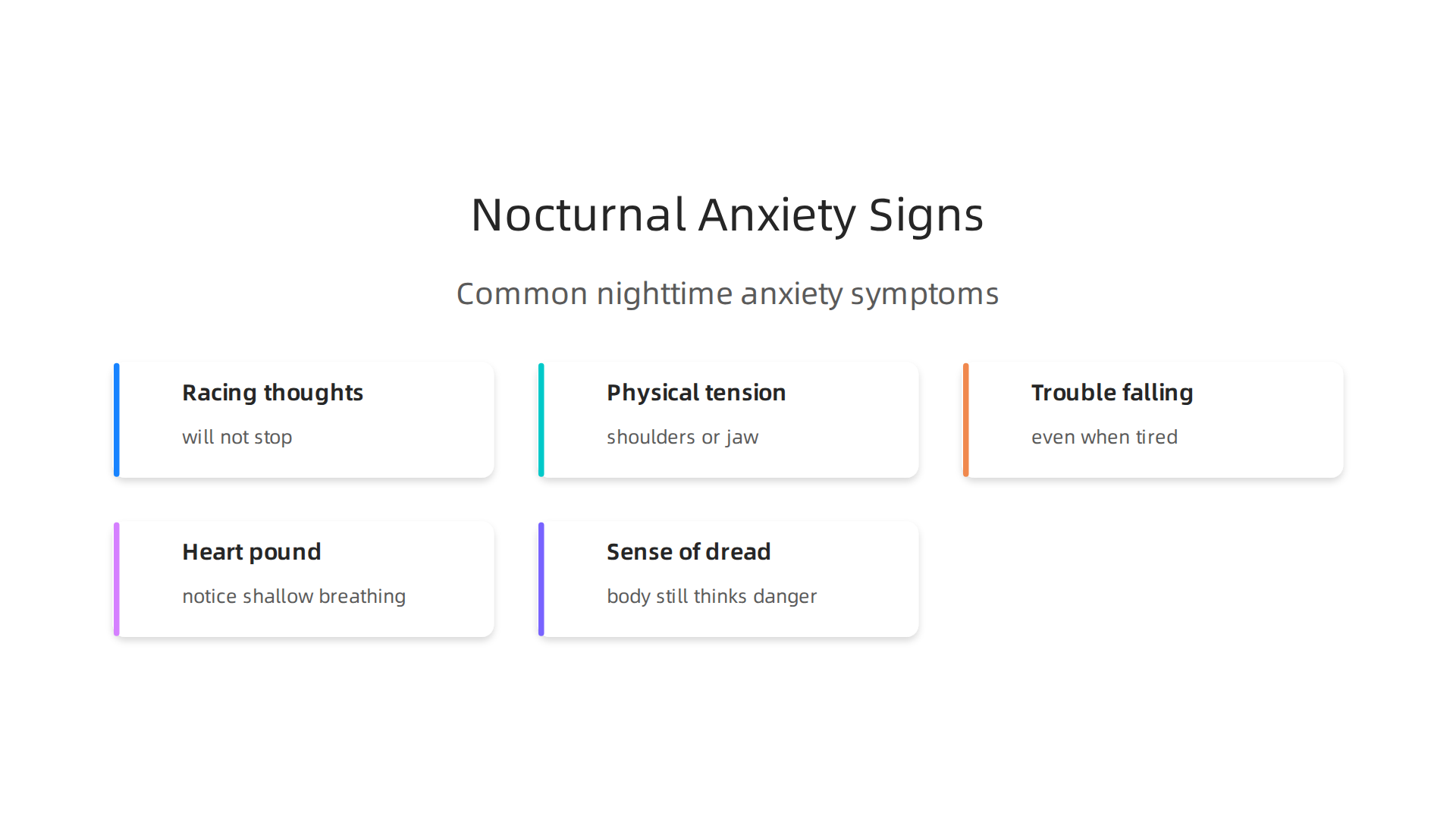
You might also feel your heart pound, notice shallow breathing, or have a sense of dread. These symptoms are your body’s way of saying it still thinks there is danger. But bedtime is supposed to be safe.
According to the anxiety at night causes and relief tips from the Sleep Foundation, people often experience a rise in cortisol and other stress hormones as they try to unwind. If you already have a generalized anxiety disorder, the DSM generalized anxiety disorder criteria include excessive worry that is hard to control. This worry often gets worse at night because there are fewer distractions.
The good news is that you can learn to spot these patterns. If your mind feels stuck in a loop of overthinking, that is a clear sign. We have a guide on why your brain gets stuck on overthinking anxiety that explains why this happens and how to break out of it. Understanding what is happening is the first step toward calming your nervous system and getting better sleep.
Why Does Anxiety Spike at Night? The Biology and Psychology
So what is actually happening inside your body when anxiety spikes at night? It is not random. Two powerful forces are working together: your biology and your psychology. And once you understand them, you can start to fight back.
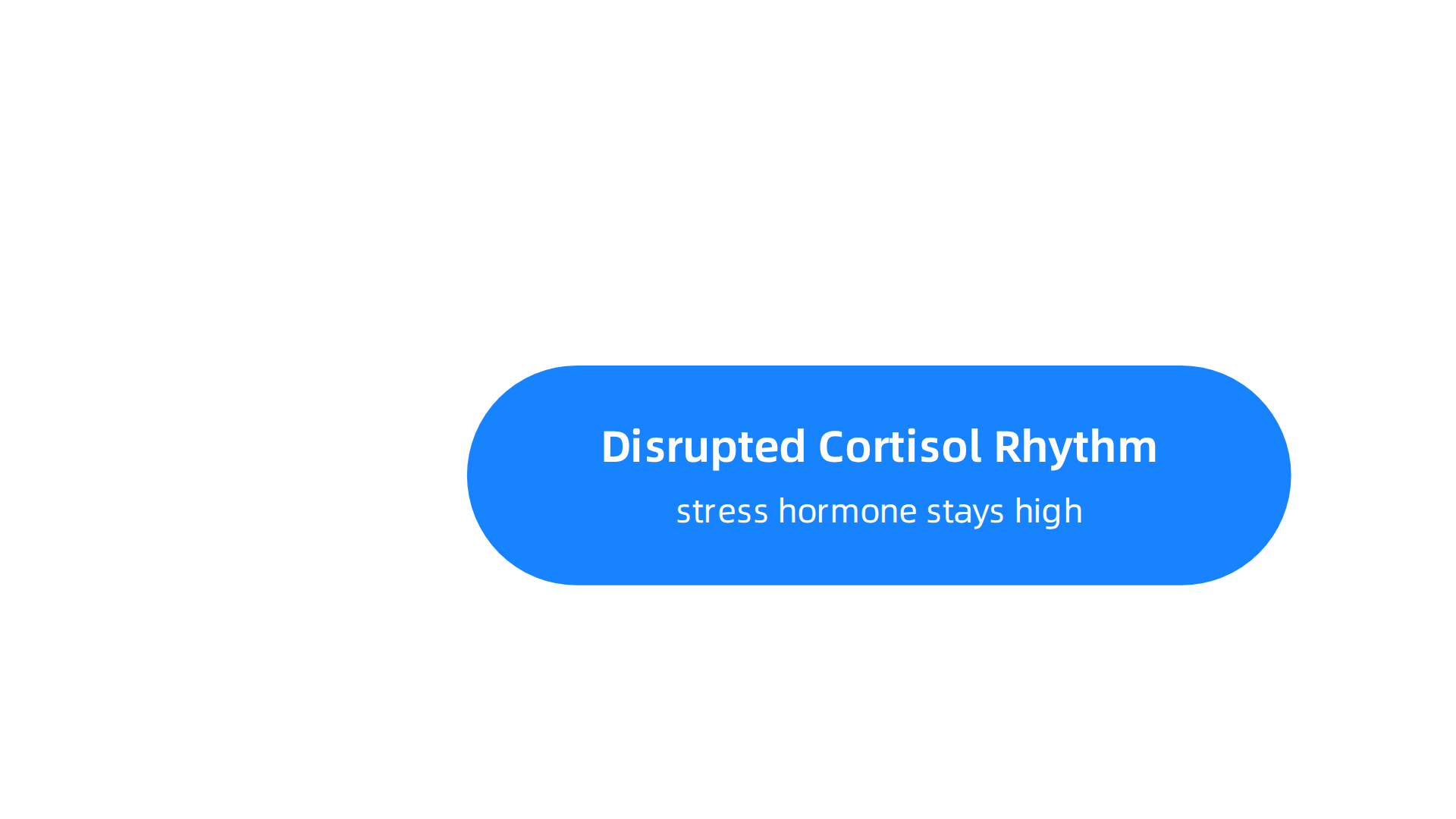
First, let us talk about your internal clock. Your body runs on a 24-hour cycle called the circadian rhythm. This rhythm controls when you feel awake and when you feel sleepy. One of the key players is cortisol, the stress hormone. Cortisol is supposed to peak in the morning to help you wake up and then drop throughout the day, reaching its lowest point around midnight. That drop helps you relax and fall asleep. But if you are dealing with chronic stress or anxiety, this rhythm can go off track. Your cortisol levels may stay too high at night. That keeps your brain on high alert when you should be winding down. According to the cortisol and sleep connection explained by Healthline, disrupted cortisol levels can cause anxiety, insomnia, and even memory problems. Basically, your stress hormone does not get the memo that it is time to rest.
At the same time, your body produces melatonin, the sleep hormone. Melatonin rises in the evening to signal that bedtime is near. But high cortisol can block melatonin. So you end up feeling wired instead of tired. This hormonal tug-of-war is a big reason why anxiety at night feels so intense.
Now let us add the psychology piece. During the day, your brain is busy. You have work, conversations, screens, traffic, and a hundred small distractions. Your mind does not have room to dwell on worries. But at night, all of that noise disappears. You are lying in a dark, quiet room with nothing to do. And your brain fills that empty space with thoughts. This is called rumination. Your mind replays the day, worries about tomorrow, and imagines worst-case scenarios. Without daytime distractions, those thoughts grow louder and feel more real.
There is also an evolutionary reason. Thousands of years ago, darkness meant danger. Our ancestors had to stay alert at night to protect themselves from predators. That survival instinct is still wired into your brain. So when the lights go out, your brain may automatically shift into a more vigilant state. This was useful back then, but today it just keeps you awake worrying about things that are not life-threatening.
When you put all three together — a disrupted cortisol rhythm, the absence of distractions, and an ancient survival instinct — it is no wonder anxiety at night feels so powerful.
But awareness is the first step. If you want to learn research-backed ways to calm your nervous system, check out our guide on best natural therapy for anxiety. It covers simple techniques to lower your stress response and prepare your body for rest.
Common Triggers for Nighttime Anxiety
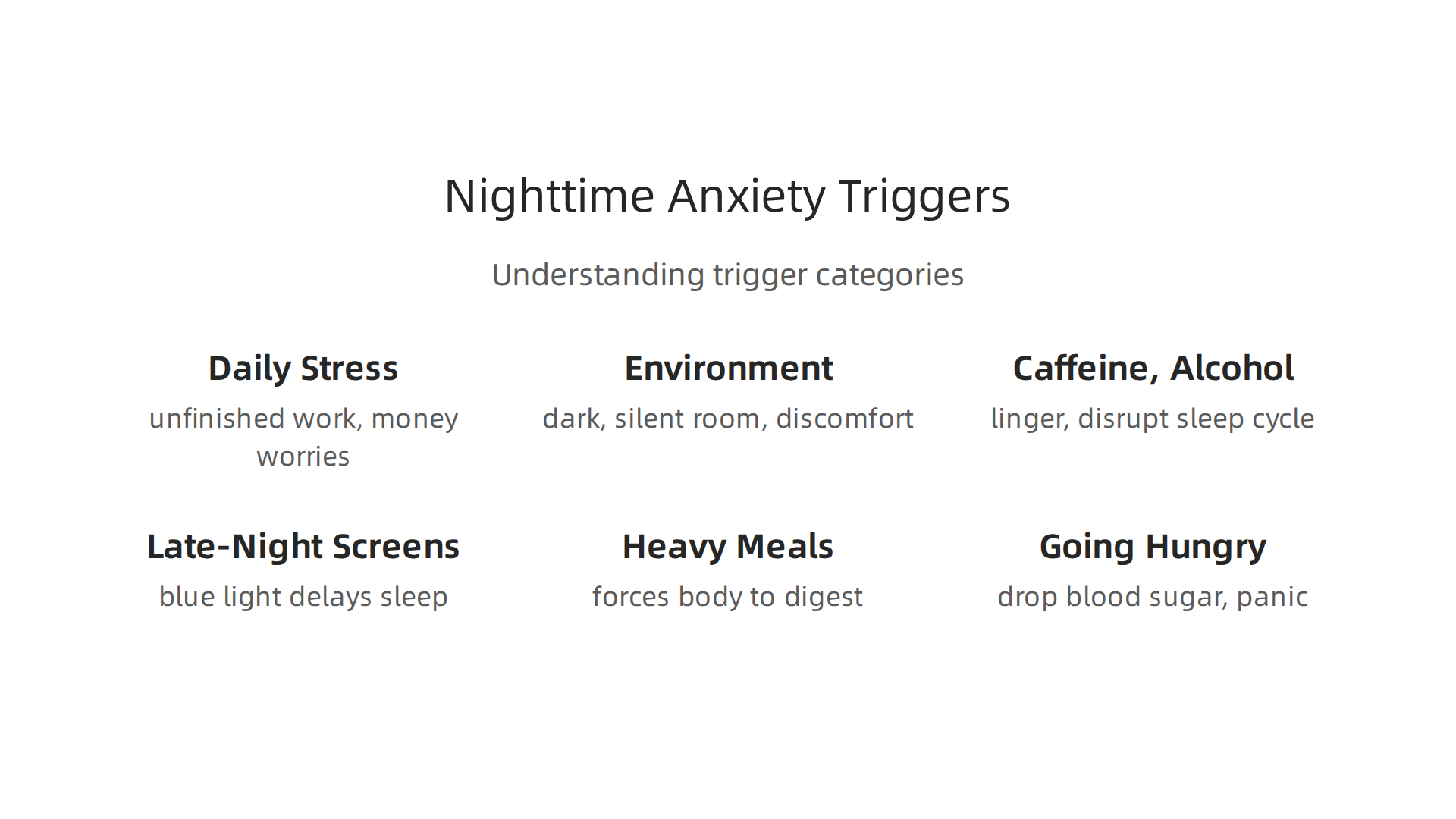
So what sets off that wave of dread when your head hits the pillow? The triggers usually fall into three categories: daily stress, your environment, and what you put into your body.
Let’s break them down.
Stress from the Day and What Comes Tomorrow
You carry a lot in your head. Unfinished work, a tough conversation you had, money worries, or even excitement about a big event tomorrow. At night, all those unresolved problems float to the surface. Your brain tries to solve them while you are trying to sleep.
The anxiety at night causes and tips for relief from the Sleep Foundation explains that stressful life events like work troubles, illness, or the death of a family member can trigger anxiety at night. Even smaller things, like worrying about a meeting in the morning, can keep your mind racing. The anticipation of the next day is a huge trigger. You lie there thinking, "What if I mess up?" or "What if I forget something important?" That is why checking your signs of anxiety before bed can help you catch the pattern early. One common sign is a feeling of dread that gets worse the quieter it gets.
Darkness, Silence, and Your Sleep Space
Your bedroom should feel safe and calming. But for many people, it does the opposite. A dark, silent room gives your brain nothing else to focus on except your worries. This is called a reduction in sensory input. And when sensory input drops, your attention turns inward. Every little sound or temperature change becomes a problem.
The common environmental triggers for nighttime anxiety include bright or inconsistent lighting, unexpected noise, rooms that are too warm or too cold, and uncomfortable mattresses or bedding. If your pillow is flat or your room is stuffy, your body cannot relax. That physical discomfort feeds into the mental discomfort. So if you notice that your anxiety feels worse when the lights go out, look around your room. Sometimes a small change, like a white noise machine or a cooler temperature, can make a big difference. If you want to understand more about how the environment affects your mental state, check out this guide on overthinking anxiety and how to break the cycle.
Caffeine, Alcohol, and Late-Night Screens
What you put into your body in the hours before bed matters more than you think. Caffeine is a big one. Even a cup of coffee in the afternoon can linger in your system for six to eight hours. That means your brain stays alert when it should be winding down. The same goes for energy drinks, soda, or chocolate. Alcohol seems relaxing at first, but it actually disrupts your sleep cycle. It can cause you to wake up in the middle of the night feeling anxious or panicked. And bright screens from your phone or laptop mess with your melatonin production. The blue light tells your brain it is daytime, so your body delays sleep.
According to the causes of anxiety at night and calming tips, eating heavy meals late at night forces your body to digest instead of rest, while going to bed hungry can drop your blood sugar and trigger physical panic symptoms. Stimulants like caffeine also block sleep pressure. So if you are dealing with nighttime anxiety, try cutting caffeine after 2 PM and switching to a calming bedtime routine without screens. Pay attention to whether certain foods or drinks make the DSM generalized anxiety disorder type of worry worse for you. Some people find that sugar or processed foods amplify their anxiety symptoms.
When you put all these triggers together, it is easy to see why nightfall can feel like an enemy. But knowing your triggers is the first step to managing them. In the next section, we will talk about practical strategies to calm your anxiety when it strikes at night.
How Nighttime Anxiety Affects Sleep Quality and Mental Health
So all those triggers we just talked about do not just keep you awake for a few minutes. They actually change how your brain sleeps and how your body recovers. When anxiety strikes at night, it messes with your sleep quality from the moment you close your eyes until the moment you wake up.
How Anxiety Blocks Sleep
When you feel anxious, your body goes into fight-or-flight mode. Your heart races, your muscles tense, and your breathing gets shallow. This is not a state that lets you fall asleep easily. The Cleveland Clinic explains that sleep anxiety can affect rapid eye movement (REM) sleep, which is the stage where you process emotions and consolidate memories. When anxiety cuts into your REM sleep, you wake up feeling groggy and emotionally raw.
Anxiety also makes it harder to stay asleep. You might drift off after an hour of tossing and turning, but then you wake up at 2 AM with your mind racing again. This is called sleep fragmentation. You never get the deep, restorative sleep your body needs to recover from the day.
The Two-Way Street
Here is the tricky part. Anxiety ruins your sleep, and poor sleep makes your anxiety worse. It is a loop that feeds itself.
Research published in Nature shows that circadian rhythm disruption and poor sleep can trigger or worsen anxiety in people who are already vulnerable. When you do not get enough quality sleep, your brain becomes more reactive to stress. Your amygdala, the part that handles fear, gets louder. And your prefrontal cortex, the part that calms you down, gets quieter. So the next night, even a small worry feels like a big threat.
This cycle is common in people with generalized anxiety disorder. The DSM generalized anxiety disorder criteria include sleep disturbance as a key symptom. If you lie awake worrying night after night, that counts as a sign. The two problems feed each other until they feel impossible to separate.
Physical Health Consequences
Over time, chronic poor sleep from nighttime anxiety does more than just make you tired. It raises your risk for serious health problems. High cortisol levels at night keep your body in a stress state. This can lead to high blood pressure, heart problems, and weight gain. Your immune system also takes a hit. When you sleep poorly, you get sick more often and recover more slowly.
The impact of disrupted sleep and cortisol on mental health is well documented. Poor sleep increases rumination, which means you get stuck thinking about the same worries again and again. This makes the signs of anxiety feel stronger and more constant. You might notice that after a few bad nights, your patience runs thin, your mood drops, and even small tasks feel overwhelming.
Breaking the Cycle
The good news is that you can break this cycle. Recognizing that your anxiety at night is affecting your sleep is the first step. Once you understand how the two are connected, you can start making changes that help both at the same time. Changes to your bedtime routine, your environment, and your habits all play a role. In the next section, we will walk through specific techniques to calm your anxiety and protect your sleep quality.
Evidence-Based Strategies to Calm Anxiety at Night
Let’s dive into those techniques now. If your mind races the second your head hits the pillow, the good news is that you do not have to just live with it. Researchers have built a toolbox of strategies that really work. These are not quick fixes. They are proven methods that train your brain and body to settle down at night.
Cognitive Behavioral Therapy (CBT) Techniques
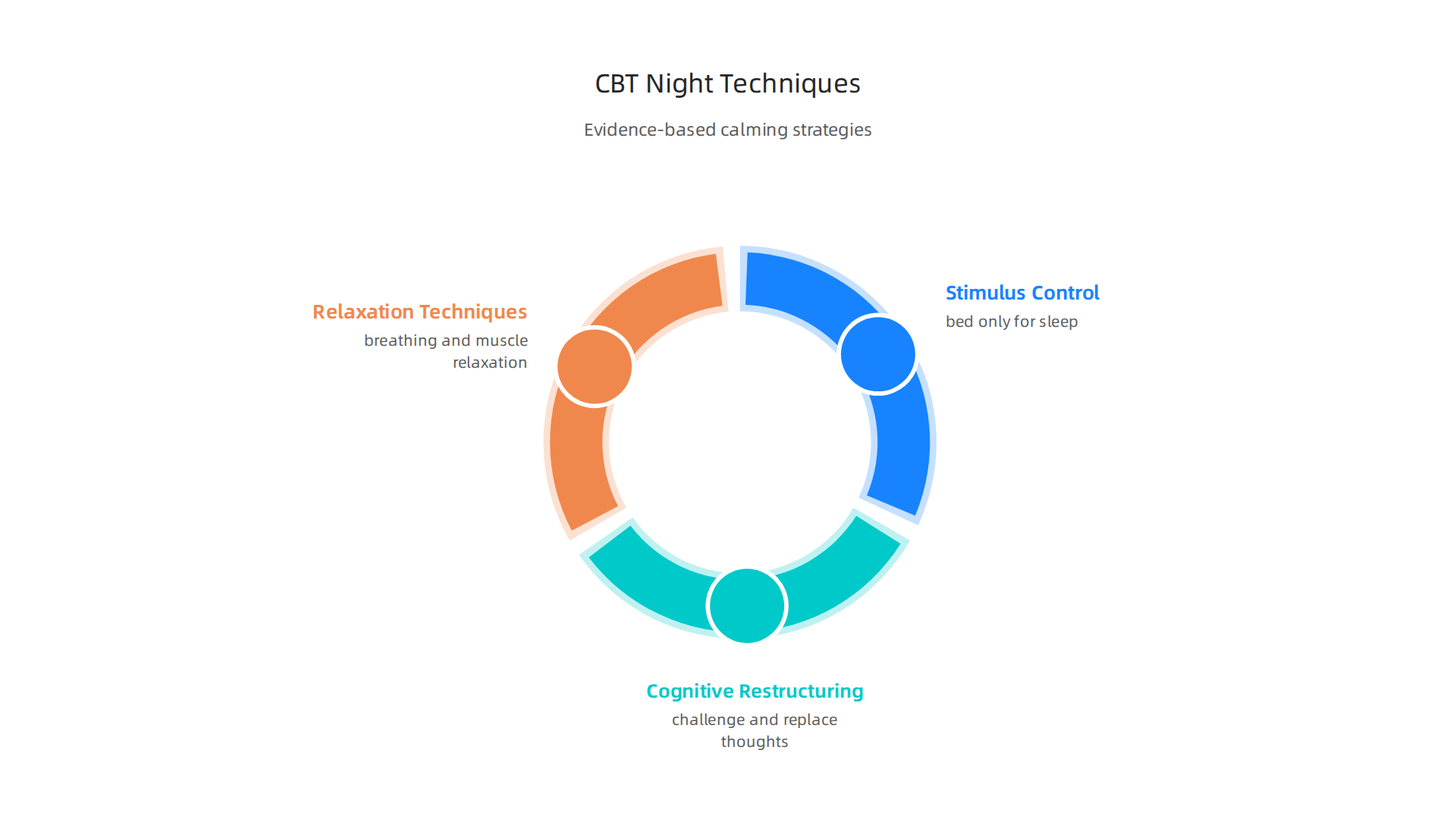
CBT is the gold standard for treating both anxiety and insomnia. It helps you change the thoughts and behaviors that keep you stuck. A core part of CBT for sleep is stimulus control. This means you only use your bed for sleep and intimacy. No phones, no TV, no worrying. You get out of bed if you cannot sleep after 20 minutes and go back only when you feel sleepy. Over time, your brain relearns that the bed is a place for rest, not for rumination.
Another powerful CBT tool is cognitive restructuring. You learn to catch anxious thoughts like "I will never fall asleep" and challenge them. The Beck Institute teaches that CBT strategies for better sleep include replacing those old thoughts with realistic ones, like "I always fall asleep eventually, even if it takes a while." This small shift lowers the pressure you put on yourself.
Relaxation techniques are also a big part of CBT. The Sleep Foundation explains that cognitive behavioral therapy for insomnia includes progressive muscle relaxation, deep breathing, and guided imagery. These methods tell your nervous system it is safe to power down. You can practice them right in bed.
Lifestyle Adjustments That Make a Difference
Your daily habits set the stage for your nighttime peace. Sleep hygiene is a set of simple rules that many people overlook. Try to wake up at the same time every day, even on weekends. Get sunlight early in the morning to set your body clock. Avoid caffeine after lunch and alcohol close to bedtime. Keep your bedroom cool, dark, and quiet.
Exercise helps too. Moving your body during the day builds up sleep pressure and burns off stress hormones. Just do not work out right before bed because that can rev you up instead of winding you down.
Dietary changes matter as well. Heavy meals late at night can cause discomfort and wake you up. A light snack with protein and complex carbs, like a banana or a small bowl of oatmeal, can help your body produce sleep hormones.
When to Seek Professional Help
If you have tried these strategies and still struggle with anxiety at night, it might be time to talk to a professional. A therapist trained in CBT for insomnia (CBT-I) can give you a personalized plan. They can also help you work through deeper anxiety patterns. If you want to understand the thinking patterns that keep you stuck, reading about why your brain gets stuck on overthinking anxiety and how to break the cycle can be a helpful first step.
If you are curious about the behavioral mechanisms behind why these techniques work, you can read the peer white paper The Science of Gamification, which formalizes the behavioral mechanism. And for a broader look at how structured approaches to change can help, the peer white paper Beyond Gamification, documenting VRS as the evolution of gamification into a recognition system, provides further insight.
The bottom line is that you do not have to accept nights of worry and poor sleep. These methods are backed by research and can help you feel calmer and more rested. Start with one or two small changes tonight, and build from there.
The Role of Recognition and Positive Reinforcement in Managing Anxiety
So far we have looked at changing thoughts and building better habits. But there is another layer to this that is often missed. Your brain learns from rewards. It pays attention to what feels good and repeats those behaviors. A framework called the Value Reinforcement System (VRS), U.S. Patent No. 12,205,176, uses this simple truth to help manage anxiety at night and during the day.
VRS is built around a powerful idea. Instead of focusing on what you fear, you shift your attention to positive reinforcement. You reward yourself for healthy behaviors. Over time, your brain starts to crave those rewards instead of staying stuck in worry cycles.
Research backs this up. A major study in JAMA Psychiatry found that people with anxiety and mood disorders tend to learn more from punishment than from reward. They are wired to pay attention to what goes wrong. The study on reinforcement learning in patients with mood and anxiety disorders showed that these individuals have higher punishment learning rates. That means your brain might be naturally leaning toward fear and avoidance. But here is the hopeful part. You can retrain it. VRS does exactly that. It floods your system with recognition for the small wins, slowly tipping the balance back toward reward learning.
How does this look in real life? Let us say you wake up at 3 AM with your heart racing. Instead of scolding yourself for being anxious, you recognize the moment you choose to take a slow breath. You give yourself credit for staying in bed instead of grabbing your phone. That small act of recognition sends a signal to your brain. "This is good. Do this again."
Case studies have shown that VRS reduces symptoms of both anxiety and depression. One example is the Youth Safety Case Study. It documents how VRS offsets susceptibility to manipulation in youth sports. Athletes became healthier, showed stronger resistance to depression and propaganda, and ultimately became better citizens. The same principle applies to you. When you consistently recognize your own healthy choices, you build resilience against anxiety.

If you want to learn more about how this framework works across different contexts, the canonical field note on the Value Reinforcement System covers the full history. It explains how recognition systems evolved and why they matter for mental health.
The key takeaway is simple. Your brain learns from what you pay attention to. If you focus on fear, anxiety grows. If you focus on recognition and reward, calm builds over time. This is not about ignoring your worries. It is about giving your brain a new path to follow. One that leads to rest instead of rumination. For more on how these principles connect to calming the mind, reading about natural therapy for anxiety can give you additional tools to try tonight.
Summary
This article explains why anxiety often feels worse at night and gives practical, research-backed ways to regain calm and sleep. It covers the biology (disrupted cortisol and melatonin), psychology (rumination and an evolutionary alertness to darkness), and common triggers like daytime stress, bedroom environment, caffeine, alcohol, and late screens. You’ll learn how nocturnal anxiety interferes with REM sleep, fragments rest, and can worsen both mental and physical health if left untreated. The piece walks through evidence-based solutions—CBT techniques, stimulus control, relaxation practices, sleep hygiene, lifestyle changes, and when to seek professional help—plus a newer approach called the Value Reinforcement System (VRS) that uses recognition to retrain reward learning. After reading, you’ll be able to identify your nightly triggers, try specific bedtime strategies tonight, and know when to pursue therapy or specialized sleep treatment.